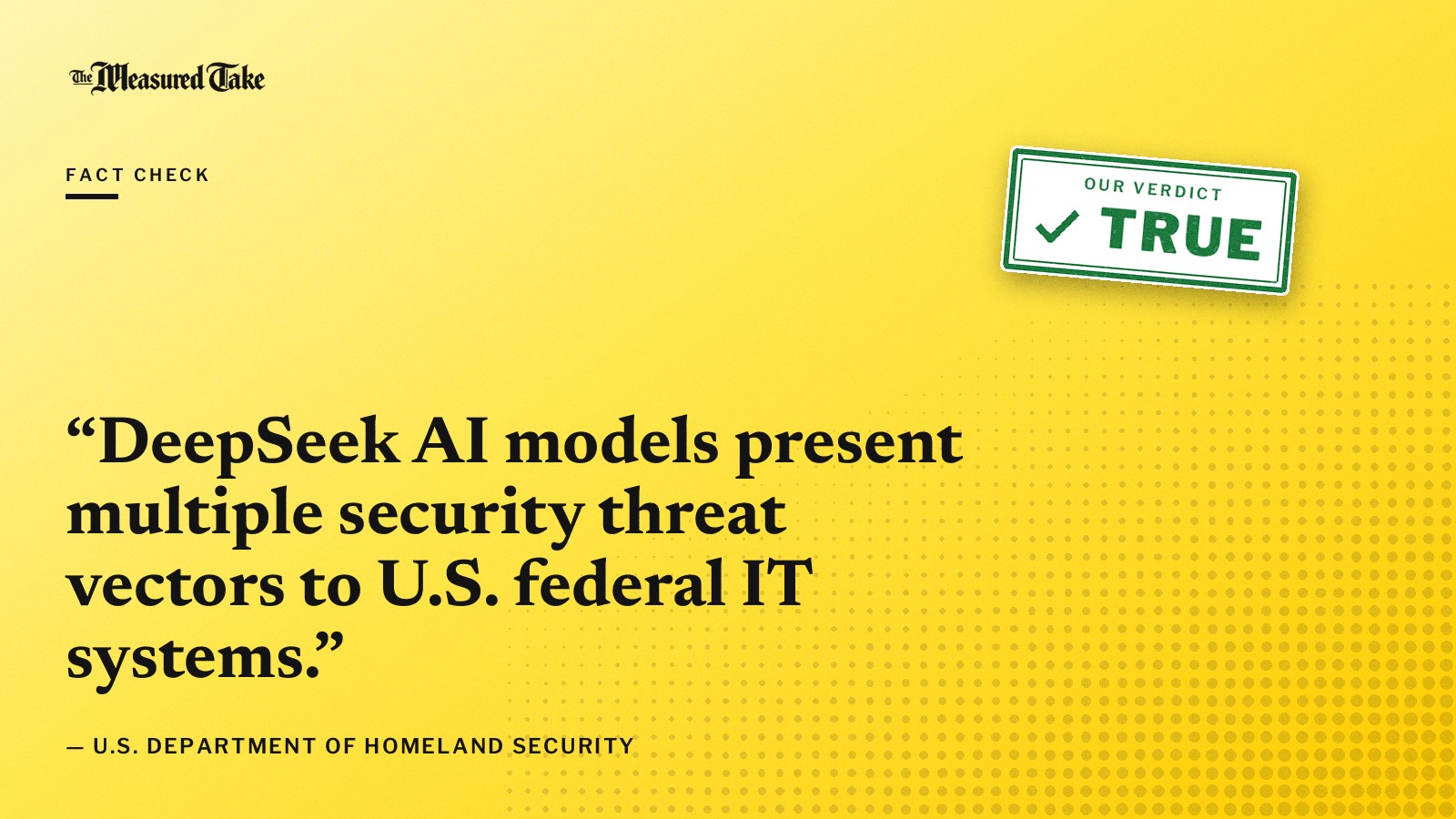
“DeepSeek AI models present multiple security threat vectors to U.S. federal IT systems.” — U.S. Department of Homeland Security. Our verdict: True.
The claim was made by the U.S. Department of Homeland Security on 20 October 2026, in an order published for public inspection in the Federal Register.
Our verdict
True
The claim is accurate. The Department of Homeland Security ordered DeepSeek products removed from federal civilian IT systems, and official evaluations found the software has serious security weaknesses.
What we found
We reached this verdict because the evidence lines up on three points. First, the Department of Homeland Security issued an order on 20 October 2026 requiring DeepSeek products to be excluded and removed from federal civilian IT systems. Second, that order amounts to a federal ban on DeepSeek in civilian agency IT. Third, an evaluation by the National Institute of Standards and Technology found that DeepSeek software is significantly more vulnerable to hijacking and jailbreaking than comparable American systems, and that these shortcomings pose risks to national security. Taken together, these show that DeepSeek presents more than one security threat to federal systems.
The evidence
4 of 5 sources support the claim; none contradict it.
- Supports the claim
The Department of Homeland Security issued an order on 20 October 2026 mandating the exclusion and removal of DeepSeek products from federal civilian IT systems. [1]
- Supports the claim
The National Institute of Standards and Technology found that DeepSeek software is significantly more vulnerable to hijacking and jailbreaking than U.S. reference systems. [2]
- Supports the claim
The National Institute of Standards and Technology reported that DeepSeek's security shortcomings pose risks to U.S. national security. [3]
- Supports the claim
A security blog reported that DeepSeek software has technical vulnerabilities such as susceptibility to jailbreaking, and that it has been involved in incidents such as exposed databases. [4]
- Background
The 2026 Economic Report of the President discusses artificial intelligence but does not mention DeepSeek or a federal ban, so it neither supports nor contradicts the claim. [5]
What we could not confirm
- The order applies to federal civilian agencies; it is not explicitly confirmed to cover all federal IT systems, such as defence or intelligence systems.
- The evaluations of DeepSeek's vulnerabilities date from 2025 and are not directly linked to the specific 2026 order.
- The claim refers to multiple threat vectors; hijacking and jailbreaking are documented, but other possible vectors, such as data poisoning or supply chain risks, were not assessed.
- The order we reviewed is a public inspection document, so the final published rule may differ.
How we checked
We looked at the Department of Homeland Security order, official National Institute of Standards and Technology evaluations of DeepSeek, a security company blog post, and the 2026 Economic Report of the President. We reviewed 5 relevant sources.
Sources
- [1]Department of Homeland Security · 2026-21447.pdf · October 20, 2026
- [2]National Institute of Standards and Technology · Evaluation of DeepSeek AI Models · September 30, 2025
- [3]nist.gov · CAISI Evaluation of DeepSeek AI Models Finds Shortcomings and Risks
- [4]theori.io · DeepSeek Security, Privacy, and Governance: Hidden Risks in Open-Source AI
- [5]192.0.66.51 · 2026-Economic-Report-of-the-President.pdf · April 1, 2026
- [6]Original statement · Statement · October 20, 2026
Have evidence we missed?
If you know of a source that confirms or contradicts this claim, send us the link. We review every submission and update fact checks when new evidence changes the picture.
Measured Take updates fact checks when new evidence emerges. Corrections are noted on the page.
All fact checks