Mike Johnson: The tax cuts enacted by the Republican‑controlled House in the 119th Congress constitute the largest tax cut for working families and middle‑class earners in U.S. history. Our verdict: Partly True.
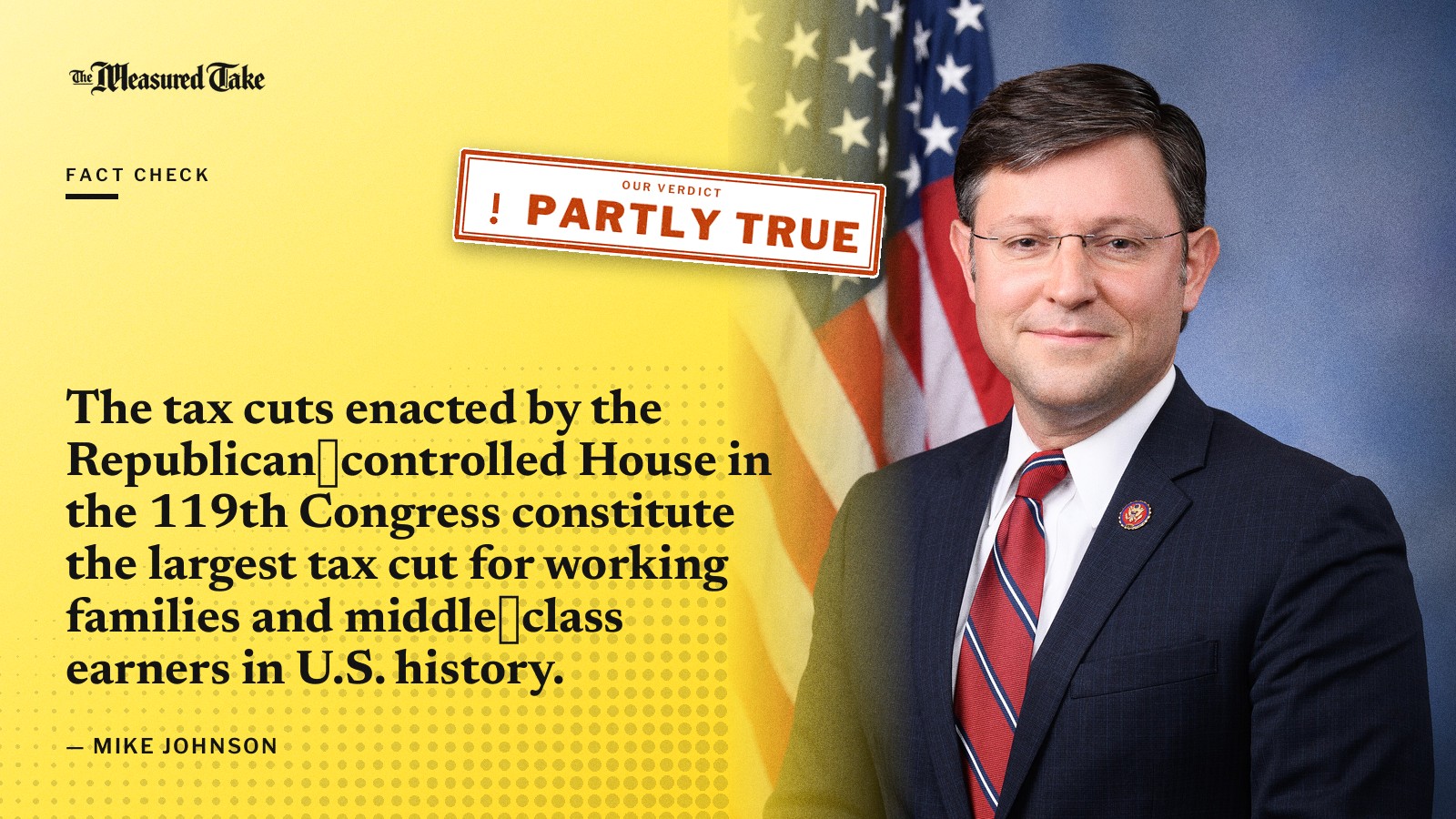
Speaker Mike Johnson made the claim in a press address as Congress reconvened, published on his official House website on 9 November 2026.
Our verdict
Partly True
The claim is partly true. The tax law was passed by a Republican-controlled House in the 119th Congress and does include tax relief for middle-income families, but we found no independent historical comparison showing it is the largest such cut in U.S. history.
What we found
Two parts of the claim check out. The Republican party held the House majority in the 119th Congress, according to the House Press Gallery's party breakdown. And Public Law 119-21, the 'One Big Beautiful Bill Act of 2025', was enacted during that Congress, as confirmed by the Joint Committee on Taxation, the Tax Policy Center and the Senate Joint Economic Committee. Independent analysts at the Tax Policy Center and Yale Budget Lab also find the law contains tax relief for middle-income families. But the word 'largest' is where the claim runs into trouble. We found no independent, nonpartisan study comparing this law's total tax cut with major historical tax cuts such as those of 1981, 2001 or 2017, adjusted for inflation or measured as a share of the economy. The Yale Budget Lab finds most households get less than $500, which casts doubt on the 'largest in history' label, but that is not the same as a full historical comparison. So the enactment and the middle-class relief are confirmed; the superlative is not.
The evidence
4 of 6 sources support the claim; none contradict it.
- Supports the claim
The Republican party held the majority in the 119th Congress, according to the House Press Gallery's party breakdown. [1]
- Supports the claim
Public Law 119-21, titled 'Working Families Tax Cuts', was enacted during the 119th Congress, according to the Joint Committee on Taxation. [2]
- Supports the claim
The Tax Policy Center's preliminary assessment confirms the law was enacted in the 119th Congress and analyses its revenue and distributional effects. [3]
- Supports the claim
The Tax Policy Center finds the law's tax provisions give substantially larger dollar benefits to higher-income households than to lower-income households, and that measured gains are largely relative to a baseline where earlier tax cuts would have expired. [4]
- Background
The Yale Budget Lab finds most households receive less than $500 in tax relief under the law, with larger cuts concentrated in the upper-middle income range rather than broad working-class relief. [5]
- Background
The White House described the 'One Big Beautiful Bill' as the largest tax cut in history for working and middle-class Americans, the same characterisation used by the Speaker. [6]
What we could not confirm
- No independent, nonpartisan historical comparison in the records we reviewed measures whether this law's total tax cut exceeds major historical tax cuts such as those of 1981, 2001 or 2017, adjusted for inflation or as a share of GDP.
- No official Joint Committee on Taxation or Congressional Budget Office report comparing P.L. 119-21 with prior major tax legislation was found.
- Distributional analyses are preliminary or model-dependent and measure gains relative to a baseline where earlier tax cuts would have expired, not absolute reductions from prior-year tax levels.
How we checked
We looked at the Speaker's official statement, the White House release, the House Press Gallery's party breakdown, the Joint Committee on Taxation, the Senate Joint Economic Committee, the Tax Policy Center and the Yale Budget Lab. We checked whether the law was passed by a Republican House in the 119th Congress, whether it provides middle-class tax relief, and whether any independent study compares it with past tax cuts. We reviewed 14 relevant sources.
Sources
- [1]pressgallery.house.gov · Party Breakdown
- [2]jct.gov · JCX-23-25 · September 18, 2026
- [3]Tax Policy Center (Urban Institute & Brookings Institution) · ONE BIG BEAUTIFUL BILL? A PRELIMINARY ASSESSMENT · March 23, 2026
- [4]Tax Policy Center (Urban Institute & Brookings Institution) · Exploring Why the Impacts of OBBBA's Tax Changes Differ by Race and Ethnicity · August 1, 2026
- [5]budgetlab.yale.edu · Distribution of Tax Cuts in the New Tax Law
- [6]whitehouse.gov · The Largest Tax Cut in History for Working and Middle-Class Americans · June 10, 2025
- [7]Original statement · Speech · November 9, 2026
Have evidence we missed?
If you know of a source that confirms or contradicts this claim, send us the link. We review every submission and update fact checks when new evidence changes the picture.
Measured Take updates fact checks when new evidence emerges. Corrections are noted on the page.
All fact checks