Mike Johnson: The Republican‑led Congress cut $1.6 trillion from federal spending, the largest spending reduction in U.S. history. Our verdict: Unverified.
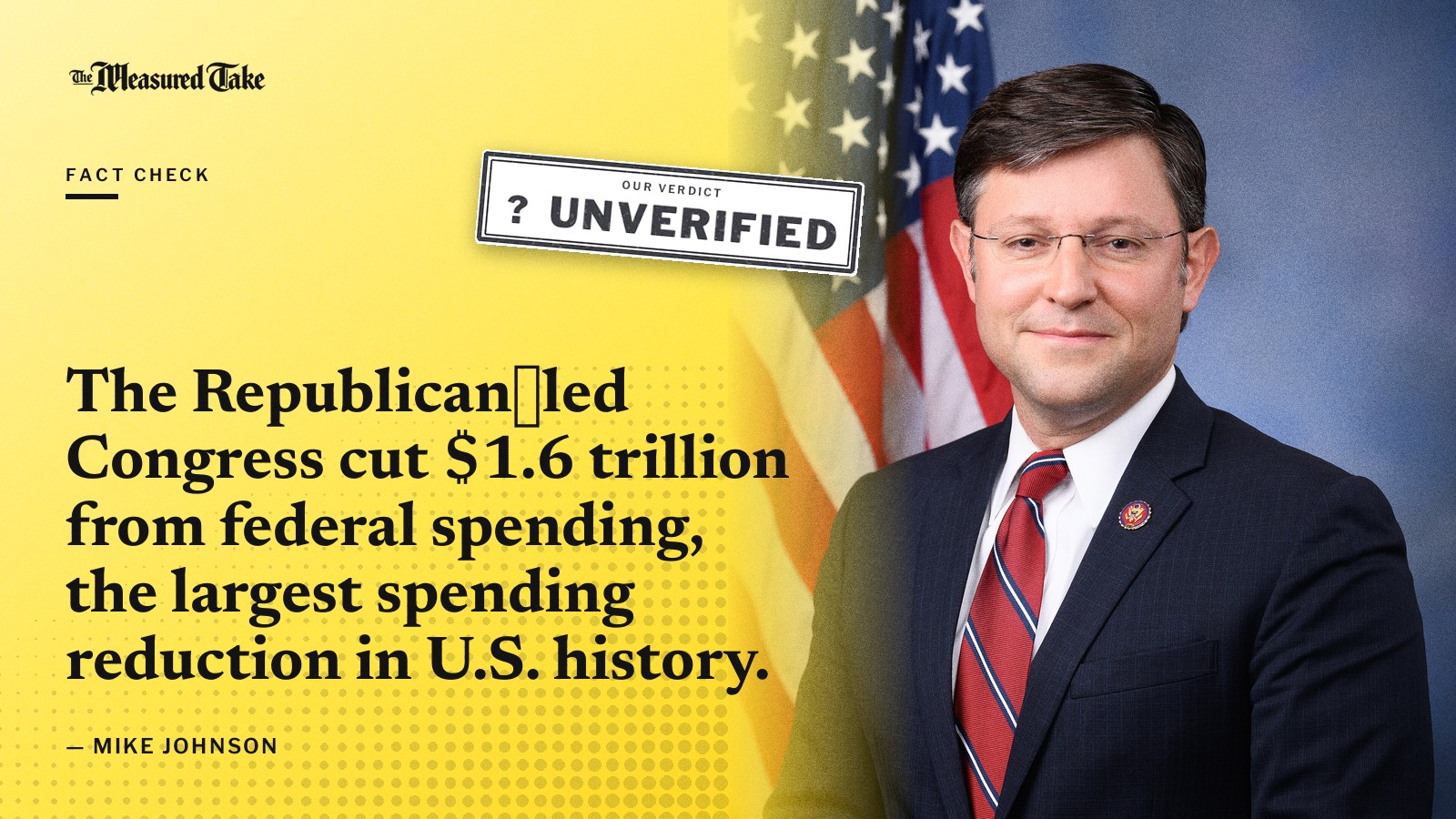
Speaker Mike Johnson made the claim in a statement published by his office on 10 November 2026, as Congress reconvened.
Our verdict
Unverified
We could not find enough public evidence to confirm or refute Mike Johnson's claim that the Republican-led Congress cut $1.6 trillion from federal spending, the largest reduction in U.S. history. The only sources we found repeating the $1.6 trillion figure are political statements, and no independent budget data backs them up.
Know something that settles it? Send us evidenceWhat we found
Mike Johnson did make this claim. His office published a statement on 10 November 2026 saying the Republican-led Congress achieved the biggest spending cut in U.S. history at $1.6 trillion, focused on rooting out fraud and waste. A member of Congress also said on the floor on 28 June 2025 that the body had reduced government spending by $1.6 trillion and called it "historic savings". But these are political statements, not independent figures. We looked for budget estimates, spending records or historical comparisons that would confirm a $1.6 trillion cut, and found none. A Brookings Institution budget report from April 2026 discusses deficits and long-term projections but does not mention a $1.6 trillion cut. A bill on Social Security fraud targets fraud but is not a broad spending reduction of that size. Without independent fiscal data, we cannot say whether the $1.6 trillion figure is right, or whether it is the largest cut in U.S. history.
The evidence
4 sources, all background: none settles the claim either way.
- Background
Mike Johnson's office published a statement saying the Republican-led Congress achieved the biggest spending cut in U.S. history at $1.6 trillion, focused on rooting out fraud and waste. [1]
- Background
A member of Congress said on the floor that the body reduced government spending by $1.6 trillion and called it "historic savings" exceeding past reductions. [2]
- Background
A Brookings Institution budget report gives context on federal deficits and long-term projections but does not mention a $1.6 trillion spending cut. [3]
- Background
A bill on Social Security fraud targets fraud but is not a broad spending reduction measure of the scale claimed. [4]
What we could not confirm
- Whether a $1.6 trillion reduction in federal spending was actually enacted.
- Whether any such reduction would be the largest in U.S. history.
- Whether the reduction, if it exists, focused on fraud and waste.
How we checked
We looked at the published statement from Mike Johnson's office, a Congressional Record entry, a Brookings Institution budget report, and a bill on Social Security fraud. We searched for independent budget estimates, spending records or historical comparisons that would confirm the $1.6 trillion figure, but found none. If you have evidence that bears on this claim, please send it to us. We reviewed 4 relevant sources.
Sources
- [1]mikejohnson.house.gov · Speaker Johnson Addresses Press as Congress Reconvenes · November 10, 2026
- [2]congress.gov · 3 · June 28, 2025
- [3]brookings.edu · Facing America’s Long-Term Budget Challenges · April 1, 2026
- [4]congress.gov · H.R.6678 - 118th Congress (2023-2024): Consequences for Social Security Fraud Act · January 25, 2024
Help us check this claim
We could not find enough public evidence to confirm or refute this claim. If you know of an official record, dataset, transcript or report that settles it, send us the link. We review every submission and update this fact check when the evidence changes the picture.
Measured Take updates fact checks when new evidence emerges. Corrections are noted on the page.
All fact checks