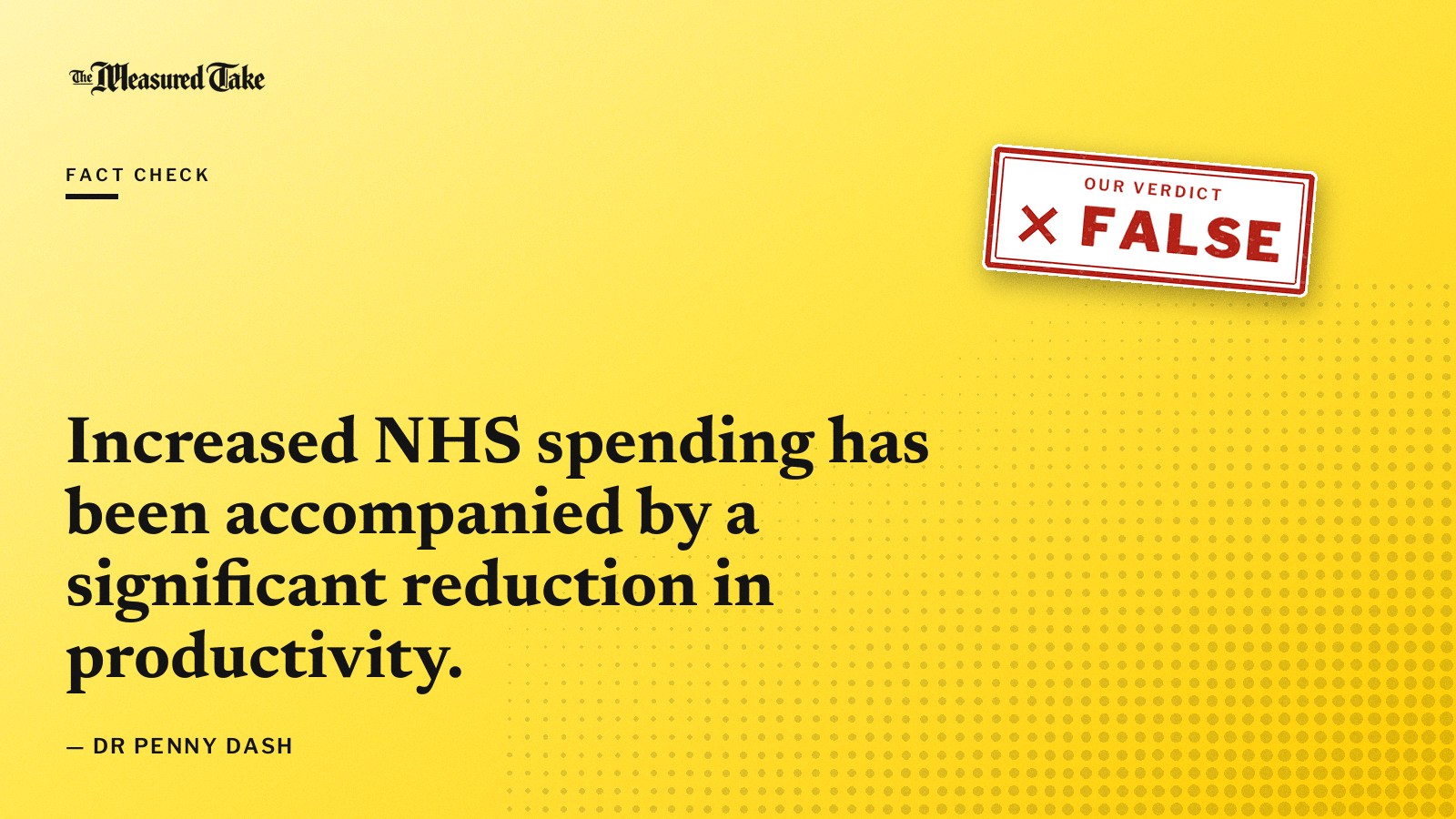
Dr Penny Dash: Increased NHS spending has been accompanied by a significant reduction in productivity. Our verdict: False.
Dr Penny Dash, chairman of NHS England, made the claim in a GB News article about Andy Burnham, Kemi Badenoch and Nigel Farage, dated 23 November 2026.
Our verdict
False
The claim is false. NHS spending did rise, but the most recent official figures show healthcare productivity also rose in 2024 and 2025, not fell.
What we found
We checked two things: whether NHS spending went up, and whether productivity went down at the same time. HM Treasury figures show Health/NHS spending rose by £12.7 billion (6.3% nominal) in 2025-26. But the Office for National Statistics reports that healthcare productivity increased in 2024 and 2025, though it remained 5.8% below 2019 levels. So spending rose while productivity also rose, which contradicts the claim of a significant reduction alongside higher spending. Reports from the Institute for Government and an independent investigation describe longer-standing productivity problems in the NHS, but they do not show a significant fall at the same time as the recent spending increases.
The evidence
1 of 6 sources contradict the claim; none support it.
- Background
Dr Penny Dash, identified as the chairman of NHS England, said a staggering increase in NHS spending was accompanied by a significant reduction in productivity. [1]
- Contradicts the claim
Official figures show healthcare productivity increased in 2024 and 2025, although it remained 5.8% below 2019 levels. [2]
- Background
HM Treasury data confirms that Health/NHS spending increased by £12.7 billion (6.3% nominal) in 2025-26. [3]
- Background
The NHS has experienced significant funding increases without a corresponding increase in hospital activity, contributing to a productivity challenge. [4]
- Background
NHS spending has increased in real terms, but the health system has faced significant performance issues and poor returns on investment, consistent with a decline in productivity. [5]
- Background
NHS England's revenue departmental expenditure limit in real terms has generally increased year on year, with larger increases during the COVID-19 pandemic, though it fell slightly after 2021-22. [6]
What we could not confirm
- The claim may refer to a longer period, such as 2010-2019 or 2019-2023, where productivity trends could differ. We could not find concurrent time-series data for both NHS spending and productivity over such extended periods to check that reading.
- Productivity is measured here using the Office for National Statistics public service productivity figures. Other ways of measuring productivity, such as clinical outcomes per pound spent, were not assessed.
How we checked
We looked at official spending figures from HM Treasury, productivity figures from the Office for National Statistics, and reports from the National Audit Office, the Institute for Government and an independent investigation of the NHS. We compared whether spending rose and whether productivity fell over the same recent period. We reviewed 6 relevant sources.
Sources
- [1]www.gbnews.com · Andy Burnham will use authoritarian 'Henry VIII' powers to force Brexit betrayal through Commons
- [2]ons.gov.uk · Public service productivity, quarterly, UK - Office for National Statistics · April 1, 2026
- [3]gov.uk · Public spending statistics: November 2026 · November 1, 2026
- [4]instituteforgovernment.org.uk · The NHS productivity puzzle · June 1, 2023
- [5]gov.uk · Independent Investigation of the National Health Service in England · May 15, 2026
- [6]National Audit Office (NAO) · NHS Financial Management and Sustainability · July 1, 2024
Have evidence we missed?
If you know of a source that confirms or contradicts this claim, send us the link. We review every submission and update fact checks when new evidence changes the picture.
Measured Take updates fact checks when new evidence emerges. Corrections are noted on the page.
All fact checks