Donald Trump: The Federal Reserve raises interest rates whenever good economic numbers are announced, making rates too high because the Fed is a very political institution. Our verdict: Unverified.
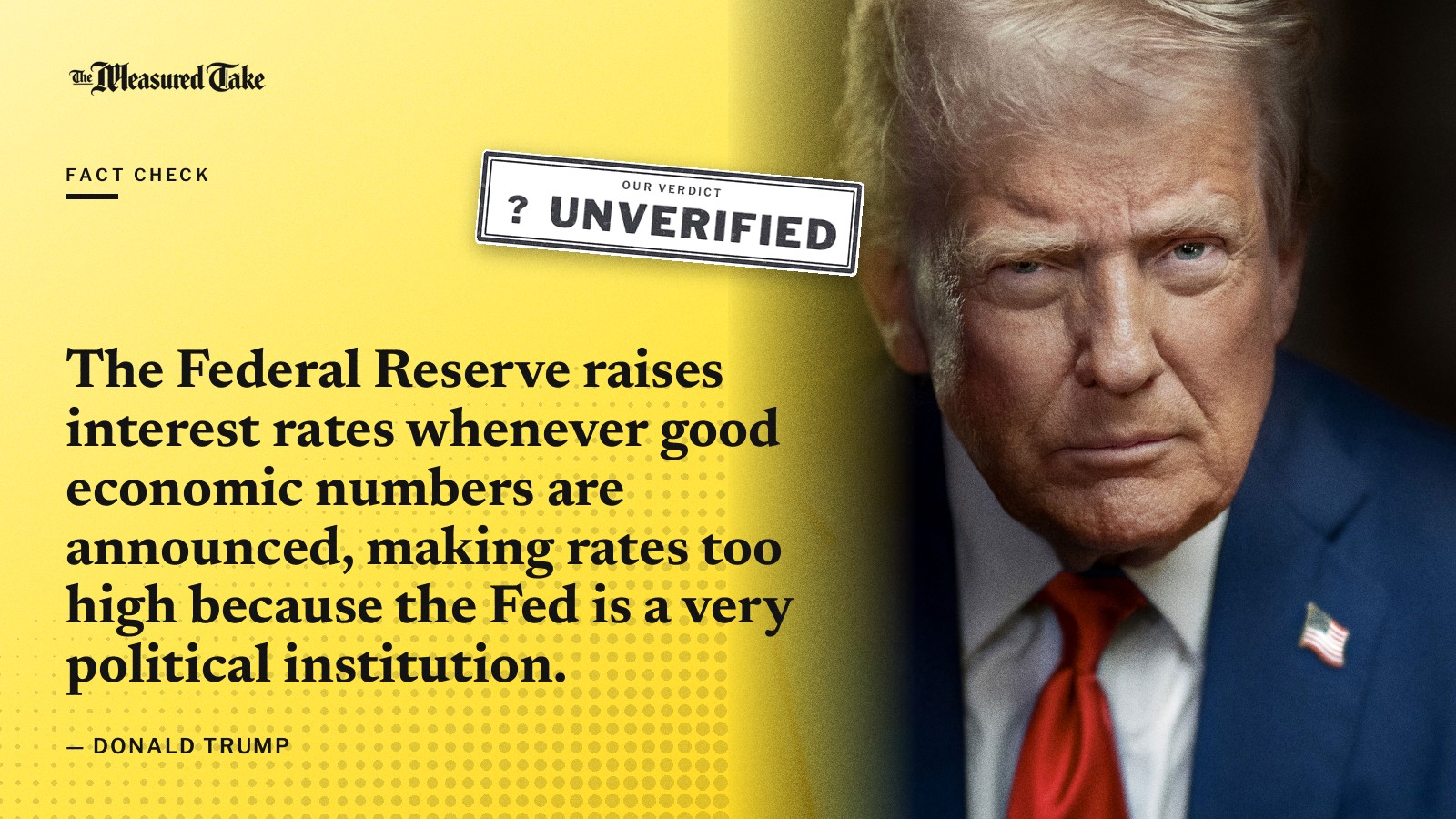
Donald Trump made the claim during a White House briefing, as reported by Prameya News; the report is undated and the claim is dated 21 November 2026.
Our verdict
Unverified
We could not find enough public evidence to confirm or refute the claim that the Federal Reserve raises interest rates whenever good economic numbers are announced, making rates too high because the Fed is a very political institution. The evidence shows the Fed kept rates unchanged at one point despite solid economic activity, but it does not settle whether rates are too high or whether political pressure drives decisions.
Know something that settles it? Send us evidenceWhat we found
The claim has three main parts: that the Fed raises rates whenever good economic numbers are announced, that rates are too high, and that the Fed is a very political institution. On the first part, the Federal Reserve's own July 2026 Monetary Policy Report records that the target range stayed unchanged during the stated period even though economic activity was solid, which works against the idea that good news always leads to a rate rise. On the second part, we found the Fed's target rate in its publications, but no independent estimates of a neutral rate to compare it with, so we cannot say whether rates are too high. On the third part, academic research from restud.com and the National Bureau of Economic Research, plus congressional testimony from Senator Elizabeth Warren, documents political pressure and criticism of the Fed, but the Fed itself describes its formal operational independence, and the evidence does not show that political actors systematically control its decisions. Because the three main parts are not settled by the available evidence, our overall verdict is unverifiable.
The evidence
6 sources, all background: none settles the claim either way.
- Background
Prameya News reports that Trump made the quoted claim during a White House briefing, which is the source for the attribution. [1]
- Background
The Federal Reserve's July 2026 Monetary Policy Report records that the target range remained unchanged during the stated period despite solid economic activity, a direct counterexample to the idea that good numbers always bring a rate rise. [2]
- Background
A Federal Reserve governor described the substantial rate increases in 2022 as a response to inflation and expressed support for a later rate cut, which points to inflation rather than good economic news as the driver. [3]
- Background
In a May 2023 press conference, the Federal Reserve justified rate hikes as a tool to return inflation to its 2 percent objective, not as a response to positive economic data or political pressure. [4]
- Background
The Federal Reserve describes its formal operational independence and accountability framework, which is relevant context for the claim that it is a very political institution. [5]
- Background
Academic research from restud.com indicates that political pressure on the Fed has historically occurred and can influence monetary policy outcomes, which is relevant to the claim that the Fed is political. [6]
What we could not confirm
- Whether the Federal Reserve raises interest rates whenever good economic numbers are announced: we could not prove a negative, and the available evidence does not include systematic timing or causal data linking positive releases to rate hikes.
- Whether rates are too high: independent neutral-rate estimates, such as those from the Congressional Budget Office, were not available in the evidence we reviewed, so we could not compare the Fed's target rate with an independent benchmark.
- Whether the Fed is a very political institution in the sense that political influence systematically controls its decisions: political pressure and criticism are documented, but the evidence does not show a causal impact on policy outcomes.
- The attribution of the claim to Trump relies on secondary news reporting from Prameya News without a primary transcript or recording.
How we checked
We looked at Federal Reserve reports, speeches and congressional testimony, academic research on political pressure on the Fed, and news reporting of the claim. We could not find enough public evidence to confirm or refute the claim, and we invite readers who have evidence to send it to us. We reviewed 13 relevant sources.
Sources
- [1]Prameya News · US President Donald Trump labels Federal Reserve political while praising India's growth and rate model
- [2]Board of Governors of the Federal Reserve System · Monetary Policy · July 10, 2026
- [3]Federal Reserve Board · Speech by Governor Waller on the economic outlook · November 17, 2025
- [4]federalreserve.gov · Transcript of Chair Powell's Press Conference -- May 3, 2023 · May 3, 2023
- [5]Board of Governors of the Federal Reserve System · Monetary Policy
- [6]restud.com · Political Pressure on the Fed · April 5, 2026
Help us check this claim
We could not find enough public evidence to confirm or refute this claim. If you know of an official record, dataset, transcript or report that settles it, send us the link. We review every submission and update this fact check when the evidence changes the picture.
Measured Take updates fact checks when new evidence emerges. Corrections are noted on the page.
All fact checks