Boris Johnson: The United Kingdom has performed exceptionally well economically since leaving the European Union, despite the current Labour government. Our verdict: False.
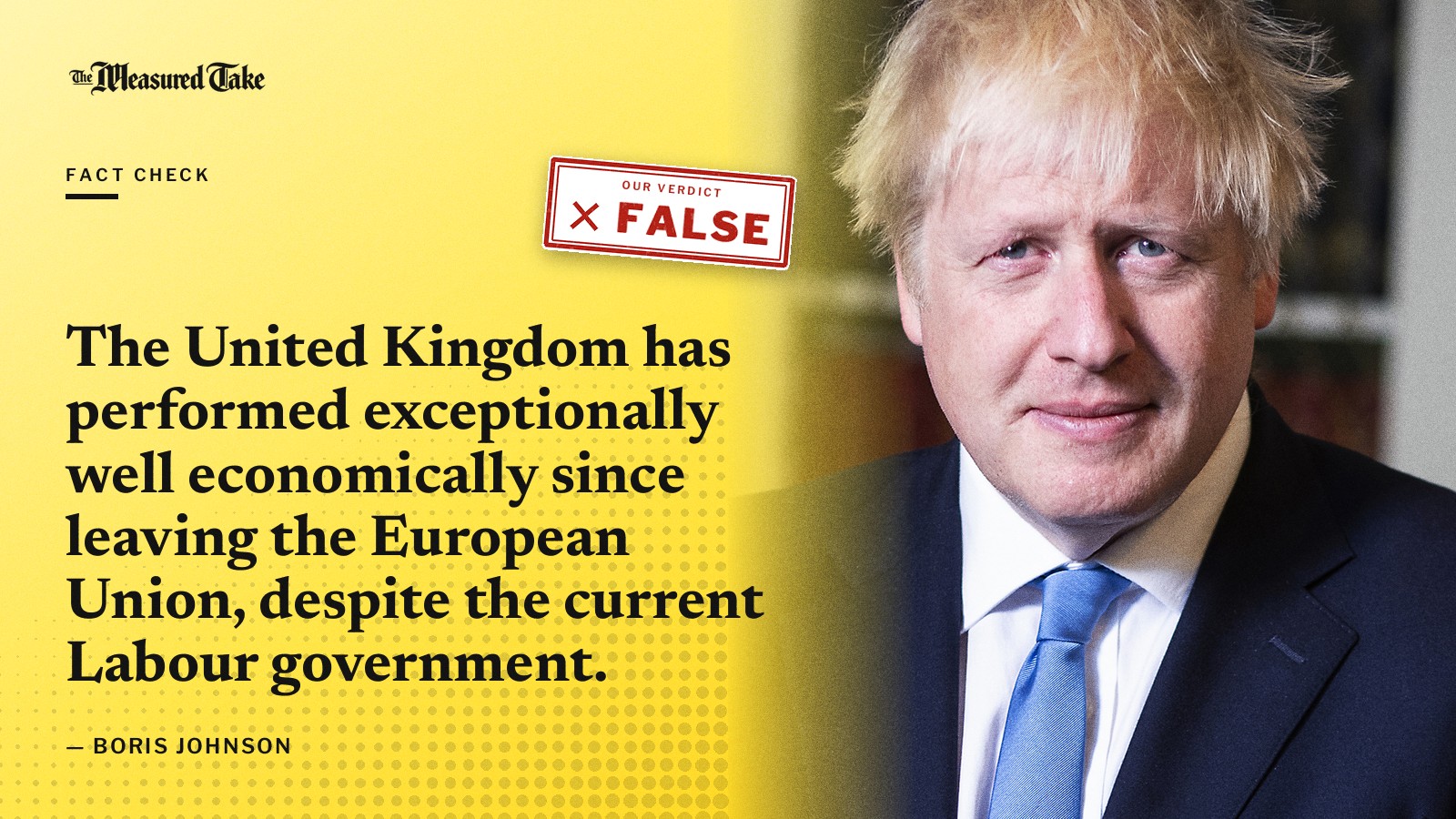
Boris Johnson made the claim on GB News on 17 November 2026.
Our verdict
False
False. The evidence does not show that the UK has performed exceptionally well since leaving the EU: recent growth has been modest, and the OECD identifies economic costs from leaving the EU single market.
What we found
The Office for National Statistics reported that GDP grew by 0.5% in the second quarter of 2026 and by 0.4% in the three months to July 2026. Business investment was mixed: it rose 1.8% in the second quarter of 2026 but was 5.2% higher year on year. These figures do not support describing the UK’s economic performance as exceptional.
The evidence
1 contradict and 1 support the claim, of 5 sources.
- Supports the claim
The Office for National Statistics reported GDP growth of 0.5% in the second quarter of 2026. [1]
- Background
The Office for National Statistics reported that GDP grew by 0.4% in the three months to July 2026. [2]
- Background
The Office for National Statistics reported that business investment rose 1.8% in the second quarter of 2026 and was 5.2% higher year on year. [3]
- Contradicts the claim
The OECD identified negative economic impacts and trade frictions from the UK’s departure from the EU. It suggested this could reduce output by 3.5%. [4]
- Background
The Office for National Statistics states that the UK left the EU on 31 January 2020. [1]
What we could not confirm
- The available figures do not provide a full assessment of long-term measures such as productivity or GDP per person, or a complete comparison with other countries.
- The evidence reviewed does not establish the exact start date of the Labour government or allow a full comparison between its economic record and the period before it.
How we checked
We reviewed Office for National Statistics data on GDP and business investment, the OECD’s assessment of the UK economy, and the cited material about the UK’s departure from the EU. The evidence available covers only part of the period since leaving the EU. We reviewed 9 relevant sources.
Sources
- [1]ons.gov.uk · GDP quarterly national accounts, UK: April to June 2026 · September 30, 2026
- [2]ons.gov.uk · GDP monthly estimate, UK: July 2026 · September 11, 2026
- [3]Office for National Statistics · Business investment in the UK - Office for National Statistics · August 20, 2026
- [4]oecd.org · OECD Economic Surveys: United Kingdom 2024 · September 1, 2024
- [5]Original statement · News report · November 17, 2026
Have evidence we missed?
If you know of a source that confirms or contradicts this claim, send us the link. We review every submission and update fact checks when new evidence changes the picture.
Measured Take updates fact checks when new evidence emerges. Corrections are noted on the page.
All fact checks