Andrew Bailey: The development of frontier artificial intelligence has increased the risk of cyber-attacks. Our verdict: True.
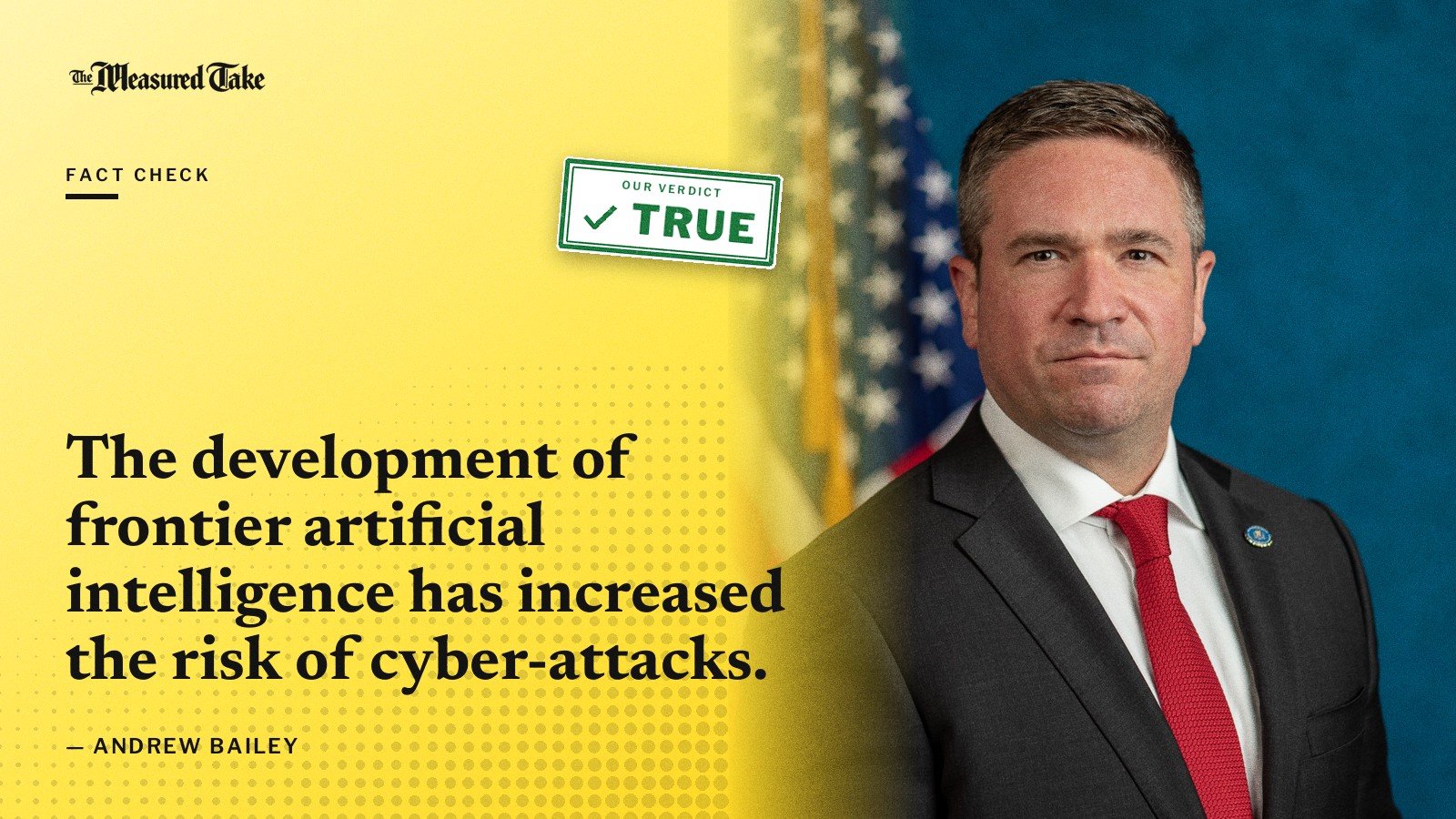
Andrew Bailey, the Governor of the Bank of England, made the claim in an interview reported by The Independent on 9 November 2026, in which he also warned that overvaluing AI stocks could cause a bubble to burst.
Our verdict
True
The claim is accurate. Andrew Bailey said frontier AI has increased the risk of cyber-attacks, and several official cybersecurity agencies support the view that AI is making attacks easier and faster.
What we found
We rated this claim true. The strongest evidence is Andrew Bailey's own statement, reported by The Independent, that frontier AI has increased the risk from cyber-attacks. That statement is backed by official cybersecurity agencies. The US Cybersecurity and Infrastructure Security Agency (CISA) says AI is being used to find software flaws faster, and that threat actors are using AI-assisted development to write and refine exploit code, lowering the barriers to attacks. The European Union Agency for Cybersecurity (ENISA) reports that frontier AI models are augmenting cyber operations and enabling more phases of the cyber kill chain. CISA guidance also identifies adversarial AI techniques used by malicious actors. One analysis from Georgetown's Center for Security and Emerging Technology notes that AI affects both attack and defence, so the overall balance is complex. But the weight of official sources supports the claim, and we found no evidence contradicting it.
The evidence
4 of 6 sources support the claim; none contradict it.
- Background
Andrew Bailey stated that frontier AI has increased the risk from cyber-attacks, while acknowledging that such risks were already prominent. [1]
- Supports the claim
CISA says AI is being used to identify software flaws, which increases the speed of vulnerability discovery. [2]
- Supports the claim
CISA reports that threat actors are actively using AI-assisted development to iterate exploit code and lower barriers to cyber-attacks. [3]
- Supports the claim
ENISA reports that frontier AI models are augmenting cyber operations and enabling more phases of the cyber kill chain. [4]
- Supports the claim
CISA guidance identifies that adversarial AI techniques are used by malicious actors to carry out cyberattacks. [5]
- Background
An analysis from Georgetown's Center for Security and Emerging Technology notes that AI impacts both offence and defence, so the overall effect on the offence-defence balance is complex. [6]
What we could not confirm
- The size of the increase in risk is not established.
- How the offence-defence balance may offset the net risk increase is not settled.
- The exact point at which 'frontier AI' emerged is not defined.
- The evidence focuses on vulnerability discovery and exploit development, not on the frequency of successful attacks.
How we checked
We looked at Andrew Bailey's public statement as reported by The Independent, and at reports and guidance from official cybersecurity agencies including CISA and ENISA, plus an independent analysis of how AI affects cyber offence and defence. We reviewed 8 relevant sources.
Sources
- [1]www.independent.co.uk · Overvaluing AI stocks may cause ‘bubble’ to burst, warns Bank of England boss
- [2]cisa.gov · Patch Smarter, Not Harder | CISA · June 10, 2026
- [3]cisa.gov · Defending Against an Active Threat to Siemens S7 Series PLCs | CISA
- [4]enisa.europa.eu · ENISA Threat Landscape 2026 · September 1, 2026
- [5]cisa.gov · INSIDER THREAT MITIGATION GUIDE · September 1, 2026
- [6]cset.georgetown.edu · Anticipating AI’s Impact on the Cyber Offense-Defense Balance | Center for Security and Emerging Technology · May 1, 2025
Have evidence we missed?
If you know of a source that confirms or contradicts this claim, send us the link. We review every submission and update fact checks when new evidence changes the picture.
Measured Take updates fact checks when new evidence emerges. Corrections are noted on the page.
All fact checks