Abdul El-Sayed: The United States provides unconditional foreign military aid to Israel, Egypt, Saudi Arabia, and Pakistan. Our verdict: False.
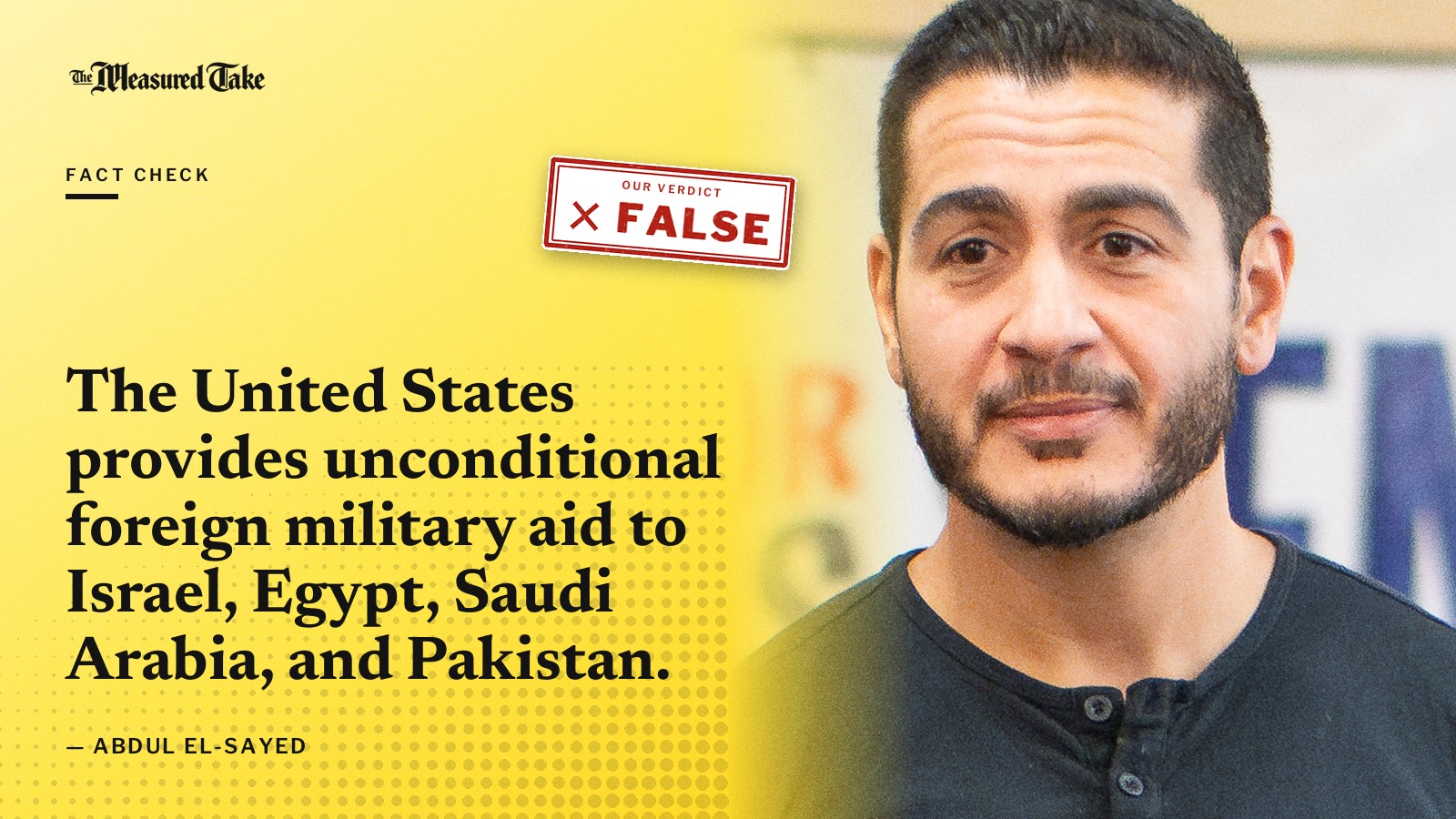
Abdul El-Sayed made the claim in an interview published by The Guardian on 20 November 2026, in which he sought to help President Trump end military aid to Israel.
Our verdict
False
The claim that the United States provides unconditional foreign military aid to Israel, Egypt, Saudi Arabia, and Pakistan is false. US law places conditions on military aid to all four countries, including human rights vetting, end-use monitoring, and congressional notification.
What we found
We reached our verdict by examining US statutes and official guidance. The Congressional Research Service explains that the Foreign Military Sales programme, a main route for US military aid to Israel and Egypt, is governed by the Arms Export Control Act, which imposes end-use and retransfer conditions and requires congressional notification. The State Department's Leahy Law fact sheet states that human rights conditions apply to US security assistance to all countries, prohibiting aid to units credibly implicated in gross human rights violations. The Arms Export Control Act itself sets out end-use monitoring, congressional reporting, and restrictions on transfers. A separate provision of US law conditions arms sales to Saudi Arabia on fulfilment of financial commitments from the Gulf War era. A Congressional Research Service report confirms that multiple statutory and policy restrictions apply to US security assistance. Because these conditions exist on paper for all four countries named, the claim of unconditionality is false.
The evidence
5 of 6 sources contradict the claim; none support it.
- Background
The Guardian reports that Abdul El-Sayed said the United States provides unconditional foreign military aid to Israel, Egypt, Saudi Arabia, and Pakistan. [1]
- Contradicts the claim
The Congressional Research Service states that the Foreign Military Sales programme, a primary mechanism for US military aid to Israel and Egypt, is governed by the Arms Export Control Act, which imposes end-use and retransfer conditions and requires congressional notification. [2]
- Contradicts the claim
The State Department's Leahy Law fact sheet says the Leahy law imposes human rights conditions on US security assistance to all countries, prohibiting aid to units credibly implicated in gross human rights violations. [3]
- Contradicts the claim
US law conditions arms sales to Saudi Arabia on fulfilment of financial commitments from the Gulf War era. [4]
- Contradicts the claim
A Congressional Research Service report identifies multiple statutory and policy restrictions on US security assistance, including Leahy law human rights vetting, country-specific conditions, and congressional oversight requirements. [5]
- Contradicts the claim
The Arms Export Control Act establishes multiple conditions on foreign military sales and financing, including end-use monitoring, congressional reporting requirements, and restrictions on transfers to countries supporting terrorism or not cooperating with counterterrorism efforts. [6]
What we could not confirm
- Whether waivers, exceptions, or non-enforcement render aid effectively unconditional in practice.
- Whether the Gulf War financial commitment condition on Saudi Arabia has been satisfied or waived.
- Other aid channels, such as Foreign Military Financing, were not fully examined.
How we checked
We looked at US statutes, Congressional Research Service reports, and State Department guidance on the legal conditions attached to US military aid. We also reviewed the original interview in which the claim was made. We reviewed 6 relevant sources.
Sources
- [1]www.theguardian.com · ‘I agree with the president’: incoming senator Abdul El-Sayed seeks to help Trump end military aid to Israel · November 20, 2026
- [2]Congressional Research Service · Transfer of Defense Articles: Foreign Military Sales (FMS) · July 27, 2026
- [3]state.gov · Leahy Law Fact Sheet - United States Department of State · January 20, 2025
- [4]govinfo.gov · U.S. Code Title 22 Section 2751 (including restriction on arms sales to Saudi Arabia and Kuwait) · January 1, 2024
- [5]congress.gov · Democracy and Human Rights in U.S. Foreign Policy: Evolution, Tools, and Considerations for Congress · January 7, 2025
- [6]U.S. Government Publishing Office · 22 U.S.C. Chapter 39 – Arms Export Control Act · January 1, 2023
Have evidence we missed?
If you know of a source that confirms or contradicts this claim, send us the link. We review every submission and update fact checks when new evidence changes the picture.
Measured Take updates fact checks when new evidence emerges. Corrections are noted on the page.
All fact checks