Rafah, Unmade: Following the Paperwork of a 2,000-Pound Bomb
Public records track the Mark 84 bomb from Texas and Oklahoma to Ashdod. What they show, what they can't, and what happened in Rafah.
Updated November 3, 2026
A 2,000-pound bomb leaves paperwork at every step. An Army notice names the factory that makes its steel body. A federal notice names the contractors. A Senate roll call records who tried to stop a sale. A defense ministry announces when a shipment docks.
The paperwork does not follow any one bomb to any one strike, and we do not claim to. This article follows the kind of bomb, the Mark 84, from Texas and Oklahoma to the port of Ashdod. It then sets out, separately, what happened in Rafah. Nothing here says that a bomb named in these records hit a particular building.
The newest chapter is still open. A proposed sale of 40,000 bombs, worth about $2.8 billion, was on hold in September 2026. We found no report of a change as of Nov. 3, 2026.
The object
The Mark 84, or MK-84, is the biggest of America's standard bombs, the MK-80 series. Bigger specialist bombs exist. It weighs about 2,000 pounds, and about 945 pounds of that is Tritonal explosive, according to Janes figures cited by Wikipedia.
In December 2023, The New York Times published a search of satellite images of southern Gaza, made with an AI tool and then checked by hand. According to published accounts of that investigation, it found at least 208 craters about 40 feet across or larger from the first six weeks of the war, in the south, where Israel had told civilians to go for safety. Munitions experts said craters that size are typically made only by 2,000-pound bombs or larger. The Times warned that many more were likely missed.
That count shows the size of a bomb, not who made it. An Israeli military spokesperson responded that Israel's priority was destroying Hamas, that its forces take "feasible precautions to mitigate civilian harm," and that "questions of this kind will be looked into at a later stage."
Where it is made
The steel bodies of MK-80 bombs come from General Dynamics Ordnance and Tactical Systems in Garland, Texas. An Army sole-source notice calls it the only domestic producer with the capability.
Then there is McAlester, Oklahoma, a city of about 18,000 people. The 2020 Census counted 18,171. An Army photo caption from 2015 says McAlester Army Ammunition Plant loads, assembles and packs MK-84s for General Dynamics.
Who pays
Under a 2016 agreement, the U.S. gives Israel $3.3 billion a year in Foreign Military Financing, according to the Congressional Research Service. That money is largely spent on U.S.-made weapons.
In September 2026, The Washington Post reported a proposed sale, as relayed by UPI: 20,000 MK-84 bombs and 20,000 BLU-117 bombs, 40,000 in all, for about $2.8 billion, with most of it financed by U.S. military aid.
Divide $2.8 billion by the 153.1 million individual tax returns filed for 2023, a count from the IRS published by the Tax Foundation, and you get $18.29 per return, for one sale. That sale has not gone ahead. The number shows scale. It is not a bill: returns do not pay equal tax, and U.S. aid would cover most of the price, not all of it.
The pause
In May 2024, with more than a million people sheltering in Rafah, the Biden administration held back a shipment of about 1,800 2,000-pound bombs and about 1,700 500-pound bombs, according to a senior U.S. official who spoke to AP on condition of anonymity. The concern was the larger bombs in a dense city.
President Biden told CNN on May 8, 2024: "Civilians have been killed in Gaza as a consequence of those bombs and other ways in which they go after population centers."
It is the only shipment of these bombs the U.S. is known to have stopped. The 500-pound bombs moved later in 2024. The 2,000-pound bombs stayed under review until Biden's term ended and were released in late January 2025, the Congressional Research Service says.
The crossing
The Israeli Defense Ministry said on Feb. 16, 2025, that a shipment of MK-84 heavy bombs had docked at Ashdod late on Feb. 15 and was offloaded overnight, and that dozens of trucks carried it to air bases. Reports described it as the batch that had been held and then released.
We give no count for that ship, because we found the number in only one outlet. We make no claim about where those bombs were used.
On Nov. 19, 2025, the ministry said 1,000 aircraft and about 150 ships had brought more than 120,000 tons since Oct. 7, 2023. That covers all military equipment. The ministry did not say how much of it was bombs.
Who signs
Arms sales normally go to Congress for review. In late February 2025, Secretary of State Marco Rubio declared an emergency that waived that review.
The notice for one of those sales, Defense Security Cooperation Agency Transmittal 25-34, covers 35,529 MK-84 or BLU-117 bomb bodies at an estimated $2.04 billion, with deliveries expected to begin in 2026. It names the prime contractors: "General Dynamics, located in Garland, TX; Ellwood National Forge Company, located in Irvine, PA; and McAlester Army Ammunition Plant, located in McAlester, OK."
The same emergency declaration cleared $295 million of Caterpillar D9 bulldozers, with deliveries expected from 2027.
On April 3, 2025, the Senate voted on S.J.Res. 33, a resolution from Sen. Bernie Sanders to block the $2.04 billion bomb sale. It failed 15–82.
The 2026 proposal met a different kind of obstacle. Sen. Jeanne Shaheen had held it since July, and Rep. Gregory Meeks added his hold in mid-September. "I therefore will not clear this sale at this time," Meeks said, according to UPI. Holds like these are informal. They can delay a sale but cannot block it, and the emergency route has been used before. We found no report that the holds were lifted or that the sale was formally notified as of Nov. 3, 2026.
Rafah
Israeli troops moved into Rafah in May 2024. UNRWA, the UN agency for Palestinian refugees, counted about 800,000 people forced to flee by May 18, and more than 1 million by early June.
On May 26, 2024, an Israeli strike set fire to a camp for displaced people in Tel al-Sultan, in Rafah. At least 45 people were killed, according to the Gaza Health Ministry and the Palestinian Red Crescent. Israel said it had targeted Hamas commanders. Fragments at the scene were tied to the U.S.-made GBU-39 by reports from CNN, The New York Times, The Washington Post and CBS. The GBU-39 is a different, smaller weapon, in the 250-pound class. Prime Minister Benjamin Netanyahu told parliament the next day that there had been "a tragic mistake." AFP rendered the phrase as "tragic accident."
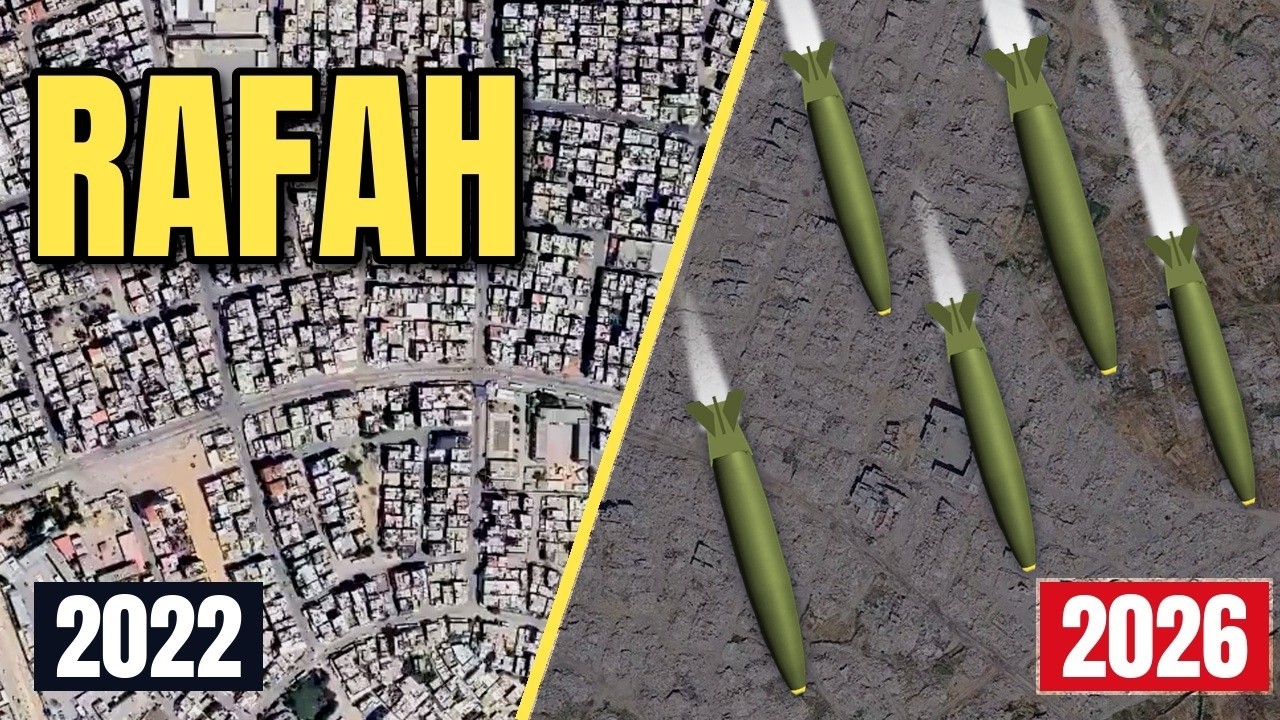
The measured damage grew sharply in 2025, after a ceasefire collapsed. The Centre for Information Resilience studied 17,916 structures in eastern Rafah from satellite images. About 22% were destroyed on Feb. 1, 2025. By May 11, 2025, the figure was 12,137 structures, or about 68%. In one Tel al-Sultan neighborhood, it rose from 59.2% to 93.8%.
The group's footage shows both detonations and excavator demolitions, and it describes a pattern "suggesting systematic demolition." It does not assign each demolition to a particular party or weapon.
An Israeli military photo from July 11, 2024, shows a D9 in Rafah. It is the same model the 2025 emergency cleared. The ones in that sale were not due until 2027.
These are two sets of facts, side by side. One is a paper trail for a kind of bomb. The other is what happened to a city. No public record we found connects a bomb named here to a building there.
We made a film that follows this paperwork. Its 3D scenes are illustrations and the people in them are composites. It is linked first under Sources.
We will update this article if the holds are lifted or the sale goes ahead.
Sources
- [1]Measured Take film, Rafah, Unmade: Following the Paperwork of a 2,000-Pound Bomb
- [2]Mark 84 weight and fill, Janes figures via Wikipedia
- [3]The New York Times crater investigation, via The New Arab
- [4]The New York Times crater investigation, via WION
- [5]The New York Times, video on the investigation
- [6]U.S. Army sole-source notice W519TC-23-R-0008, via HigherGov
- [7]GovConWire, General Dynamics Garland
- [8]Defense Daily, General Dynamics Garland
- [9]U.S. Army, McAlester Army Ammunition Plant
- [10]U.S. Census Bureau, McAlester
- [11]Congressional Research Service, RL33222
- [12]Tax Foundation, IRS figures for tax year 2023
- [13]UPI, Meeks hold and The Washington Post's report
- [14]The Hill, Shaheen and Meeks holds
- [15]AP via KATV, the May 2024 pause
- [16]CBC, President Biden on CNN
- [17]CNN via KRDO, President Biden on CNN
- [18]The Week, shipment at Ashdod
- [19]Khaleej Times, shipment at Ashdod
- [20]AFP via The Kathmandu Post, shipment at Ashdod
- [21]Israeli Defense Ministry figures, via Antiwar.com
- [22]Israeli Defense Ministry figures, via JNS
- [23]Federal Register, DSCA Transmittal 25-34
- [24]CBS News, the 2025 sales
- [25]The New Arab, D9 sale
- [26]European Security & Defence, D9 sale
- [27]JTA, Senate vote
- [28]Sen. Peter Welch, S.J.Res. 33
- [29]CBS News, GBU-39 fragments
- [30]CBC, Tel al-Sultan fire
- [31]AP via PBS, Netanyahu in parliament
- [32]AFP via EWN, Netanyahu in parliament
- [33]U.S. Air Force, GBU-39 fact sheet
- [34]Centre for Information Resilience, "The destruction of Rafah: A city unmade"
- [35]UNRWA via UN Department of Operational Support, 1 million fled
- [36]UNRWA via Sharjah24, 800,000 fled
- [37]Photo: U.S. Army photo (public domain)

Editor
Peter OlaleruPeter is the editor of Measured Take and a cybersecurity professional. He leads our news, fact checks, sport and guides from around the world, with a particular eye on cyber attacks, data breaches, scams, AI and misinformation.
More from Politics



Conversation
Reader notes
Loading comments...