Air France and American Airlines Jets Nearly Collide Over LAX: What the Radio and the Track Show
An Air France A350 and an American A321 came within 0.71 nautical miles after leaving LAX. The radio, the ADS-B track and the FAA's statement.
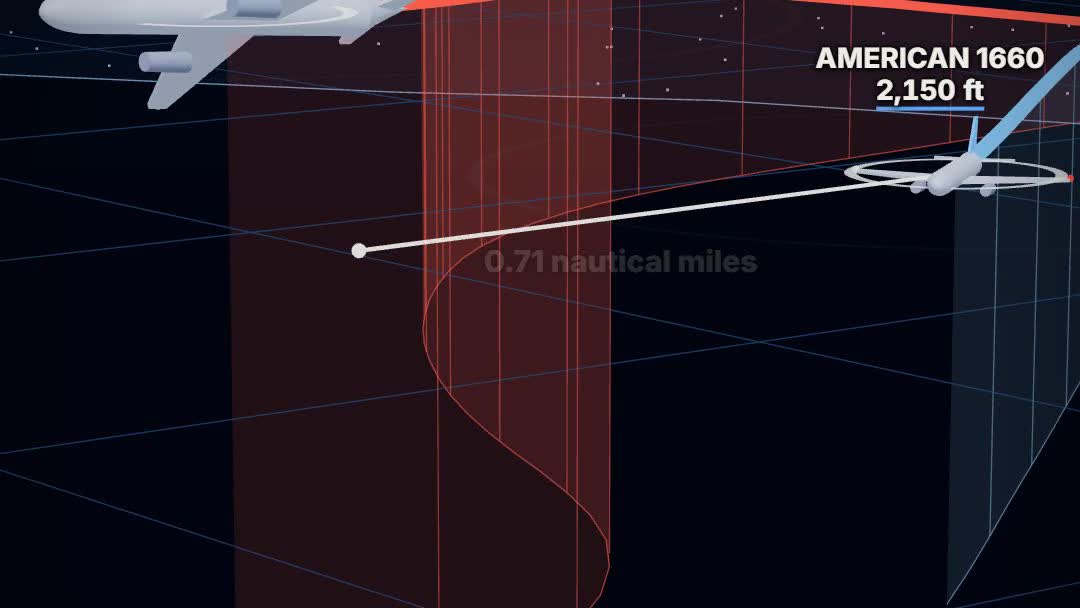
An Air France Airbus A350 and an American Airlines Airbus A321 came within 0.71 nautical miles of each other, with about 1,050 feet between them vertically, minutes after taking off from Los Angeles on the night of 7 November 2026. The FAA says the Air France jet made an "unauthorized turn" into the American flight's path and that air traffic control "immediately issued corrective instructions". Nobody was hurt. The investigation is open and no cause has been given.
What happened
Air France 28, an Airbus A350-900 bound for Papeete, took off from runway 24L at about 00:15 local time (08:15 UTC) on Saturday 7 November. Roughly a minute later American Airlines 1660, an Airbus A321 bound for Dallas/Fort Worth, took off from runway 25R.
Public ADS-B data from adsb.lol shows the Air France jet climbing on about 263 degrees, then turning left to about 201 degrees between 08:17:01 and 08:17:43 UTC, then turning back right to about 280 degrees. The American jet was tracking about 263 degrees and turned left to about 232 degrees from 08:17:19. The closest point in the data is at 08:18:04 UTC.
The FAA's statement, as reported by ABC7, KTLA and CBS Los Angeles, is that the Air France flight made an unauthorized turn into the path of the American flight, that controllers issued corrective instructions straight away, and that it is investigating. Air France told KTLA the crew received a request to adjust its flight path and complied immediately. No injuries have been reported on either flight, and Air France 28 landed in Papeete.
What the radio shows
LiveATC.net archives the SoCal Departure frequency (125.2 MHz) that handled both flights. The recording of the hour shows the departure controller's side of the exchange. The Air France crew's replies are not audible in that feed. In order:
- "Air France 028 Heavy, fly heading of 270 immediately."
- To the American flight: "American 1660, traffic alert, traffic 12 o'clock, less than a mile, maintain 2,000."
- "Why did you turn to a heading?"
- "You are instructed to climb via SID, not turn to a heading."
- "What departure were you instructed to fly?"
A SID is a standard instrument departure, the published route a crew is cleared to fly after take-off. Reports say Air France 28 was cleared to follow the SUMMR2 departure. The recording's clock lines up with the closest point in the ADS-B data. The controller can be heard saying "Thank you" at 08:18:04 UTC.
Why the figures differ
Published separation figures for this event do not agree. We measured ours ourselves.
| Figure | Where it comes from |
|---|---|
| About 400 ft vertical, 4,600 ft sideways | Flight-tracking sites, repeated by several outlets |
| About 301 ft vertical | AIRLIVE |
| About 0.76 nautical miles | AIRLIVE |
| 0.71 nautical miles sideways, about 1,050 ft vertical, at the closest point (08:18:04 UTC) | Our reading of adsb.lol data (barometric altitude, samples one to three seconds apart) |
The smallest vertical gap inside one nautical mile in our data is about 840 ft, at 0.99 nautical miles. A gap of 300 to 340 ft appears only at about 1.6 nautical miles, earlier in the climb. We cannot reproduce a 400 ft gap as the closest pass from this data. FAA and NTSB radar may differ from ADS-B barometric altitude, and the official figures will come from the investigation. None of these numbers is an official finding.
What is not known
- Why the Air France jet turned. The FAA has not said, and the airline has not addressed it. The controller used the words "possible pilot deviation" on the frequency, which is a description of what the controller saw, not a finding.
- Whether any collision alert sounded in either cockpit. No traffic collision avoidance advisory has been reported either way.
- The official separation. Only the FAA's radar data and the investigation can settle it.
- Whether this is linked to other incidents. Earlier near misses off the same runways have been reported, among them ITA Airways and American on 31 October 2025 and TAP on 20 October 2026. No official finding links them to this one.
How we made the video
The film is a 3D replay, not footage. Both flight paths come from public ADS-B data on adsb.lol, drawn to scale. The radio clips are from the LiveATC.net recording and are placed in their real order; film time is compressed against the real clock. Cockpit voice recordings are not public and are not used.
Sources
- [1]FAA statement as reported by ABC7 Los Angeles, KTLA and CBS Los Angeles, 8 to 10 November 2026
- [2]adsb.lol open ADS-B flight history, aircraft 39d2aa (F-HUVK) and a16db9 (N191UW)
- [3]LiveATC.net archive, SoCal Departure KLAX West/Northwest 125.2, 7 November 2026, 0800Z
- [4]AIRLIVE, "Unauthorized Air France turn after takeoff from LAX causes 301 ft vertical separation with American A321", 8 November 2026
- [5]Simple Flying and The Aviation Herald on the departure and the aircraft

Editor
Peter OlaleruPeter is the editor of Measured Take and a cybersecurity professional. He leads our news, fact checks and sport from around the world, with a particular eye on cyber attacks, data breaches, scams, AI and misinformation.
More from Politics


Conversation
Reader notes
Loading comments...