“Escalating global conflicts are currently causing disruption to global energy markets and impacting oil and diesel prices.” — Rubio. Our verdict: True.
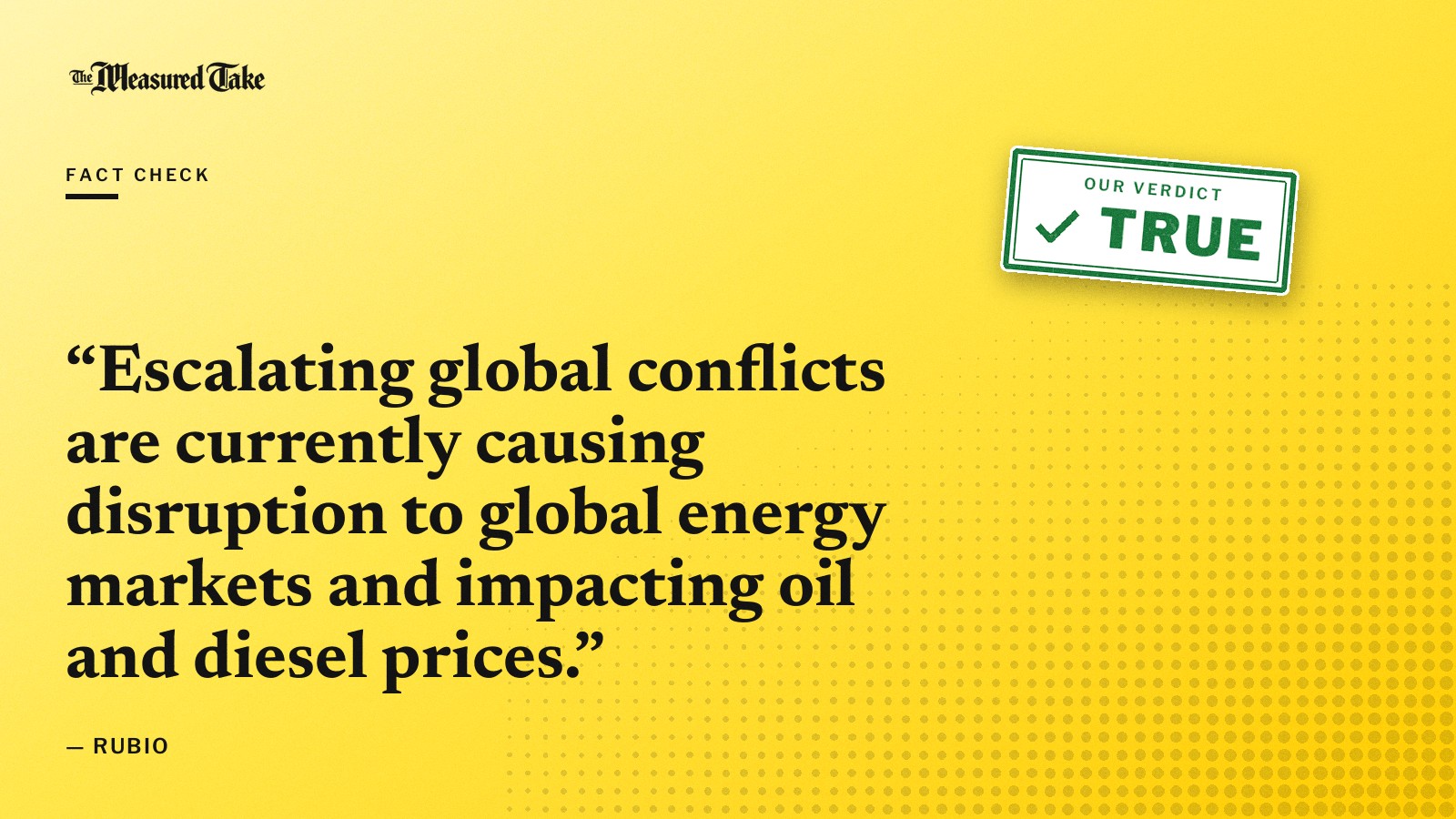
Marco Rubio made the claim in a statement reported by sana.sy on 11 October 2026, in which he also said Trump had paused Russia sanctions for 60 days.
Our verdict
True
The claim is accurate. Official energy data and market reports show that wars in the Middle East and between Russia and Ukraine are disrupting oil supply and pushing up crude, diesel and other fuel prices.
What we found
We found strong support for the claim. The US Energy Information Administration reported that conflicts in the Middle East and Russia have raised crude oil prices and caused market volatility. The International Energy Agency said the Middle East conflict has caused a major disruption to global oil supply, and its June report found global supply well below pre-conflict levels. The Atlantic Council linked conflicts in Russia, Ukraine and the Middle East to refinery outages and higher diesel prices. The OECD also said energy supply shocks from Middle East conflicts are affecting inflation and economic stability. Together these sources confirm all parts of the claim: conflicts are ongoing, they are disrupting energy markets, and they are affecting oil and diesel prices.
The evidence
6 of 6 sources support the claim; none contradict it.
- Supports the claim
The US Energy Information Administration reported that military conflicts in the Middle East and Russia have caused crude oil price increases and market volatility. [1]
- Supports the claim
The International Energy Agency said conflict in the Middle East has caused a major disruption to global oil supply and production. [2]
- Supports the claim
The OECD reported that energy supply shocks from Middle East conflicts are affecting global inflation and economic stability. [3]
- Supports the claim
The World Economic Forum said geopolitical risks and disruptions in the Strait of Hormuz are straining global energy systems. [4]
- Supports the claim
A May 2026 oil market report found that Middle East disruptions caused oil prices to surge and affected refining margins for middle distillates, which include diesel. [5]
- Supports the claim
The Atlantic Council reported that conflicts in Russia, Ukraine and the Middle East have caused refinery outages and reduced global product exports, leading to higher diesel prices. [6]
What we could not confirm
- We could not check the exact diesel spot prices in specific countries, because the sources describe refining margins and price trends rather than direct price indices.
- We could not capture market developments after June 2026, as the evidence we reviewed runs only to that point.
How we checked
We reviewed official energy data and market reports from the US Energy Information Administration, the International Energy Agency and the OECD, along with analysis from the World Economic Forum and the Atlantic Council, and the original report of the claim. We reviewed 8 relevant sources.
Sources
- [1]eia.gov · Crude oil prices and refinery margins generally increased throughout the third quarter - U.S. Energy Information Administration (EIA) · October 5, 2026
- [2]iea.org · Oil Market Report - March 2026 - IEA · March 1, 2026
- [3]oecd.org · Global economic outlook remains robust but has weakened amid energy shock and geopolitical risks · March 26, 2026
- [4]weforum.org · Fragmentation in the Global Energy Transition as Geopolitical Risks Surge | World Economic Forum · June 18, 2026
- [5]20.209.8.43 · 13 May 2026 · May 13, 2026
- [6]atlanticcouncil.org · No quick fixes for the squeeze on refined products
- [7]Original statement · Speech · October 11, 2026
Have evidence we missed?
If you know of a source that confirms or contradicts this claim, send us the link. We review every submission and update fact checks when new evidence changes the picture.
Measured Take updates fact checks when new evidence emerges. Corrections are noted on the page.
All fact checks