“Mass immigration since 2015 has resulted in the average British worker being over £1,000 worse off financially.” — Richard Tice. Our verdict: Unverified.
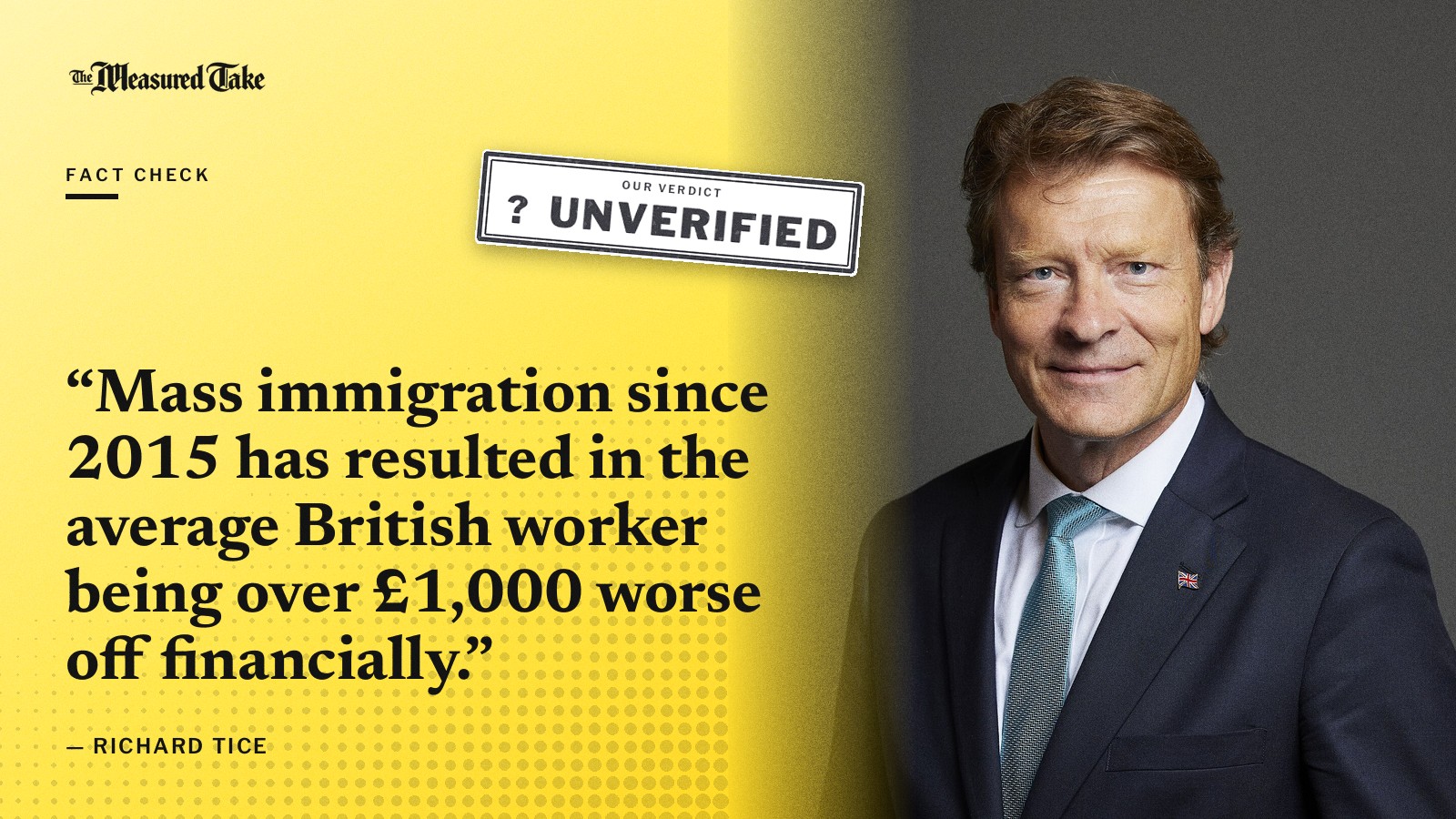
Richard Tice of Reform UK made the claim in an interview published by London TV, dated 26 October 2026.
Our verdict
Unverified
We could not find enough public evidence to confirm or refute Richard Tice's claim that mass immigration since 2015 has left the average British worker over £1,000 worse off. The figures needed to test the £1,000 figure, and any study linking immigration to workers' finances, were not available to us.
Know something that settles it? Send us evidenceWhat we found
The claim rests on three things: that migration since 2015 counts as "mass immigration", that the average British worker is over £1,000 worse off, and that immigration caused that loss. We could not verify any of them from the records we hold. There is no official net migration figure or agreed definition of "mass immigration" to test the first point. The Office for National Statistics publishes average weekly earnings, including a long-run series, but we did not have the 2015 starting figure, an inflation-adjusted comparison, or household disposable income data needed to check a specific £1,000 loss. And nothing in the records we looked at tests whether immigration is the cause of any change in workers' finances. Because we cannot confirm or refute the claim, our verdict is unverifiable. If you have evidence that bears on it, please send it to us.
The evidence
3 of 4 sources support the claim; none contradict it.
- Background
London TV reported Richard Tice's claim that mass immigration since 2015 has left the average British worker over £1,000 worse off. This is the claim we checked, not evidence for it. [1]
- Supports the claim
The Office for National Statistics published average weekly earnings figures for July 2026. These give a current picture of pay but do not, on their own, show a change since 2015. [2]
- Supports the claim
The Office for National Statistics published average weekly earnings figures for January 2026. Again, this is a snapshot of pay, not a comparison with 2015. [3]
- Supports the claim
The Office for National Statistics publishes a long-run series for average weekly earnings across the whole economy. It could be used to work out real-terms pay changes since 2015, but only if combined with inflation data, which we did not have. [4]
What we could not confirm
- Whether net migration since 2015 amounts to "mass immigration", and what that term means.
- Whether the average British worker is over £1,000 worse off, which needs a 2015 pay baseline, an inflation adjustment, and household disposable income figures.
- Whether immigration is the cause of any fall in the average worker's finances.
How we checked
We looked at the report of the claim itself and at official earnings statistics from the Office for National Statistics, including current pay figures and the long-run average weekly earnings series. We did not find net migration data, a 2015 pay baseline with inflation adjustment, household disposable income figures, or any study linking immigration to workers' finances. We reviewed 4 relevant sources.
Sources
- [1]london-tv.co.uk · Burnham 'babbling' on Europe but voters want net zero immigration, says Reform UK's Richard Tice - London TV
- [2]ons.gov.uk · Average weekly earnings in Great Britain - Office for National Statistics · September 1, 2026
- [3]ons.gov.uk · Average weekly earnings in Great Britain - Office for National Statistics · March 1, 2026
- [4]ons.gov.uk · AWE: Whole Economy Level (£): Seasonally Adjusted Total Pay Excluding Arrears - Office for National Statistics · October 20, 2026
- [5]Photo: ©House of Commons / Laurie Noble / Wikimedia Commons, CC BY 3.0
Help us check this claim
We could not find enough public evidence to confirm or refute this claim. If you know of an official record, dataset, transcript or report that settles it, send us the link. We review every submission and update this fact check when the evidence changes the picture.
Measured Take updates fact checks when new evidence emerges. Corrections are noted on the page.
All fact checks