“Conflicts such as the US war on Iran and Houthi attacks on Saudi Arabia are affecting global energy prices.” — Marco Rubio. Our verdict: Unverified.
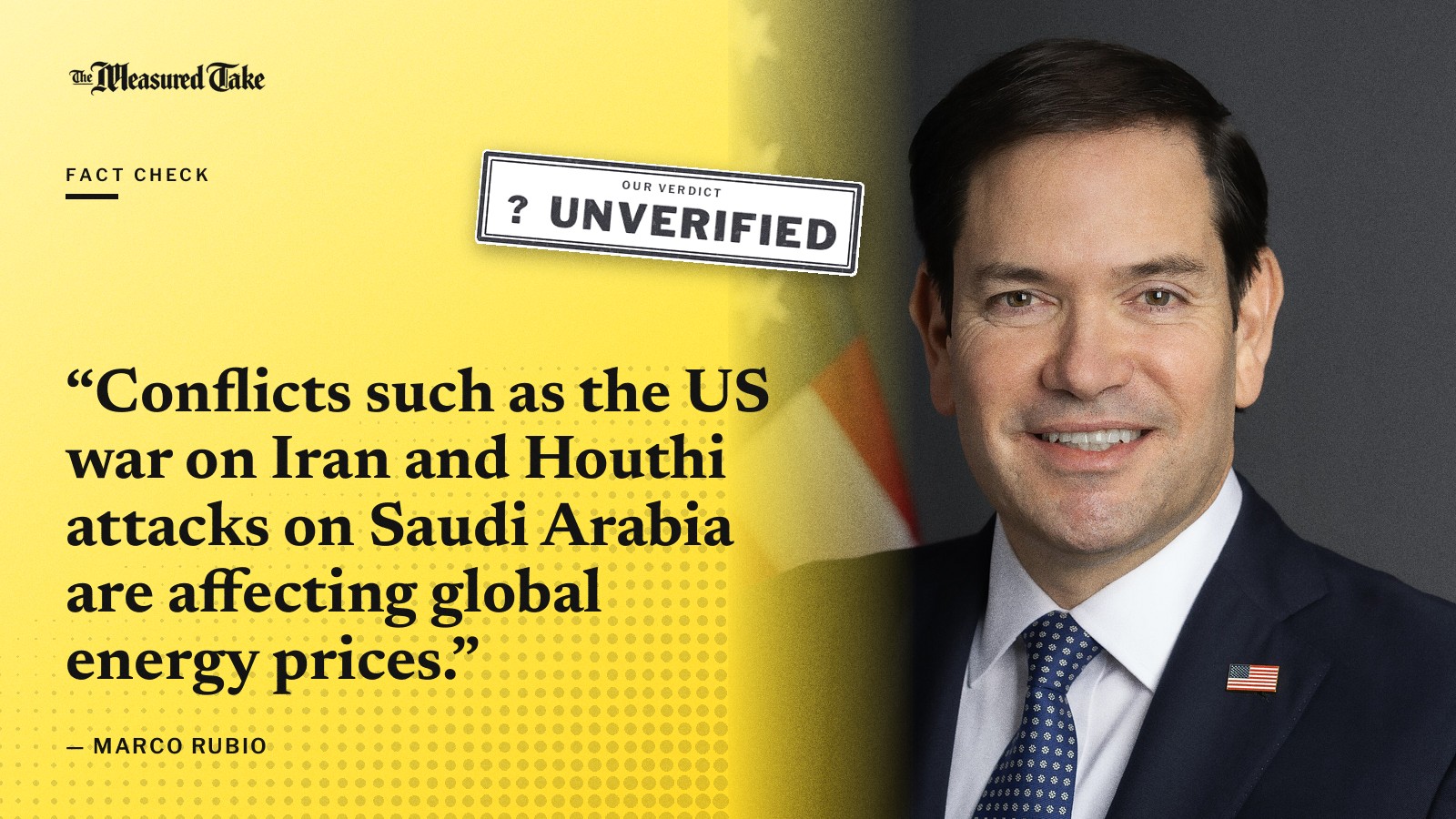
Marco Rubio made the claim in an interview with RTÉ, reported on 18 October 2026, while discussing the pause on Russia sanctions.
Our verdict
Unverified
We could not find enough public evidence to confirm or refute Marco Rubio's claim that conflicts such as the US war on Iran and Houthi attacks on Saudi Arabia are affecting global energy prices. The evidence shows the conflicts are real, but it does not establish a clear causal link between them and movements in global energy prices.
Know something that settles it? Send us evidenceWhat we found
We looked at whether the two conflicts named by Rubio are affecting global energy prices. On the first, the Harvard Kennedy School notes that the United States has carried out military actions in Iran and keeps a large troop presence there, but Congress has not declared war, so even the word "war" is uncertain. On the second, a UN Security Council transcript records Houthi attacks on Saudi energy infrastructure, including airports. The US Energy Information Administration reports that Brent crude rose from $61 to $118 a barrel in the first quarter of 2026, driven by Middle East military action, Iranian threats to shipping in the Strait of Hormuz, and oil production shutdowns in Iraq, Saudi Arabia and the UAE. That points to Middle East conflict affecting prices in general, but it does not tie the rise specifically to a US war on Iran or to Houthi attacks on Saudi Arabia. Because the evidence does not show a direct causal link for either conflict, we rate the claim unverifiable.
The evidence
4 of 6 sources support the claim; none contradict it.
- Background
RTÉ reports that Rubio said conflicts including the US war on Iran and Houthi attacks on Saudi Arabia are affecting global energy prices. This records the claim but does not verify it. [1]
- Supports the claim
The Harvard Kennedy School says the United States has taken military action in Iran and keeps a significant troop presence there, suggesting an ongoing conflict, though Congress has not declared war. [2]
- Supports the claim
A UN Security Council transcript records that Houthi forces attacked Saudi energy infrastructure, including airports. [3]
- Supports the claim
The US Energy Information Administration forecasts higher oil prices and cites constraints including attacks on infrastructure, indicating a possible impact on global energy prices. [4]
- Supports the claim
The Energy Information Administration reports that Brent crude rose from $61 to $118 a barrel in the first quarter of 2026, driven by Middle East military action, Iranian threats to shipping in the Strait of Hormuz, and oil production shutdowns in Iraq, Saudi Arabia and the UAE. [5]
- Background
A State Department transcript of Rubio's remarks to the press on 17 October 2026 covers his travel and global crises but does not mention the specific claim about conflicts affecting energy prices. [6]
What we could not confirm
- Whether a formal US war on Iran exists, since Congress has not declared war.
- Whether the US war on Iran has directly caused changes in global energy prices.
- Whether Houthi attacks on Saudi Arabia have directly caused changes in global energy prices, and by how much.
How we checked
We reviewed the original RTÉ report of Rubio's remarks, a Harvard Kennedy School analysis of the legal status of the US conflict with Iran, a UN Security Council transcript on Houthi attacks, and two Energy Information Administration reports on oil prices and the energy outlook. We reviewed 7 relevant sources.
Sources
- [1]www.rte.ie · Trump paused Russia sanctions to 'analyse' impact - Rubio
- [2]hks.harvard.edu · Are we officially at war with Iran?
- [3]transcripts.un.org · The situation in the Middle East - Security Council, 10236th meeting
- [4]eia.gov · Short-Term Energy Outlook - U.S. Energy Information Administration (EIA) · October 6, 2026
- [5]eia.gov · Crude oil and petroleum product prices increased sharply in the first quarter of 2026 - U.S. Energy Information Administration (EIA) · April 7, 2026
- [6]state.gov · Secretary of State Marco Rubio Remarks to the Press - United States Department of State · October 17, 2026
- [7]Photo: U.S. Department of State / Wikimedia Commons, Public domain
Help us check this claim
We could not find enough public evidence to confirm or refute this claim. If you know of an official record, dataset, transcript or report that settles it, send us the link. We review every submission and update this fact check when the evidence changes the picture.
Measured Take updates fact checks when new evidence emerges. Corrections are noted on the page.
All fact checks