“US tariffs have been pro-inflationary and have severed global supply chains.” — Ken Griffin. Our verdict: Unverified.
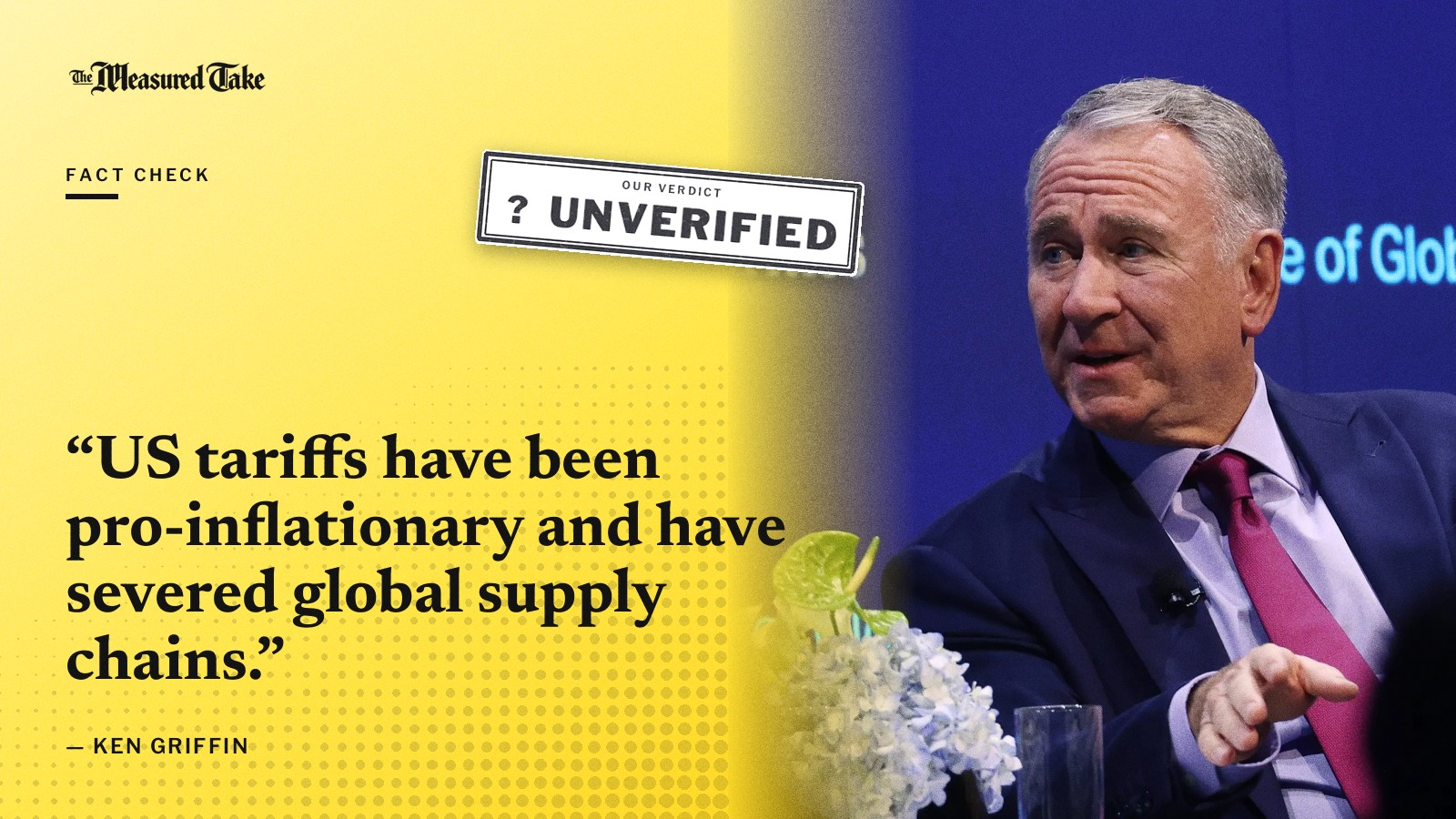
Ken Griffin said US tariffs have been pro-inflationary and have severed global supply chains in an interview with Bloomberg, reported by AOL and Business Insider.
Our verdict
Unverified
We could not find enough public evidence to confirm or refute Ken Griffin's claim that US tariffs have been pro-inflationary and have severed global supply chains. The evidence we found points in different directions on prices, and supports disruption to supply chains rather than a complete break.
Know something that settles it? Send us evidenceWhat we found
We rated this claim unverifiable. On inflation, the evidence conflicts. The Yale Budget Lab found that 2025 US tariffs pushed up core goods prices, with some tariff-sensitive categories rising above their pre-2025 trend. But the Federal Reserve Bank of San Francisco, looking at 150 years of tariff policy, found that tariff hikes have lowered inflation rather than raised it. These two findings cannot both settle the question, and neither speaks directly to the 2025–2026 tariff regimes.
On supply chains, the picture is clearer but does not match the word "severed". A study published in the American Economic Review by Princeton University found that unanticipated tariffs, especially US tariffs on China, disrupted global supply chains by forcing firms to change where they buy inputs and to spend more on searching for suppliers. The United States International Trade Commission also examined price effects and supply chain disruption from the Section 232 and 301 tariffs. But disruption is not the same as severance. The evidence suggests uneven, partial effects, not a total break in global supply chains.
We could verify that Ken Griffin made the statement, but not the economic assertions behind it. Because the underlying evidence is contradictory and the word "severed" goes beyond what the data shows, we cannot say the claim is accurate or inaccurate. If you have evidence that bears on this, please send it to us.
The evidence
1 contradict and 3 support the claim, of 6 sources.
- Supports the claim
The Yale Budget Lab found that 2025 US tariffs contributed to rises in core goods prices, with some tariff-sensitive categories notably above their pre-2025 trend. This supports the inflation part of the claim. [1]
- Contradicts the claim
The Federal Reserve Bank of San Francisco, reviewing 150 years of tariff policy, found that tariff hikes lower inflation rather than raise it. This contradicts the inflation part of the claim. [2]
- Supports the claim
A study in the American Economic Review by Princeton University found that unanticipated tariffs, particularly US tariffs on China, disrupted global supply chains through changes in input sourcing and higher search costs. This supports the idea of disruption, though not a total severance. [3]
- Supports the claim
The United States International Trade Commission analysed the economic impact of the Section 232 and 301 tariffs on US industries, covering both price effects and supply chain disruption. [4]
- Background
US goods and services trade data for 2025 show the trade deficit fell slightly from 2024, with both exports and imports rising substantially. This suggests trade flows continued rather than being severed. [5]
- Background
Ken Griffin made the statement during a Bloomberg interview, as reported by AOL and Business Insider. [6]
What we could not confirm
- Whether recent US tariff policies have caused inflation, since the academic findings we found point in opposite directions.
- Whether global supply chains have been completely severed, since the evidence shows disruption and higher search costs but does not quantify a total break.
- Whether findings based on historical tariff data apply to the specific economic conditions of the 2025–2026 tariff regimes.
How we checked
We looked at academic research on how tariffs affect prices and supply chains, official US trade and tariff analyses, and the original report of Ken Griffin's remarks. We compared findings that pointed in different directions and checked whether any source measured a complete break in global supply chains. We reviewed 8 relevant sources.
Sources
- [1]Yale Budget Lab · Short-Run Effects of 2025 Tariffs So Far
- [2]frbsf.org · What is a Tariff Shock? Insights from 150 years of Tariff Policy · November 17, 2025
- [3]American Economic Review / Princeton University · When Tariffs Disrupt Global Supply Chains · April 1, 2024
- [4]United States International Trade Commission · Economic Impact of Tariffs Under Sections 232 and 301 on U.S. Industries · March 1, 2023
- [5]bea.gov · U.S. International Trade in Goods and Services, December and Annual 2025 · February 19, 2026
- [6]AOL / Business Insider · Ken Griffin calls Trump’s tariffs on US allies 'a disaster' and predicts it will hurt Republicans in the midterms
- [7]Photo: Bloomberg.com via Google Images, licence not verified
Help us check this claim
We could not find enough public evidence to confirm or refute this claim. If you know of an official record, dataset, transcript or report that settles it, send us the link. We review every submission and update this fact check when the evidence changes the picture.
Measured Take updates fact checks when new evidence emerges. Corrections are noted on the page.
All fact checks