“Current energy bills are higher than they were when Labour first came to office, and they are projected to increase further in January.” — John Swinney. Our verdict: Unverified.
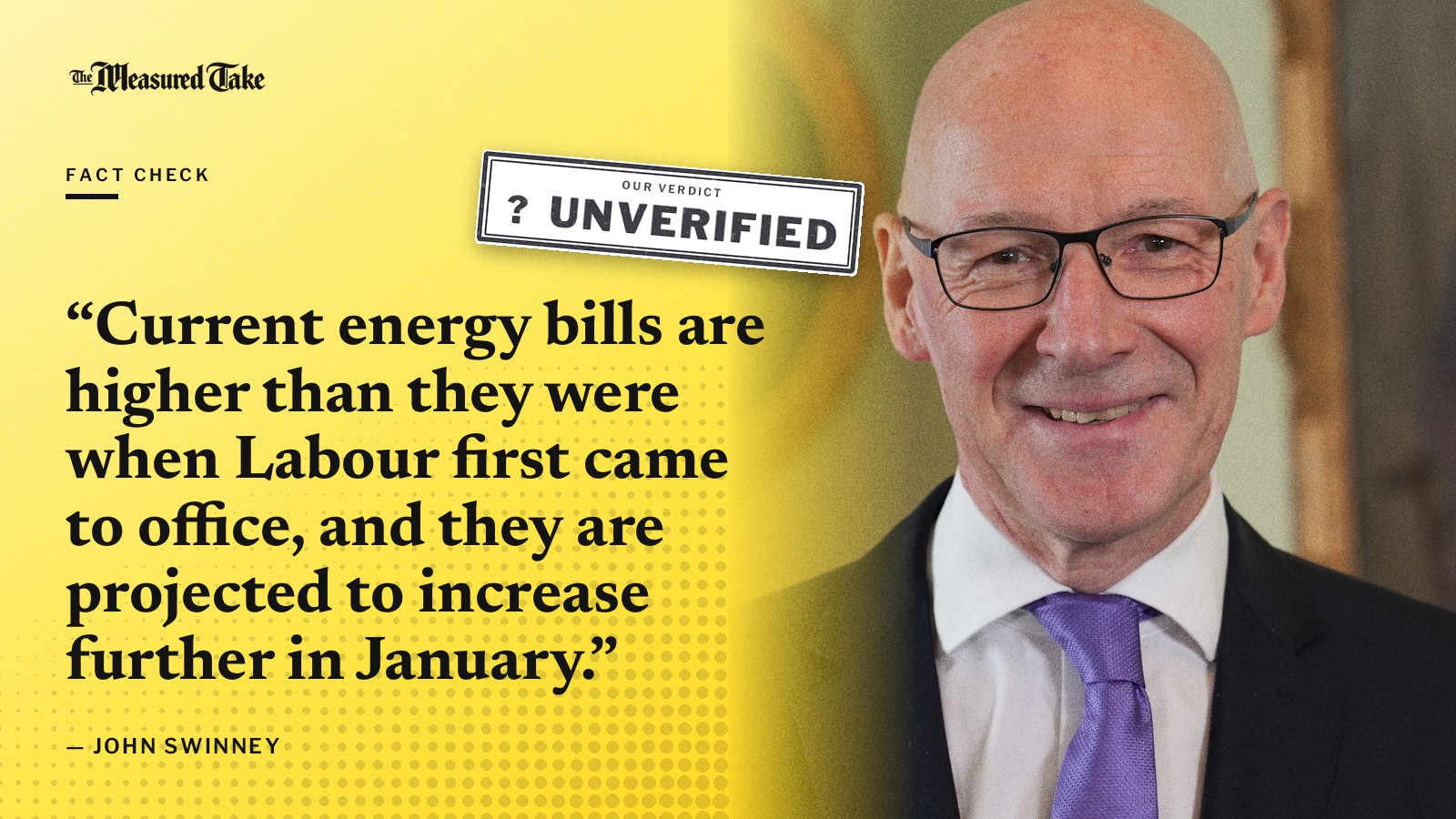
John Swinney made the claim in a news report by The Standard, published around 28 October 2026, while calling for substantial support with energy bills in the UK Budget.
Our verdict
Unverified
We could not find enough public evidence to confirm or refute this claim. John Swinney did say it, but the figures behind it — that bills are higher than in May 1997 and will rise again in January — are not backed by the sources we found.
Know something that settles it? Send us evidenceWhat we found
The claim has two factual parts: that energy bills are higher now than when Labour first came to office, and that they are projected to rise further in January. We could not verify either. The only relevant data we found was official historical electricity information, which does not directly compare average household bills in May 1997 with bills in October 2026. On the second part, a Clackmannanshire Council advice page mentions forecasts of a rise in January 2027, but it does not confirm those forecasts were published before October 2026, nor that they project higher average bills than in October 2026. The page itself stresses how uncertain energy price forecasts are. Because the factual core of the claim is not supported by the evidence we found, our verdict is unverifiable. We did confirm that Mr Swinney made the claim: a report in The Standard quotes him saying it directly.
The evidence
1 of 4 sources support the claim; none contradict it.
- Background
The Standard quotes John Swinney saying current energy bills are higher than when Labour first came to office and are projected to rise further in January. [1]
- Supports the claim
A Clackmannanshire Council advice page notes forecasts that energy prices will increase in January 2027, but it does not confirm when those forecasts were made or that they project higher average bills than in October 2026, and it highlights the uncertainty of such forecasts. [2]
- Background
An official impact assessment covers industrial electricity pricing, not household energy bills, so it does not help verify the claim. [3]
- Background
A local council treasury strategy document is unrelated to national energy bill data and does not help verify the claim. [4]
What we could not confirm
- Whether average household energy bills in October 2026 are actually higher than in May 1997, when Labour first came to office.
- Whether credible forecasts published before October 2026 projected higher average household energy bills in January 2027 than in October 2026.
How we checked
We looked at the news report carrying Mr Swinney's words, a council advice page on fuel tariffs, an official impact assessment, and a council treasury document. We could not find a direct comparison of average household energy bills between May 1997 and October 2026, or verified pre-October 2026 forecasts for January 2027 bills. If you have evidence that bears on this claim, please send it to us. We reviewed 4 relevant sources.
Sources
- [1]www.standard.co.uk · Swinney calls for ‘substantial support’ with energy bills in UK Budget
- [2]clacks.gov.uk · Fuel tariffs could save you money
- [3]legislation.gov.uk · The Renewables Obligation and Electricity Capacity (Amendment) (British Industrial Competitiveness Scheme Excluded Electricity) Regulations 2026
- [4]democracy.stratford.gov.uk · Treasury Management Strategy Statement and Annual Investment Strategy Mid-Year Review Report 2026/27
- [5]Photo: Scottish Government / Wikimedia Commons, CC BY 2.0
Help us check this claim
We could not find enough public evidence to confirm or refute this claim. If you know of an official record, dataset, transcript or report that settles it, send us the link. We review every submission and update this fact check when the evidence changes the picture.
Measured Take updates fact checks when new evidence emerges. Corrections are noted on the page.
All fact checks