“The United States' current strategy is global competition, while China's strategy is to protect its domestic market for local chipmakers.” — Jensen Huang. Our verdict: Partly True.
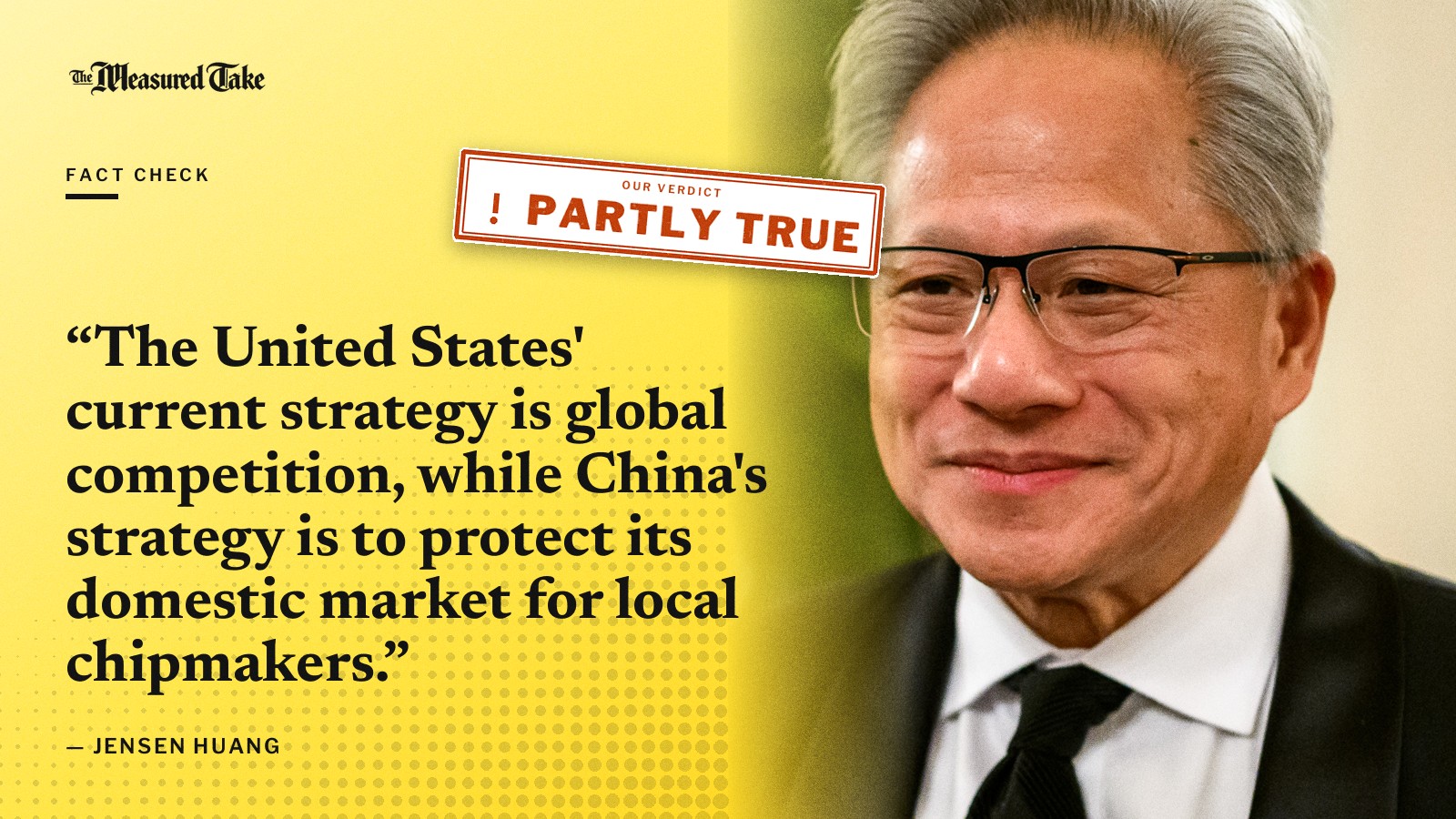
Jensen Huang made the claim in a public statement reported by Yahoo Finance, dated 14 October 2026.
Our verdict
Partly True
Jensen Huang's claim is partly true. The evidence backs up his description of the United States' strategy as one of global competition, but his description of China's strategy rests only on his own words, with no independent confirmation.
What we found
We split the claim into two parts. The first part — that the United States' strategy is global competition — is well supported. A Congressional Research Service report from 28 September 2023 describes the CHIPS Act as an effort to regain a competitive edge in the global semiconductor industry, and a 2025 article in the Harvard National Security Journal describes a global subsidy war and competition for technological superiority. The second part — that China's strategy is to protect its domestic market for local chipmakers — comes only from Jensen Huang himself, as reported by Yahoo Finance. We could not find any Chinese government or policy documents, or any other independent source, that confirm this. Because one half of the claim is supported and the other half is not, our verdict is partly true.
The evidence
2 of 4 sources support the claim; none contradict it.
- Background
Jensen Huang publicly stated that the United States' strategy is global competition and that China's strategy is to protect its domestic market. [1]
- Supports the claim
A Congressional Research Service report says the CHIPS Act is explicitly aimed at regaining a competitive edge in the global semiconductor industry, which supports the United States half of the claim. [2]
- Supports the claim
An article in the Harvard National Security Journal says the semiconductor industry is marked by a global subsidy war and competition for technological superiority, which also supports the United States half of the claim. [3]
- Background
Testimony before the House Foreign Affairs Committee gives background on United States policy debates about AI chip sales to China, but does not mention Jensen Huang or his descriptions of either country's strategy. [4]
What we could not confirm
- Whether China's strategy is in fact to protect its domestic market for local chipmakers. We found no Chinese government or policy documents, and no independent sources, that confirm this part of the claim.
How we checked
We looked at the news report carrying Jensen Huang's remarks, a Congressional Research Service report on the CHIPS Act, an academic article on semiconductor subsidies, and testimony before a House committee. We checked whether any of these independently confirmed his description of China's strategy. We reviewed 4 relevant sources.
Sources
- [1]finance.yahoo.com · Nvidia’s Jensen Huang Says US ‘Absolutely Must’ Work With China On ‘Potentially Dangerous’ AI
- [2]congress.gov · Semiconductors and the CHIPS Act: The Global Context · September 28, 2023
- [3]141.193.213.21 · CHIP SECURITY: RECONCILING INDUSTRIAL SUBSIDIES WITH WTO ... · January 1, 2025
- [4]104.18.43.50 · Oren M. Cass before the House Foreign Affairs Committee · January 14, 2026
- [5]Photo: The White House / Wikimedia Commons, Public domain
Have evidence we missed?
If you know of a source that confirms or contradicts this claim, send us the link. We review every submission and update fact checks when new evidence changes the picture.
Measured Take updates fact checks when new evidence emerges. Corrections are noted on the page.
All fact checks