“U.S. oil refining capacity decreased during the tenure of former President Joe Biden.” — JD Vance. Our verdict: False.
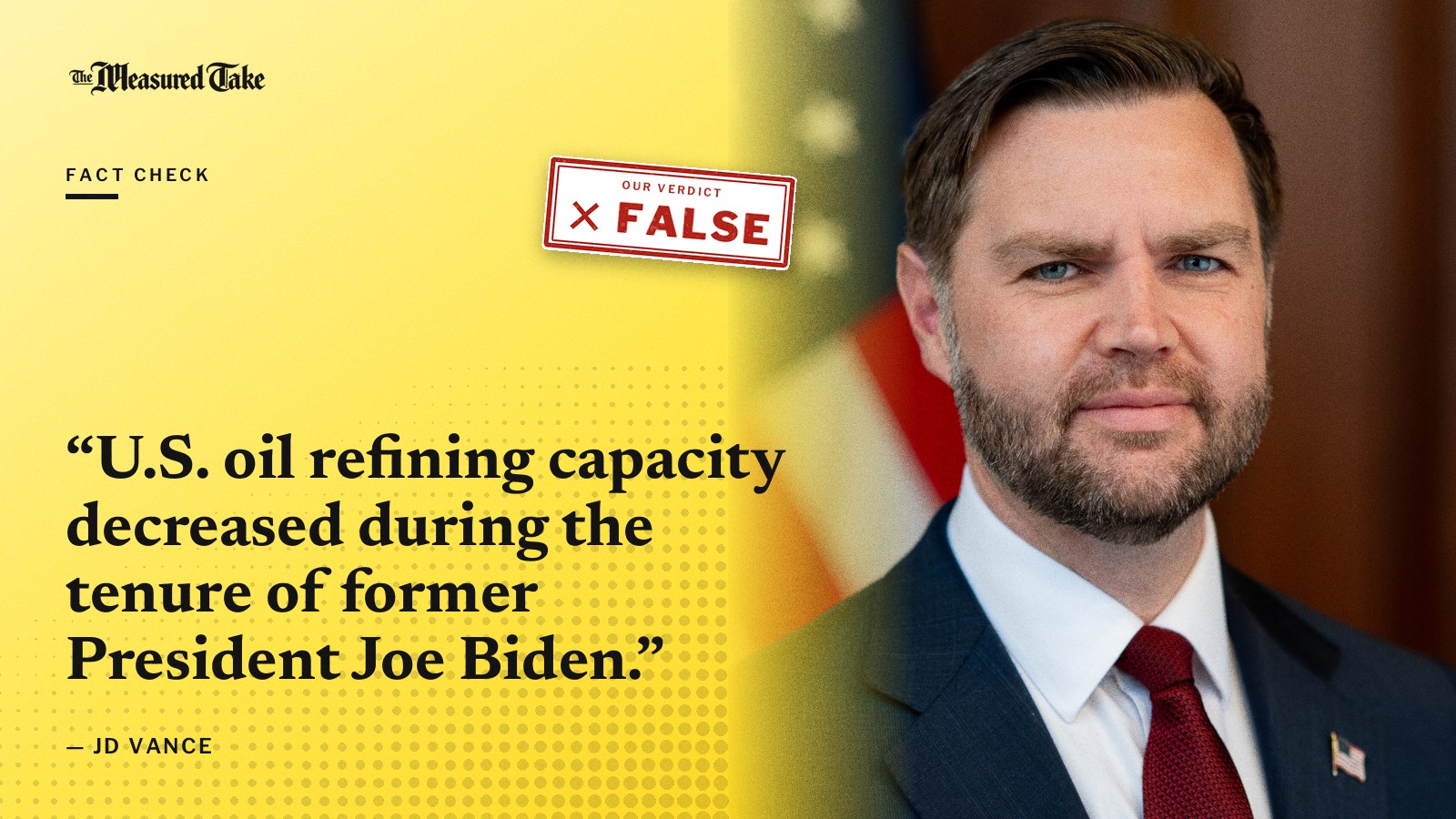
JD Vance made the claim during a CBS town hall, reported by ABC News, in which he faced questions on the Iran war, immigration and other topics.
Our verdict
False
The claim is false. Official U.S. Energy Information Administration data show that operable refining capacity rose from 18.1 million barrels per calendar day at the start of 2021 to 18.4 million barrels per calendar day on 1 January 2025, a net increase of about 1.6% across Joe Biden's term.
What we found
We checked the claim against the U.S. Energy Information Administration, the agency that publishes the official figures on American refining capacity. Its data show capacity stood at 18.1 million barrels per calendar day at the start of 2021, and at 18.4 million barrels per calendar day on 1 January 2025. That is a net rise, not a fall.
It is true that capacity dipped during 2021, as the Energy Information Administration reported in June 2022. But it then rose in each of the following years, according to the agency's reports in July 2023, June 2024 and July 2024. The overall direction across the period was upward.
Because the claim says capacity decreased over Biden's tenure, and the official figures show it increased, we rate the claim false.
The numbers
U.S. oil refining capacity in million barrels per calendar day
U.S. oil refining capacity rose from 18.1 million barrels per calendar day at the start of 2021 to 18.4 million barrels per calendar day on 1 January 2025.
The evidence
4 contradict and 2 support the claim, of 7 sources.
- Background
ABC News reported that JD Vance claimed U.S. refining capacity decreased during Joe Biden's tenure. This records the claim being made but does not establish whether it is true. [1]
- Supports the claim
The Energy Information Administration reported that U.S. operable atmospheric crude oil distillation capacity was 18.1 million barrels per calendar day at the start of 2021. [2]
- Supports the claim
The Energy Information Administration reported that U.S. refining capacity fell during the 2021 calendar year, the second consecutive annual decline. [3]
- Contradicts the claim
The Energy Information Administration reported that capacity increased between 1 January 2022 and 1 January 2023, the first rise since the COVID-19 pandemic. [4]
- Contradicts the claim
The Energy Information Administration reported that U.S. refining capacity grew by 2% in 2023, reaching 18.4 million barrels per calendar day at the start of 2024. [5]
- Contradicts the claim
The Energy Information Administration reported that U.S. refining capacity increased in 2023 through expansions at existing facilities, reaching 18.4 million barrels per calendar day at the beginning of 2024. [6]
- Contradicts the claim
The Energy Information Administration reported that U.S. operable atmospheric crude oil distillation capacity was 18.4 million barrels per calendar day on 1 January 2025, up from 18.1 million at the start of 2021. [7]
What we could not confirm
- Exact capacity figures for 20 January 2021 and 20 January 2025 are not published directly; the analysis uses 1 January values as close proxies, which introduces only minimal uncertainty.
- The assessment covers the period up to 1 January 2025 and does not include any changes after that date.
- The fact check relies on publicly available Energy Information Administration reports; any later revisions to those reports are not taken into account.
How we checked
We looked at official U.S. Energy Information Administration reports on refinery capacity, including its annual capacity figures and its reports on capacity changes in 2021, 2022, 2023 and 2025, and compared the start-of-2021 figure with the start-of-2025 figure. We reviewed 8 relevant sources.
Sources
- [1]abcnews.com · Vance faces tough questions on Iran war, immigration and more in CBS town hall
- [2]eia.gov · Refinery closures decreased U.S. refinery capacity during 2020 - U.S. Energy Information Administration (EIA) · July 8, 2021
- [3]eia.gov · U.S. refinery capacity decreased during 2021 for second consecutive year - U.S. Energy Information Administration (EIA) · June 29, 2022
- [4]eia.gov · Refinery capacity increased slightly for the first time since the COVID-19 pandemic - U.S. Energy Information Administration (EIA) · July 25, 2023
- [5]eia.gov · U.S. refinery capacity increased 2% in 2023 - U.S. Energy Information Administration (EIA) · June 18, 2024
- [6]eia.gov · U.S. refining capacity increased in 2023 with expansions at existing facilities - U.S. Energy Information Administration (EIA) · July 30, 2024
- [7]eia.gov · U.S. refining capacity largely unchanged as of January 2025 - U.S. Energy Information Administration (EIA) · June 30, 2025
- [8]Photo: Emily J. Higgins / Wikimedia Commons, Public domain
Have evidence we missed?
If you know of a source that confirms or contradicts this claim, send us the link. We review every submission and update fact checks when new evidence changes the picture.
Measured Take updates fact checks when new evidence emerges. Corrections are noted on the page.
All fact checks