“Presidents of the United States typically lose seats in midterm elections regardless of their performance or political party.” — Donald Trump. Our verdict: Partly True.
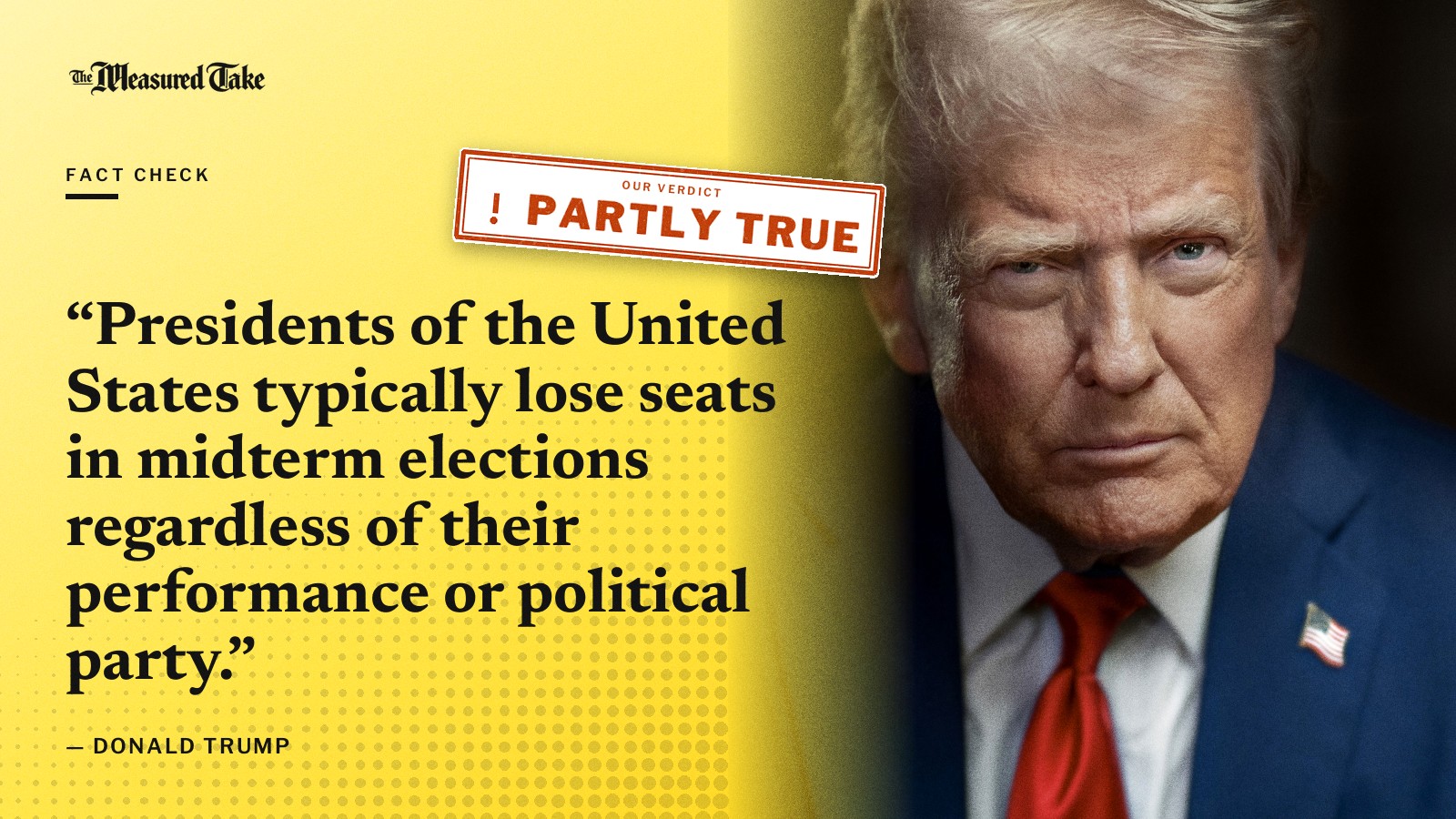
Donald Trump made the claim on 2 November 2026, as reported by Nepalnews.com.
Our verdict
Partly True
The claim is partly true: data show that the president’s party usually loses House seats in midterm elections, but we cannot confirm that this happens regardless of the president’s performance.
What we found
Historical records from the American Presidency Project and the Brookings Institution show that in 20 of 22 midterm elections since 1938 the president’s party lost House seats, a pattern that holds for both Democrats and Republicans. The House of Representatives’ own archive confirms frequent losses and notes occasional exceptions. Al Jazeera’s recent analysis echoes this trend, calling it the ‘midterm penalty.’ A study of presidential approval ratings linked to midterm outcomes is not comprehensive enough to rule out any influence of performance. Therefore, the part of the claim about the typical loss of seats is supported, while the assertion that performance is irrelevant remains unverified.
The evidence
5 of 6 sources support the claim; none contradict it.
- Supports the claim
The Brookings Institution article notes that in 20 of 22 midterm elections since 1938 the president’s party lost House seats. [1]
- Supports the claim
The American Presidency Project dataset records that the president’s party lost House seats in 20 of 22 midterm elections from 1934 to 2022. [2]
- Supports the claim
The House of Representatives’ archive shows that the president’s party often loses seats in midterms, with some exceptions such as 1934, 1954, 1998, and 2002. [3]
- Supports the claim
Al Jazeera’s article describes the ‘midterm penalty’ as a consistent pattern of seat losses for the president’s party, regardless of party affiliation. [4]
- Supports the claim
A study of presidential approval ratings shows frequent losses for the president’s party in midterms, but does not isolate performance as a decisive factor. [5]
- Background
The claim was reported by Nepalnews.com on 2 November 2026. [6]
What we could not confirm
- Whether the midterm loss occurs regardless of presidential performance or popularity.
How we checked
We examined historical seat‑loss data from the American Presidency Project, the House of Representatives archive, and analyses by the Brookings Institution and Al Jazeera, and we reviewed studies linking approval ratings to midterm outcomes. We reviewed 10 relevant sources.
Sources
- [1]Brookings Institution · What history tells us about the 2026 midterm elections · August 28, 2025
- [2]The American Presidency Project · Seats in Congress Gained/Lost by the President's Party in Mid-Term Elections
- [3]history.house.gov · Majority Changes in the House of Representatives, 1856 to Present
- [4]aljazeera.com · How the president’s party has fared in every US midterm election since 1946 · November 2, 2026
- [5]cardinalscholar.bsu.edu · Presidential Approval Ratings on Midterm Elections
- [6]english.nepalnews.com · Trump says presidents usually lose midterms, regardless of whether they are ‘great’ or ‘lousy’
- [7]Photo: Daniel Torok / Wikimedia Commons, Public domain
Have evidence we missed?
If you know of a source that confirms or contradicts this claim, send us the link. We review every submission and update fact checks when new evidence changes the picture.
Measured Take updates fact checks when new evidence emerges. Corrections are noted on the page.
All fact checks