“Andy Burnham claims that council tax bands A to D cover the vast majority of the country.” — Andy Burnham. Our verdict: Unverified.
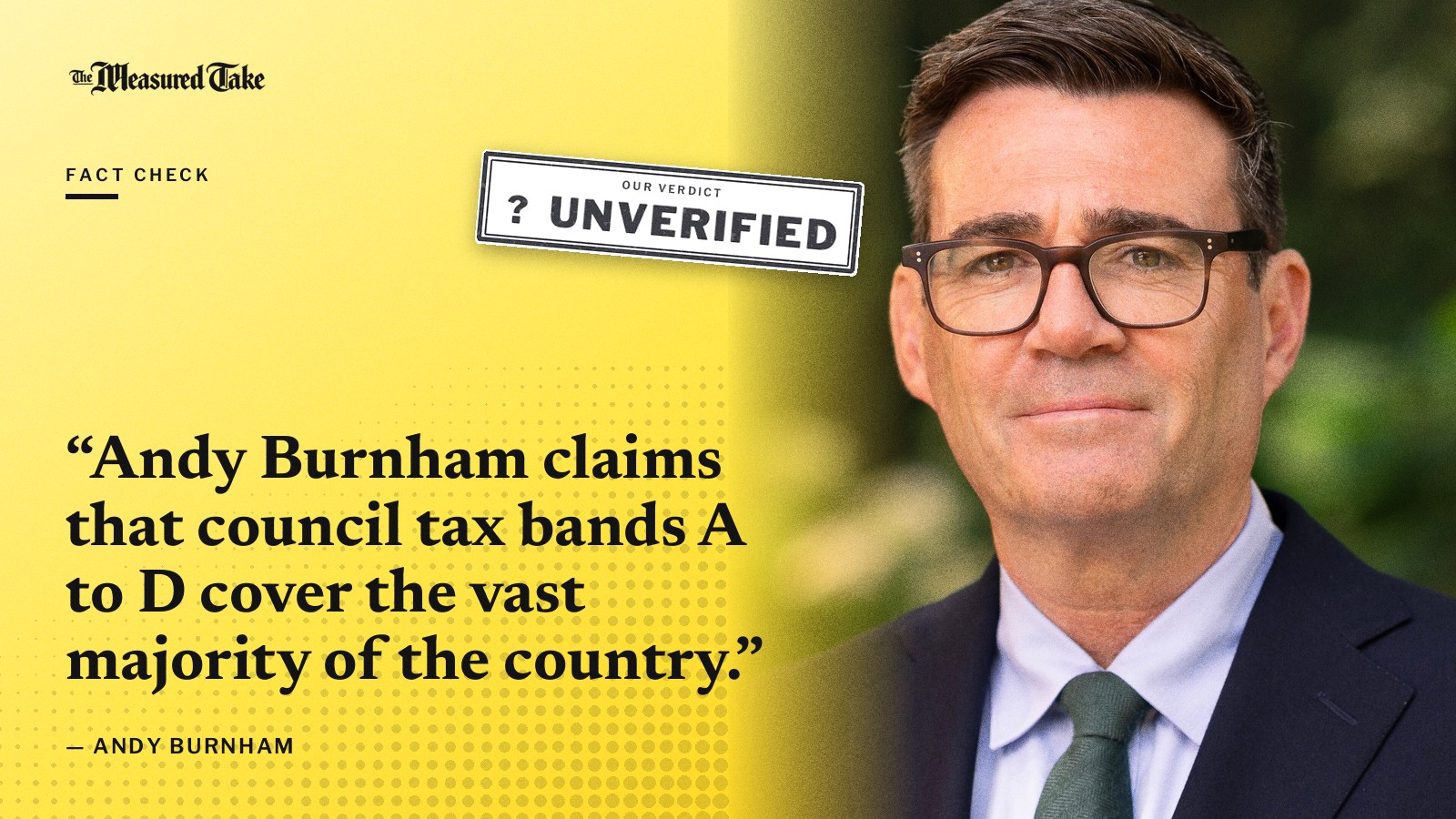
Andy Burnham made the claim on 29 October 2026, during a visit to Derby, as reported by The Irish News.
Our verdict
Unverified
Andy Burnham did say that council tax bands A to D cover the vast majority of the country, but we could not find enough public evidence to confirm or refute whether that description is accurate. The available figures cover England and Wales only, and they do not give the combined share of properties in bands A to D.
Know something that settles it? Send us evidenceWhat we found
We could not verify this claim. A news report from The Irish News on 29 October 2026 confirms that Andy Burnham made the statement during a visit to Derby, so there is no doubt about what he said. The harder question is whether bands A to D really do cover the vast majority of homes. The figures we found from the UK government cover England and Wales only, and even there they do not set out the combined share of properties in bands A to D. We also looked at material from the Scottish Government, which explains that public debate often mixes up average bills with band distributions, but it does not give the band figures we needed. Nothing we found covers Northern Ireland, which uses a different system of domestic rates, and nothing gives a UK-wide total. Without that, we cannot say whether the claim is accurate.
The evidence
3 of 4 sources support the claim; none contradict it.
- Background
The Irish News reports that Andy Burnham said council tax bands A to D cover the vast majority of the country during a visit to Derby on 29 October 2026. [1]
- Supports the claim
Official statistics give the distribution of properties by council tax band for England and Wales as of March 2025, but they do not provide the combined share of properties in bands A to D. [2]
- Supports the claim
An earlier release of the same statistics gives a breakdown of properties by council tax band in England and Wales, but again the combined proportion for bands A to D is not set out in the material we saw. [3]
- Supports the claim
The Scottish Government explains that public discussion of council tax often confuses average bills with band distributions, and that official answers distinguish between the two. This does not give the band figures needed to test the claim. [4]
What we could not confirm
- Whether bands A to D cover the vast majority of homes across the UK as a whole.
- The share of properties in bands A to D in England and Wales combined.
- The distribution of properties by council tax band in Scotland.
- How Northern Ireland's domestic rates system affects the picture, since it does not use council tax bands.
- Independent confirmation of the quote beyond the news report.
How we checked
We looked at the news report carrying the quote and at official statistics on the stock of properties by council tax band for England and Wales, along with Scottish Government material on council tax banding. We could not find any source giving a UK-wide figure for the share of homes in bands A to D. We reviewed 4 relevant sources.
Sources
- [1]www.irishnews.com · Burnham defends £100 energy payment as ‘real help’ in face of soaring bills · October 29, 2026
- [2]gov.uk · Council Tax: stock of properties statistical commentary · May 22, 2026
- [3]gov.uk · Council Tax: stock of properties statistical commentary · October 7, 2024
- [4]gov.scot · Council Tax banding queries: FOI release · May 18, 2026
- [5]Photo: Prime Minister's Office / Wikimedia Commons, OGL 3
Help us check this claim
We could not find enough public evidence to confirm or refute this claim. If you know of an official record, dataset, transcript or report that settles it, send us the link. We review every submission and update this fact check when the evidence changes the picture.
Measured Take updates fact checks when new evidence emerges. Corrections are noted on the page.
All fact checks