Artemis II Record: Tiangong Farthest From Crew
On April 6, Artemis II reached 406,771 km from Earth, a new distance record, but calculations show China’s Tiangong station was 419,643 km from the crew, making it the farthest human‑occupied object.
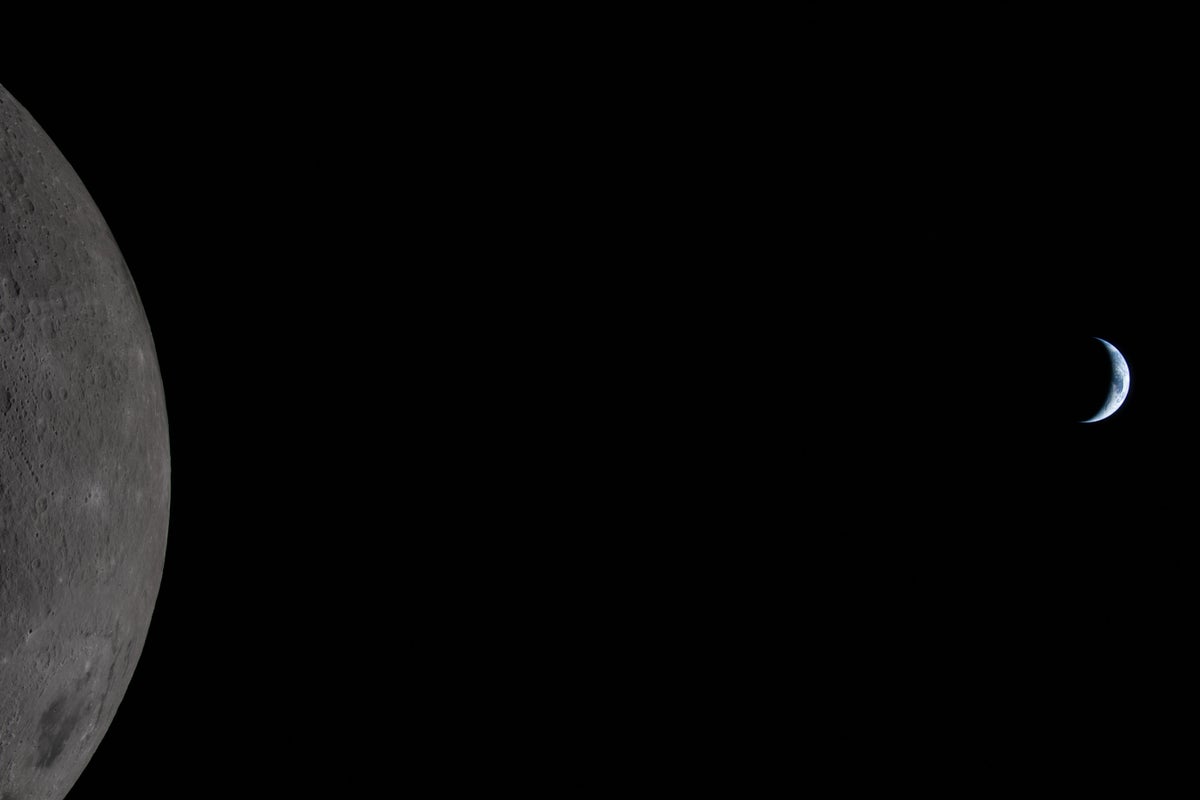
Taken 36 minutes before Earthset, our home planet is visible in the blackness of space off the limb of the illuminated Moon. Earth is in a crescent phase, with sunlight coming from the right. Orientale mare basin, with its dark floor of cooled lava and outer rings of mountains, covers nearly the lower third of the imaged lunar surface. Different colors in the mare hint at its mineral composition. The lines of small indentations above Orientale are secondary crater chains, formed by material ejected during a violent primary impact. Both of the new craters that the Artemis II crew has suggested names for – Integrity and Carroll – are in full view. The edge of the visible surface of the Moon is called the “lunar limb.” Seen from afar, it almost looks like a circular arc – except when backlit, as in other images captured by the Artemis II crew.
**TL;DR:** On April 6, Artemis II reached 406,771 km from Earth, a new record, but at that moment China’s Tiangong station lay 419,643 km from the crew, making it the farthest human‑occupied object.
## Context The Artemis II mission launched with four astronauts aboard Orion, aiming to test the spacecraft’s systems on a lunar flyby. On the sixth day, the capsule passed behind the Moon and attained its greatest distance from Earth at 7:02 p.m. EDT. NASA administrator Jared Isaacman praised the crew for pushing Orion, the Space Launch System, and human exploration farther than ever before.
Although the distance record was celebrated in real time on Earth, the actual moment occurred while Orion was behind the Moon, out of radio contact. Millions watched a livestream of the capsule’s approach, but none saw the peak distance because it happened during the communications blackout. This geometry meant that other human‑occupied spacecraft could be farther from the crew even though they were closer to Earth.
## Key Facts At the peak distance of 406,771 km, astrophysicist Jonathan McDowell calculated the separation to the International Space Station as 419,581 km and to China’s Tiangong space station as 419,643 km. The difference of about 62 km places Tiangong slightly farther, making it the most remote human‑occupied object from the Artemis II crew at that instant. In relative terms, Tiangong was roughly 0.015 % farther than the Earth‑based distance mark.
McDowell’s method used publicly available orbital elements from NORAD and space‑track.org, converted timestamps to a common reference frame that accounted for relativistic time‑scale differences and Earth’s axial precession. He then applied straightforward geometry—treating each spacecraft as a point in three‑dimensional space—to compute moment‑to‑moment distances as Orion reached its apogee. The result shows that the ordering of distance can shift quickly due to the stations’ 90‑minute orbital periods.
## What It Means The finding shows that “farthest from Earth” does not always equal “farthest from all humans” because other crews orbit the planet at different phases. As more nations operate stations and plan deep‑space missions, such cross‑vehicle distance records will become more common. This highlights the need for coordinated tracking systems when planning future lunar or Mars missions.
Watchers should watch for upcoming Artemis III lunar landing and the next crewed Tiangong rotations (Shenzhou 22) to see which vehicle claims the new “farthest from humanity” mark. Continued improvements in deep‑space navigation will likely reduce uncertainties in these measurements.
Conversation
Reader notes
Loading comments...