Notius Labs Founder Says Team Structure Outweighs AI Model Choice
Chris Lovejoy of Notius Labs says team structure and domain expertise matter more than AI models, introducing a three‑role framework for better AI product development.
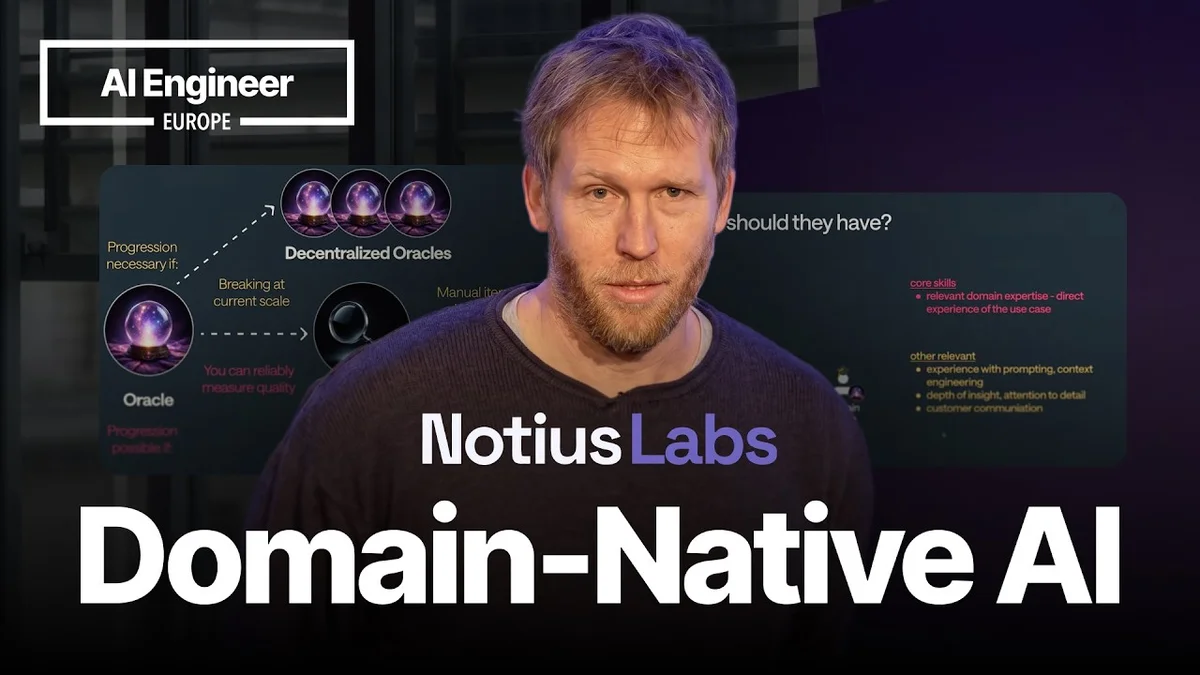
Chris Lovejoy on Building Domain-Native AI Organizations
Chris Lovejoy of Notius Labs says that how a team is organized and the domain knowledge it holds matter more than the AI models they use. He shared a three-role framework—Oracle, Evaluator, Architect—to help companies build better AI products.
At the AI Engineer Europe event in London, Lovejoy presented his view that successful AI products stem less from the sophistication of underlying models and more from how expertise is woven into the development process. He argued that many teams over‑invest in model tuning while neglecting the structures that let domain specialists shape the work.
The AI Engineer Europe conference, held annually in London, draws practitioners from industry and academia focused on practical AI implementation. This year’s agenda included talks on model optimization, data pipelines, and team structures.
Lovejoy introduced a framework with three distinct roles. The Oracle role puts domain experts directly into the AI workflow, for example by crafting prompts or curating training data; prompt engineering is the practice of designing inputs that steer a model’s responses.
The Evaluator role defines quality benchmarks and builds measurement systems, using metrics such as accuracy, precision, or error rates to judge performance. The Architect role creates automated feedback loops that capture model outputs, compare them against the benchmarks, and trigger retraining or adjustments without manual intervention. Lovejoy noted that the three roles can be filled by existing staff or new hires, depending on the organization’s size.
By separating expertise into these functions, companies can reduce bottlenecks caused by waiting for data scientists to interpret business needs. The model becomes a tool that is continuously refined by people who understand the problem space, rather than a black box tuned in isolation.
This approach also makes it easier to scale AI efforts across different domains because the same structural pattern can be replicated with new Oracles, Evaluators, and Architects. He also suggested that companies start with a pilot team to test the framework before broader rollout.
Expect more firms to pilot the Oracle-Evaluator-Architect model and report on how it affects development speed and product accuracy over the next six to twelve months.
Continue reading
More in this thread
Conversation
Reader notes
Loading comments...