Domain Expertise Beats AI Models: Notius Labs Founder Shares Three‑Role Framework
Chris Lovejoy of Notius Labs argues that organizational structure and domain knowledge matter more than AI models, introducing a three‑role framework—Oracle, Evaluator, Architect—for building effective AI solutions.
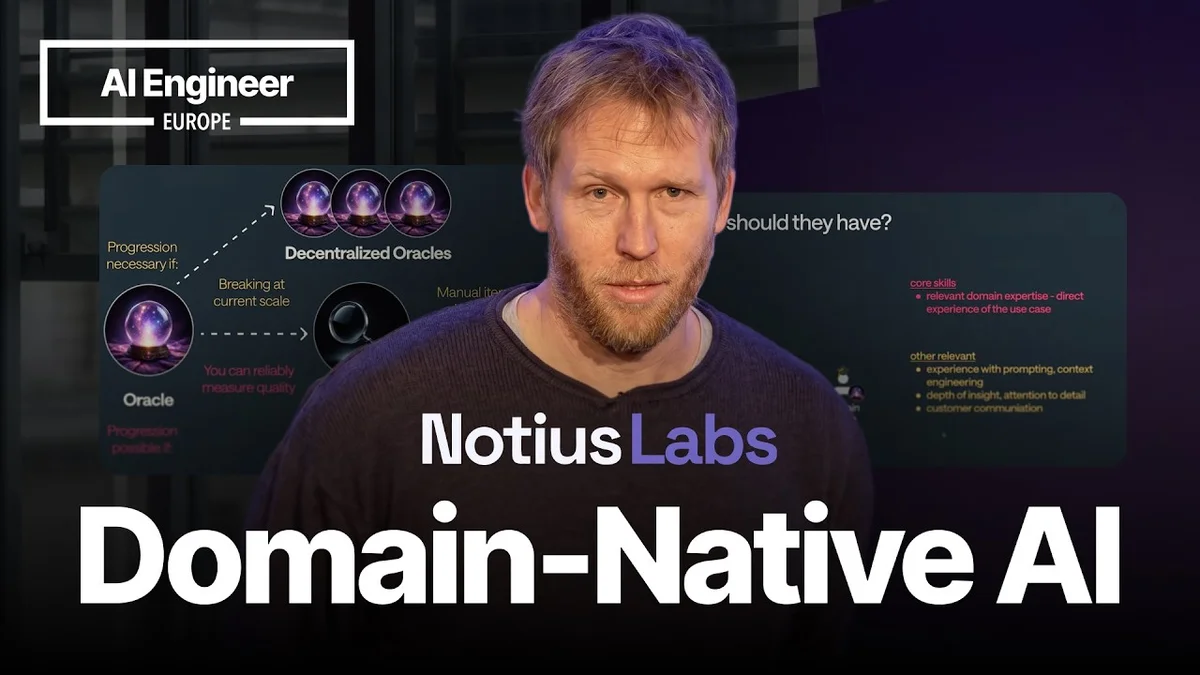
Chris Lovejoy on Building Domain-Native AI Organizations
TL;DR: Chris Lovejoy of Notius Labs argues that team structure and domain knowledge matter more than the AI models themselves. He introduces a three‑role framework—Oracle, Evaluator, Architect—to embed expertise into AI projects.
Context: At the AI Engineer Europe conference, Lovejoy challenged the prevailing focus on model size and performance. He said that how an organization is built and how domain knowledge is woven into AI work determines success more than the underlying algorithms.
Lovejoy, founder of Notius Labs, shared these insights during his talk 'How to Leverage Domain Expertise to Build Better AI Products.' The audience included engineers, product leaders, and researchers seeking practical guidance on AI adoption.
Key Facts: Lovejoy stated that organizational structure and domain knowledge integration are more important than the AI models themselves for successful AI solutions. He proposed a framework with three roles—Oracle, Evaluator, and Architect—for organizing AI teams around domain expertise. The Oracle role embeds domain expertise into AI applications via prompt engineering or curated data.
The Evaluator role focuses on defining and measuring AI quality, establishing metrics and systems to track performance. Finally, the Architect role designs systems that enable continuous learning and improvement through automated feedback loops. Together, these roles create a loop where expertise is injected, outcomes are judged, and infrastructure evolves.
What It Means: The framework shifts attention from chasing the latest model to building teams that can translate specialist knowledge into usable AI. Companies adopting the Oracle, Evaluator, Architect structure may see faster iteration and clearer accountability for AI outcomes.
By formalizing how expertise is captured, measured, and fed back, organizations can reduce reliance on trial‑and‑error model tuning. This approach could also help bridge the gap between data scientists and subject‑matter experts in industries such as healthcare, finance, and manufacturing. Early adopters report that having a dedicated Oracle reduces misalignment between model outputs and real‑world requirements.
What to Watch Next: Watch for pilot implementations of the three‑role model in upcoming AI product launches and whether they deliver measurable gains in deployment speed and accuracy.
Continue reading
More in this thread
Conversation
Reader notes
Loading comments...