NOAA Scientists Identify Golden Orb as Deep-Sea Anemone Remnant
Researchers solve a three‑year mystery: a golden mass found over two miles deep is dead tissue from a giant deep‑sea anemone. Details inside.
TL;DR
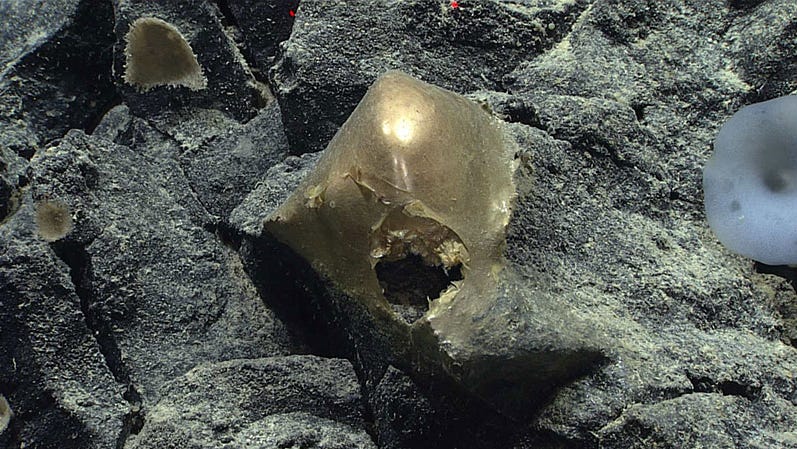
Scientists have confirmed that a mysterious golden mass found more than two miles deep in the Gulf of Alaska in 2023 is the leftover tissue of a giant deep‑sea anemone called Relicanthus daphneae. The identification ended a three‑year investigation that combined anatomy, genetics, and bioinformatics.
Context In 2023, a NOAA remotely operated vehicle captured images of a smooth, dome‑shaped golden object attached to a rock at a depth exceeding 3,200 meters. Initial guesses ranged from an egg case to a sponge fragment, sparking public curiosity. The specimen was retrieved and sent to the Smithsonian Institution’s National Museum of Natural History for further study.
Key Facts Researchers used morphological examination to note the object’s texture and attachment point, then extracted DNA for barcoding. When the first barcode proved inconclusive, they performed whole‑genome sequencing, revealing animal DNA with a strong signal from Relicanthus daphneae. Mitochondrial genome comparison showed greater than 99 % identity to a reference sequence of that anemone. The effort required zoologists, geneticists, deep‑sea biologists, and bioinformaticians working together for nearly three years.
What It Means The result confirms that the golden orb is not an unknown life form but a structural remnant—the basal disc—of Relicanthus daphneae, the part that anchors the anemone to hard substrate. This finding adds to the limited knowledge of deep‑sea cnidarian biology and demonstrates how combining traditional taxonomy with modern genomics can resolve enigmatic specimens. Continued exploration of the Gulf of Alaska and similar habitats may uncover more cryptic structures that clarify deep‑sea ecosystem functions. Watch for upcoming NOAA expeditions that will target unexplored seafloor ridges, aiming to link such biological remnants to broader patterns of biodiversity and geochemical cycling.
Continue reading
More in this thread
South Dakota Report Details 2°F Temperature Increase, Urges Climate Action
Dr. Leo Tanaka
Advocates Flood Capitol Hill as Congress Rejects NASA Budget Cuts, Calls for $9B Science Funding
Dr. Leo Tanaka
White Sands Missile Range: A Key Site for Space Shuttle Landings and Deep Space Mission Testing
Dr. Leo Tanaka
Conversation
Reader notes
Loading comments...