NIST's Ten‑Year Big G Experiment Yields New Data but Leaves Gravity Constant Unsettled
NIST's decade‑long Big G measurement published in Metrologia adds a data point but leaves the gravitational constant uncertainty unchanged.
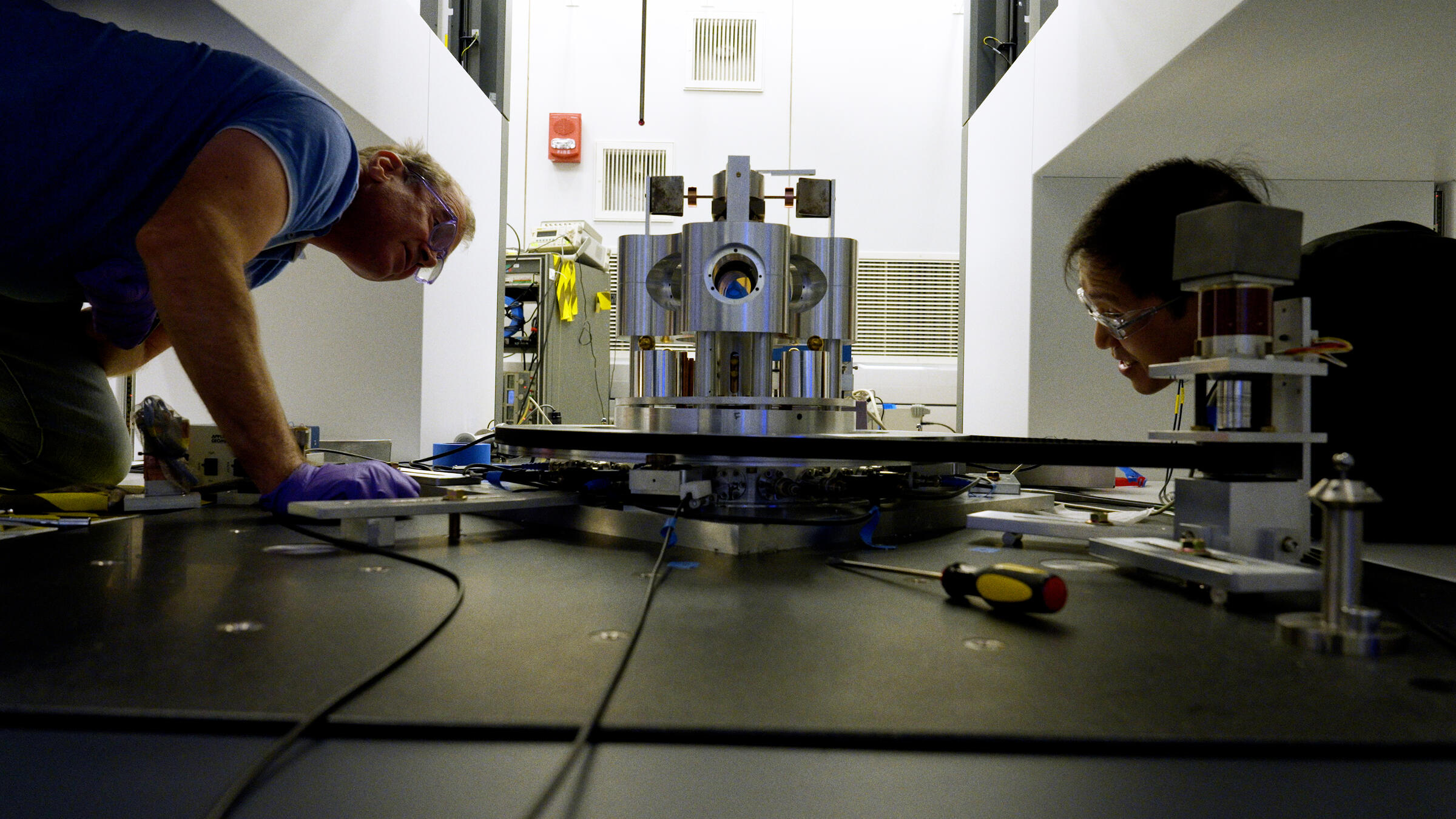
Wide shot shows two researchers on either side of a scientific device made of metal cylinders, peering closely at it.
TL;DR
NIST released a new measurement of Big G after a ten‑year replication effort. The figure adds to the existing spread but does not resolve the discrepancy.
Context The gravitational constant, known as Big G, sets the strength of gravity between two masses. Its value is known only to about one part in ten thousand, far less precise than other fundamental constants. Scientists have struggled to improve this because gravity is extremely weak and easily masked by local disturbances.
Key Facts NIST researchers announced their latest Big G value in a peer‑reviewed paper published in the journal Metrologia. The study followed a decade‑long effort to replicate one of the most divergent recent experiments. The measurement contributes another data point, yet the overall spread of published values remains at roughly 0.01%.
What It Means The new figure does not shrink the existing uncertainty band; it simply populates it with an additional result. Physicists will continue to compare this data with other high‑precision attempts to identify systematic errors. Until the spread narrows, Big G will remain the least precise of the known constants.
Watch for upcoming results from competing groups using atom interferometry and cryogenic torsion balances, as they may reveal whether the current discrepancies stem from hidden biases or genuine variability in the constant.
Continue reading
More in this thread
Conversation
Reader notes
Loading comments...