NIST’s Decade‑Long Study Refines Big G Measurement
NIST’s ten‑year study adds a new data point to the elusive Big G measurement, published in Metrologia, with values differing by only 0.01 %.
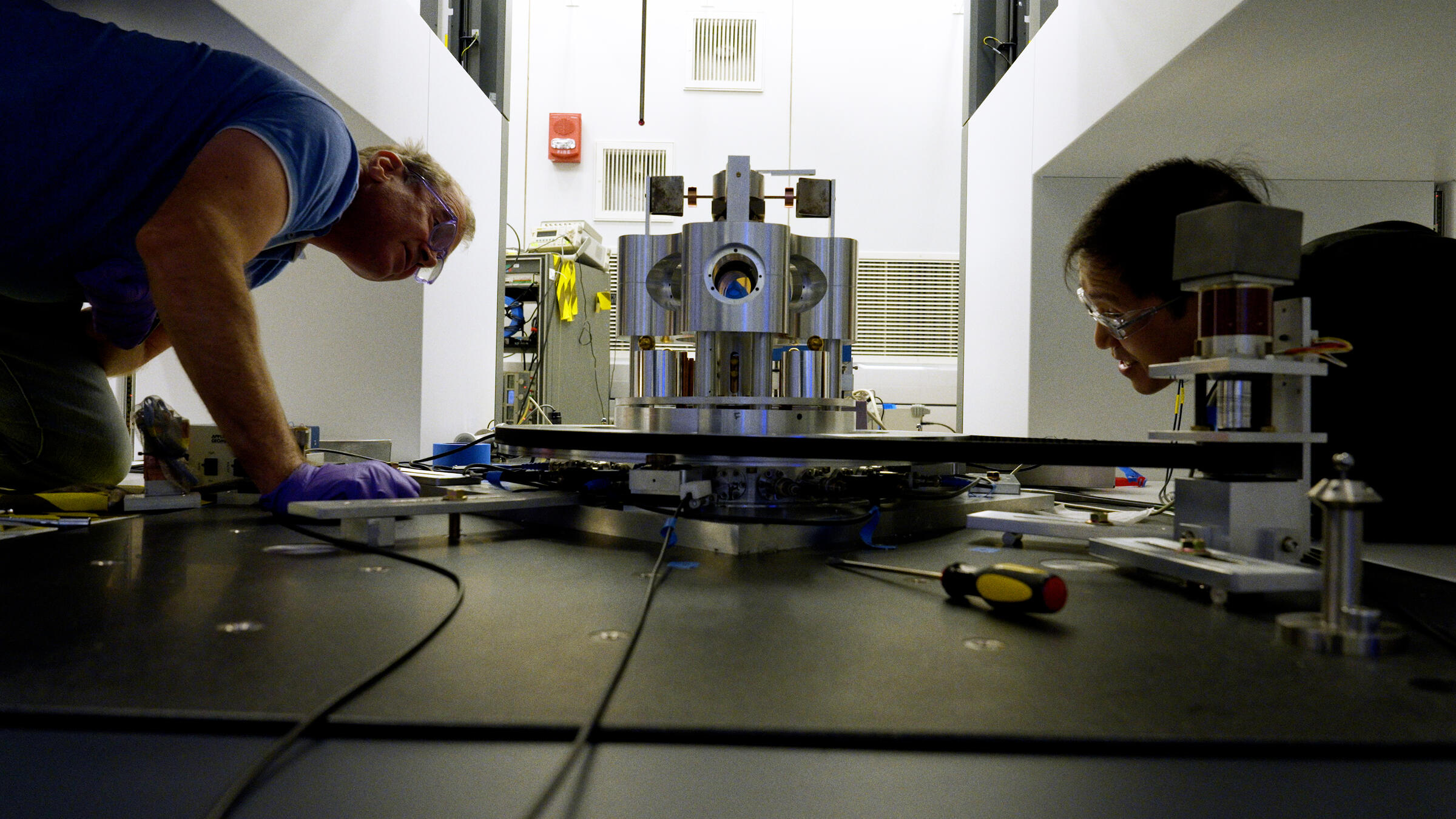
Wide shot shows two researchers on either side of a scientific device made of metal cylinders, peering closely at it.
TL;DR: NIST’s ten‑year effort to measure Newton’s gravitational constant, Big G, adds another data point to a field where values differ by only 0.01 %. The result, published in *Metrologia*, does not close the gap but refines the ongoing quest for precision.
Context: The gravitational constant describes how strongly masses attract each other and is notoriously difficult to measure because gravity is the weakest fundamental force. Laboratory measurements are masked by Earth’s own gravity, causing results to scatter by about one part in ten thousand. Despite centuries of effort, Big G remains the least precise of the fundamental constants.
Key Facts: NIST researchers spent the last decade replicating a divergent recent experiment and announced their findings in a *Metrologia* paper. Their measurement agrees with the existing spread of values, which varies by roughly 0.01 % (one part in 10,000). Isaac Newton first conceived the constant in the late 1600s, though the symbol “Big G” did not appear until the 1890s.
What It Means: The new figure does not resolve the discrepancy but provides an additional reference point for theorists and experimentalists. It underscores the need for innovative approaches—such as atom interferometry or space‑based tests—to push the uncertainty below the current 0.01 % level. Continued collaboration across laboratories will be essential to converge on a definitive value.
Watch for upcoming experiments using quantum sensors and micro‑gravity environments that aim to shrink the error margin further and finally settle the value of Big G.
Continue reading
More in this thread
Roman Space Telescope Ready for September Launch, Will Deliver 1.4 TB/Day Using Repurposed Spy-Satellite Optics
Dr. Leo Tanaka
NIST's Ten‑Year Big G Experiment Yields New Data but Leaves Gravity Constant Unsettled
Dr. Leo Tanaka
AI Model Detects Lion Roars from Collar Movement Data
Dr. Leo Tanaka
Conversation
Reader notes
Loading comments...