Dartmouth Releases AI Guidelines After Professor’s Claude Data Leak
Following a accidental student data leak via Dartmouth’s Claude portal, the college released nine generative AI guidelines and emailed them to campus, emphasizing caution and human oversight.
TL;DR
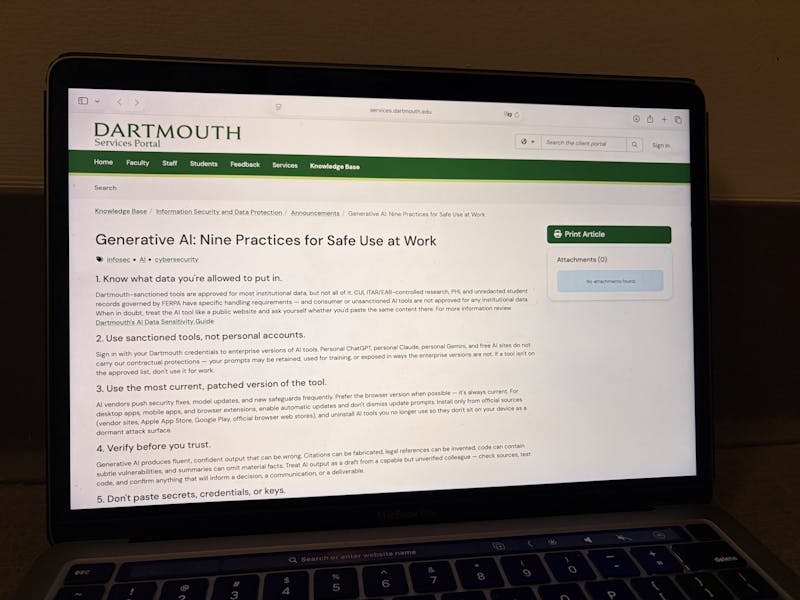
Dartmouth’s ITC office released nine workplace generative AI guidelines on May 6. Six days later, after a chemistry professor accidentally leaked student data via the Claude portal, the college emailed the guidelines to campus. The message reminded users to treat AI like a public website and only input data they would share openly.
Context On May 6, the Information, Technology and Consulting office published an updated set of nine guidelines for generative AI use in the workplace. The guidelines tell community members to know what data they may put into AI chats, to keep humans in the loop for consequential decisions, and to document AI’s role in research, code, or written work. They also prohibit letting AI make decisions about people—such as admissions, grading, discipline, accommodations, or hiring—without human review.
Special note is given to FERPA‑protected student records, which must be handled as if they were posted on a public site. ITC said the guidelines reflect the college’s ongoing commitment to responsible AI use and are meant as general best practices for safe and effective tool use. The nine points also advise users to verify AI outputs for bias and to store prompts and results for accountability.
Key Facts - ITC released the nine guidelines on May 6. - VOX Daily emailed the guidelines to the Dartmouth community on May 13, six days after The Dartmouth reported that a chemistry professor unintentionally released student problem sets through the Claude enterprise portal while testing the tool’s grading capabilities. - In the announcement, VOX Daily quoted the core advice: “Keep your friends close, keep your AI closer,” and explained that users should ask themselves whether they would share the same information publicly before entering it into any generative AI system. - The Dartmouth could not confirm whether the leak constituted a FERPA violation, but noted that student submissions on Canvas generally fall under FERPA protections. - ITC’s statement to The Dartmouth emphasized that the guidelines help community members use AI tools safely and effectively. - English professor James Dobson called the advice generally good and said more platform‑specific guidance and literacy training are a clear need. - Computer science professor Tim Tregubov warned that faculty who expect students to avoid AI should not grade homework with AI themselves. - Learning fellow Theo Chan said instructors should hold themselves to the same transparency standard they require of students. - The college has not disclosed any disciplinary action related to the incident.
What It Means The leak exposed a practical need for clearer AI handling rules on campus. By circulating the guidelines swiftly, Dartmouth seeks to close that gap and reinforce a culture of caution when using generative AI tools. Faculty and staff are now expected to label any AI‑generated contribution in their work and to ensure a human reviews any decision that affects individuals.
The incident also underscores the demand for more platform‑specific training, as noted by professors who called for literacy sessions tailored to tools like Claude. If faculty adopt the guideline to document AI’s role, it could improve transparency in grading and research outputs. Adherence to the “keep humans in the loop” rule may slow some automated workflows but aims to protect student privacy.
The college’s quick response shows an intent to prevent repeat incidents while balancing innovation with compliance. Clear documentation may also aid future audits of AI use across departments.
What to watch next Watch for Dartmouth’s rollout of targeted AI literacy workshops and any updates to the guidelines as the college monitors compliance and feedback from the campus community. Additionally, observe whether the college adopts a formal process for reporting accidental data exposures involving AI tools. Finally, track how departments implement the documentation requirement and whether it influences perceptions of AI use in academic work. A possible timeline for the first training session is expected within the next six weeks, according to internal communications.
Continue reading
More in this thread
Conversation
Reader notes
Loading comments...