Dartmouth Issues AI Use Rules After Professor Leaks Student Data
Dartmouth College releases AI use policies following a professor's accidental student data exposure, emphasizing FERPA compliance and human oversight.
TL;DR
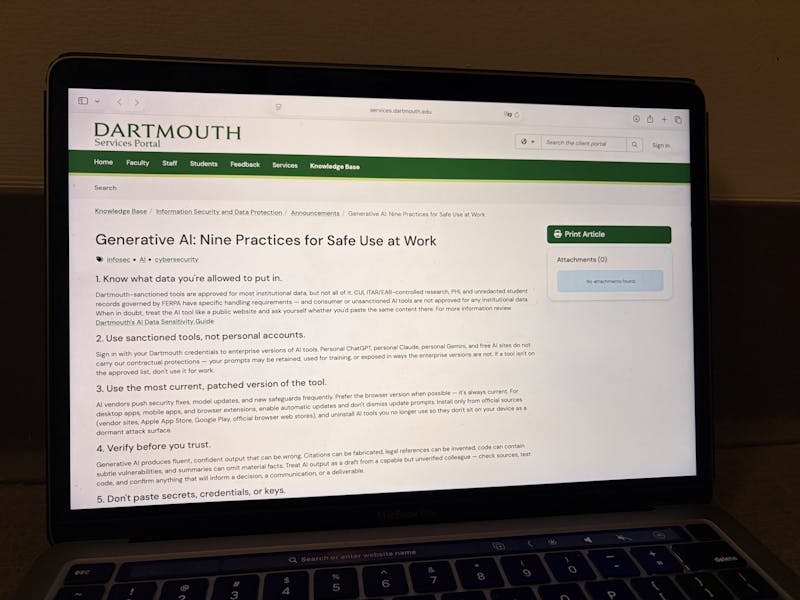
Dartmouth College posted nine generative‑AI guidelines after a chemistry professor unintentionally shared student information via an AI grading test.
Context On May 6, Dartmouth’s Information, Technology and Consulting office (ITC) posted updated AI policies on its website. The college’s newsletter, VOX Daily, emailed the rules to staff and faculty on May 13, a week after The Dartmouth reported that a professor’s test of the Dartmouth Claude portal exposed student problem sets campus‑wide.
Key Facts The new policy lists nine best‑practice points. Users must know which data they can feed into AI chats, keep humans in the loop for consequential decisions, and document AI’s role in any work product. The guidelines explicitly forbid AI from making decisions about people—such as admissions, discipline, grading, accommodations, or hiring—without human review.
FERPA, the Family Educational Rights and Privacy Act, protects student records and sets strict handling rules. The guide reminds staff that unredacted records must be treated like public‑website content: if you wouldn’t post it publicly, don’t feed it to AI. VOX Daily echoed the advice, urging, “Ask yourself, ‘Would I share this info with the public?’ If no, then don’t use GenAI.”
Faculty who ban AI for student work are also told not to grade assignments with AI. Tim Tregubov, co‑founder of the Digital Applied Learning and Innovation Lab, warned, “If you expect your students not to use AI, don’t then go around and grade their homework with AI.” English professor James Dobson called the guidance “generally good,” while noting a need for platform‑specific training.
Students assisting peers, like learning fellow Theo Chan, report mixed faculty attitudes: some prohibit AI‑generated code, others allow it for concept learning if usage is explicitly disclosed. Chan stresses that professors should hold themselves to the same transparency standards they expect from students.
What It Means The guidelines formalize Dartmouth’s stance on responsible AI, tying compliance to FERPA and reinforcing human oversight. By documenting AI contributions and restricting AI‑driven decisions about individuals, the college aims to prevent future data leaks and ensure equitable treatment. The policy also signals a broader academic shift toward clear AI usage norms.
Looking ahead, watch how Dartmouth monitors adherence to these rules and whether additional training programs emerge to address the “clear need” for platform‑specific AI literacy.
Continue reading
More in this thread
Dartmouth Releases AI Guidelines After Professor’s Claude Data Leak
Alex Mercer
NTSB Halts Public Docket After AI Recreates Crash Voices
Alex Mercer
Redlands Police Drone Helps Locate Mental‑Health Crisis Suspect During Armed Confrontation and Drug‑Gun Bust
Alex Mercer
Conversation
Reader notes
Loading comments...