AI Systems Spending Set to Hit $1.79 Trillion by 2030 as Banks and Consultancies Scale Up
AI systems market projected at $1.79 trillion by 2030; Commonwealth Bank partners with Anthropic, EY launches AI workforce platform.
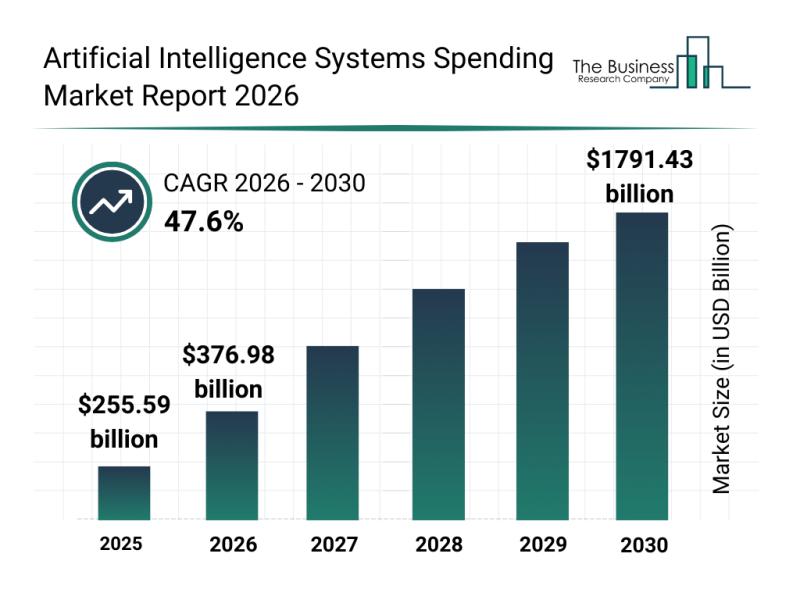
TL;DR: AI systems spending is forecast to top $1.79 trillion by 2030, with banks and consulting firms accelerating adoption through safety‑focused partnerships and AI‑powered workforce tools.
Context The global market for AI systems—hardware, software and services that power machine learning, natural language processing and computer vision—is on a rapid growth trajectory. Companies across banking, healthcare, manufacturing and retail are investing heavily to embed intelligence into core operations.
Key Facts - Market analysts project the AI systems spending market to reach $1.79 trillion by 2030, expanding at a compound annual growth rate of 47.6%. - In March 2025, Commonwealth Bank of Australia deepened its strategic alliance with Anthropic PBC, a firm specializing in large‑language models and AI safety, to fast‑track generative AI in customer‑facing services. - In October 2023, EY launched EY.AI Workforce, an AI platform built with IBM that combines IBM’s Watsonx Orchestrate automation with EY’s HR expertise to lift productivity in human‑resources functions. - Leading players such as Alphabet, Microsoft, Amazon Web Services and IBM dominate the market, driving investments in AI infrastructure, security and regulatory compliance.
What It Means The projected $1.79 trillion spend signals that AI is moving from experimental pilots to mainstream enterprise backbones. The Commonwealth Bank‑Anthropic deal illustrates a shift toward responsible AI, where financial institutions prioritize safety while exploiting generative models for personalized services. EY’s AI‑driven HR platform shows how consulting firms are packaging AI as a productivity tool, turning automation into a service offering for clients.
For hardware manufacturers, the surge in edge AI devices—processors that run AI locally on equipment—will create new demand for chips and sensors. Software vendors will see heightened interest in platforms that integrate machine‑learning models with existing IT stacks, while service providers will benefit from managed AI offerings that reduce the complexity of deployment.
Regulators are likely to tighten oversight as AI permeates critical sectors, prompting firms to allocate more budget to compliance and security solutions. Companies that can demonstrate robust AI governance will gain a competitive edge in securing contracts, especially in banking and healthcare.
Looking ahead, watch for additional cross‑industry collaborations that blend AI safety expertise with domain knowledge, and for the emergence of standardized metrics that quantify AI ROI across different business functions.
Continue reading
More in this thread
AI in Video Games Set to Reach $10.7 B by 2030, Fueled by Microsoft Deal
Alex Mercer
AI in Video Games Set to Reach $10.7 B by 2030, Boosted by Microsoft’s $69 B Activision Deal
Alex Mercer
AI‑Augmented Software Engineering Market Projected at $25 B by 2030 After JFrog‑Qwak Deal and Cognition’s Devin Launch
Alex Mercer
Conversation
Reader notes
Loading comments...