AI-driven models improve prediction of disruptive tearing modes in fusion tokamaks
Researchers show how machine learning improves forecasting of disruptive tearing modes in tokamaks, extending prediction lead times and supporting steady fusion plasma operation.
TL;DR
Machine learning models now predict tearing mode onset in tokamaks more accurately, helping keep fusion plasma stable.
Fusion reactors rely on donut‑shaped tokamaks to confine plasma heated to over 100 million °C. Tearing modes reconfigure field lines, break symmetry and eject plasma onto the vessel wall in a few milliseconds.
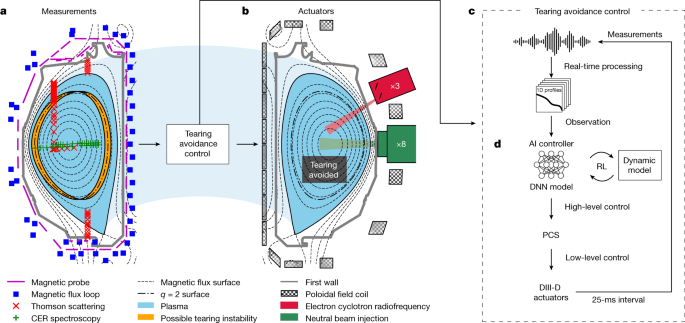
Benjamin explained that the mechanism behind tearing mode appearance is nonlinear, coupled and chaotic. He added that tearing modes are very difficult to predict with traditional physics models, but their stochastic complexity makes them attractive for machine‑learning approaches. The researchers focused on using ML to predict tearing‑mode onset, interpret onset data and develop plasma controllers that use AI‑based tearing‑stability predictors.
By applying ML to large experimental tokamak datasets, the studies surveyed in the review show that prediction lead times can be extended by several milliseconds, giving controllers enough time to act. This reduces the chance of a disruption and improves the odds of sustaining steady fusion reactions.
Next, watch for real‑time ML controllers being tested on devices such as JET and DIII‑D to see if they can prevent disruptions during long‑pulse plasma campaigns.
Continue reading
More in this thread
Mitsubishi Electric’s Soil Carbon Tech to Feed Japan’s 2027 Emissions Trading Scheme
Dr. Leo Tanaka
Ancient tooth proteins reveal Denisovan‑Homo erectus interbreeding
Dr. Leo Tanaka
Mitsubishi Electric’s Remote‑Sensing Method Measures Soil Carbon Without Sampling
Dr. Leo Tanaka
Conversation
Reader notes
Loading comments...