Kevin Warsh: Increased capital expenditure and funding activities by hyperscalers are contributing to the rise in bond yields. Our verdict: Unverified.
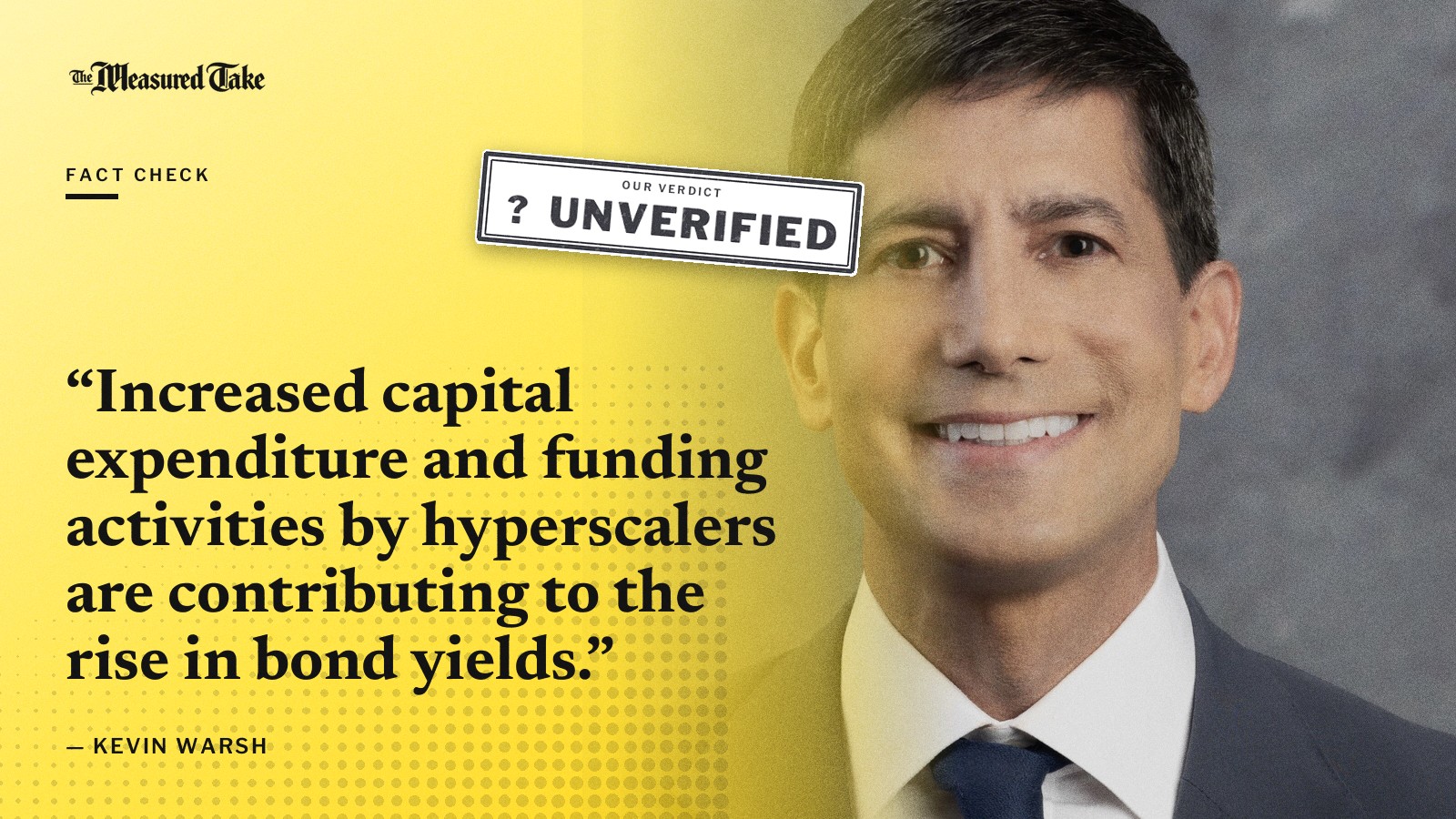
Kevin Warsh made the claim during a press conference reported by Yahoo Finance on 3 October 2026.
Our verdict
Unverified
We cannot verify this claim. While hyperscalers have sharply increased their capital spending and bond issuance, there is no public evidence proving that these activities caused the rise in bond yields.
Know something that settles it? Send us evidenceWhat we found
Kevin Warsh stated that hyperscaler spending and debt supply are pushing up bond yields. We found clear evidence that major tech firms have indeed ramped up capital expenditure and bond issuance in 2025–2026. Reports from Vanguard, Morningstar, and others confirm multi-billion-dollar funding rounds. However, the crucial part of the claim—that this activity is a cause of higher yields—remains unproven. Federal Reserve research shows that AI-related debt adds duration to the market and can influence yield dynamics, but it stops short of establishing a direct causal link. Other reports note that yields are sensitive to capex forecasts, but again only show correlation. Without a rigorous analysis that isolates the effect of hyperscaler funding from other factors like inflation, economic growth, or monetary policy, we cannot confirm the claim.
The evidence
6 sources, all background: none settles the claim either way.
- Background
Kevin Warsh said that hyperscaler capital expenditure and increased debt supply are factors contributing to the rise in long-term bond yields. [1]
- Background
Hyperscalers significantly increased their reliance on the bond market to fund capital expenditures in 2025 and 2026. [2]
- Background
Federal Reserve research indicates that AI-related debt issuance supplies duration to fixed income markets, which can influence yield curve dynamics, but does not prove it caused the overall rise in yields. [3]
- Background
Market yields have shown sensitivity to hyperscaler capex forecasts, and firms are increasingly using external funding, but this shows correlation rather than causation. [4]
- Background
In mid-2026, major hyperscalers collectively issued roughly $218 billion of investment-grade bonds to finance AI-related projects. [5]
- Background
During 2025–2026, hyperscalers executed multiple multi-billion-dollar bond issuances, pointing to a substantial increase in funding for data-centre build-outs. [6]
What we could not confirm
- No independent econometric analysis was available to prove that hyperscaler funding caused the rise in yields rather than simply coinciding with it.
- The exact total of hyperscaler bond issuance for the full year 2026 remains uncertain.
- The full context and exact wording of Kevin Warsh's remarks are based on reported excerpts, not a complete verified transcript.
How we checked
We examined public statements, financial market reports, and Federal Reserve research to see whether a causal link between hyperscaler activities and bond yields had been established. We reviewed 7 relevant sources.
Sources
- [1]linkedin.com · Long-Term Treasury Yields: Structural Capital Demand, Economic Resilience & Geopolitical Risk | Chair Kevin Warsh| Press Conference | FOMC | 02:30 PM
- [2]corporate.vanguard.com · The AI buildout comes to the bond market · August 19, 2026
- [3]dallasfed.org · How AI debt financing impacts duration supply and interest rates · February 10, 2026
- [4]cnbc.com · Bond market anxiety is growing over AI capex budgets · July 24, 2026
- [5]morningstar.com · Bond Issuance Backing AI Investment Tops $250 Billion, Testing Limits of Investor Demand
- [6]mawer.com · Extra Credit: “Hey Google, how much can I borrow before I break the bond market?” · March 18, 2026
- [7]Original statement · News report · October 3, 2026
Help us check this claim
We could not find enough public evidence to confirm or refute this claim. If you know of an official record, dataset, transcript or report that settles it, send us the link. We review every submission and update this fact check when the evidence changes the picture.
Measured Take updates fact checks when new evidence emerges. Corrections are noted on the page.
All fact checks