JD Vance: Individuals holding H-1B visas are completely subordinate to their employers and must leave the United States if they lose their jobs. Our verdict: Misleading.
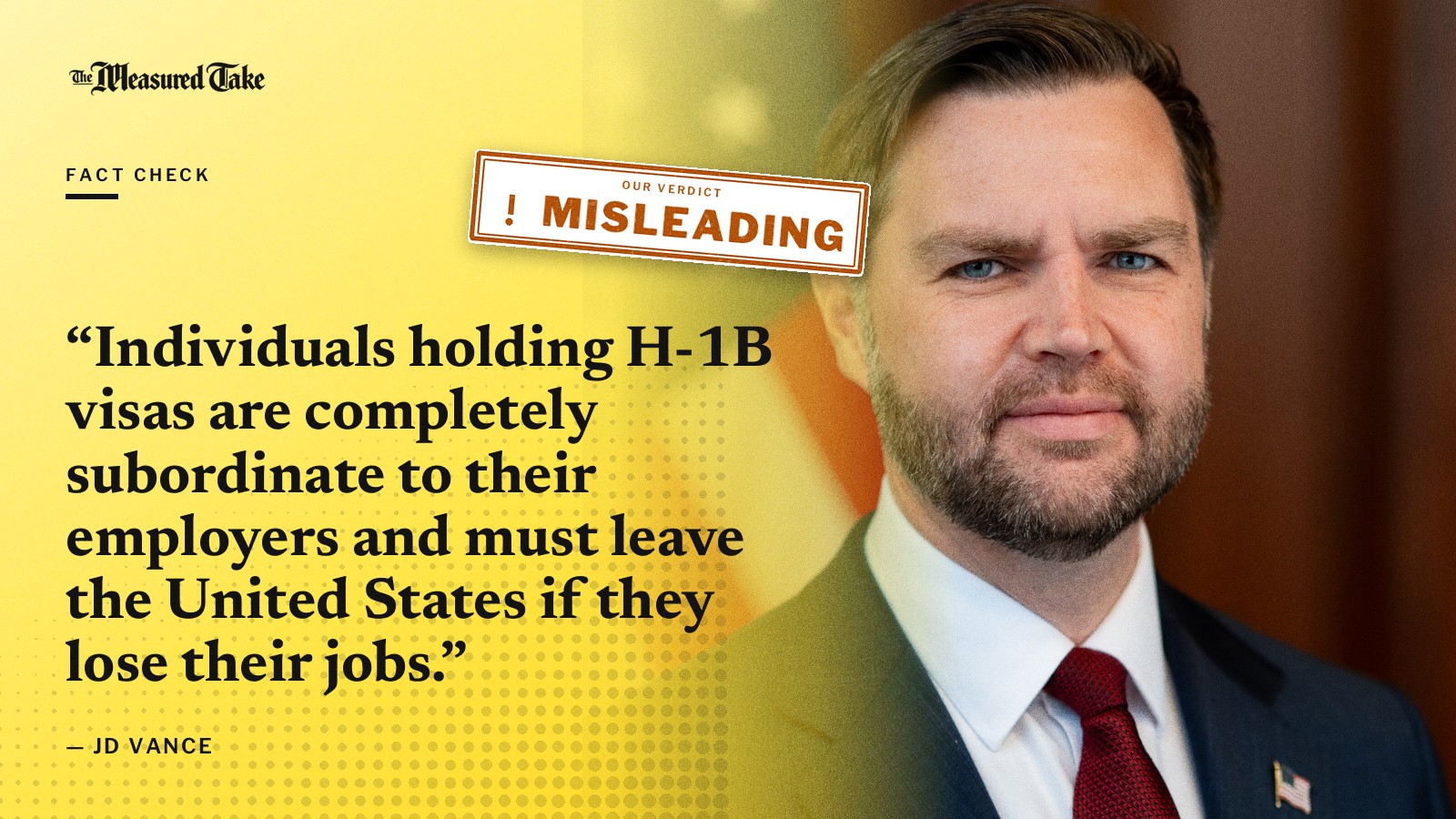
JD Vance made the remarks about H-1B visa holders in comments reported by The National on 9 October 2026, in the context of the United States barring Microsoft, Adobe and several Indian IT firms from a worker visa programme.
Our verdict
Misleading
Misleading. An H-1B worker's right to stay is tied to their employer, but a worker who loses their job has up to 60 days to find a new sponsor or change status. They do not have to leave at once.
What we found
JD Vance said at the Department of Labor that H-1B workers are "completely subordinate" to their company and that "if they lose that job, they have to leave the country", The National reported. H-1B status does depend on a sponsoring employer, so the worker's position is weaker than a citizen's. But US Citizenship and Immigration Services says a worker whose job ends gets a grace period of up to 60 days, during which they can move to a new employer, change to another status or apply to stay. Only if none of that happens must they leave. Saying they have to leave if they lose their job leaves out the main way most of them stay.
The evidence
3 contradict and 1 support the claim, of 6 sources.
- Background
The National reported that JD Vance said H-1B visa holders are "completely subordinate" to their employers and "have to leave the country" if they lose their jobs, confirming he made the claim. [1]
- Contradicts the claim
USCIS says H-1B workers are not required to leave immediately after termination. They get a grace period of up to 60 days and can change status or employers. [2]
- Supports the claim
USCIS policy allows nonimmigrants to extend their stay or change status, giving a legal route to remain in the United States beyond a specific job. [3]
- Background
A transcript of JD Vance speaking about H-1B and J-1 visa fraud does not contain the statements that H-1B holders are completely subordinate to employers or must leave if they lose their jobs. [4]
- Contradicts the claim
USCIS regulations provide a discretionary 60-day grace period for H-1B visa holders after employment ends, allowing them to remain temporarily rather than leave at once. [5]
- Contradicts the claim
USCIS FAQs state that H-1B workers have options to remain in the United States for up to, and sometimes beyond, 60 days after termination, contradicting the idea that they must leave immediately. [6]
How we checked
We looked at a news report quoting JD Vance's remarks and compared them with official USCIS guidance and FAQs on what happens to H-1B workers after their employment ends. We reviewed 6 relevant sources.
Sources
- [1]www.thenationalnews.com · JD Vance’s comments about immigrants 'unwarranted' and ‘deeply offensive’, India's Foreign Ministry says | The National · October 9, 2026
- [2]uscis.gov · Options for Nonimmigrant Workers Following Termination of Employment | USCIS
- [3]uscis.gov · Chapter 4 - Extension of Stay, Change of Status, and Extension of Petition Validity
- [4]rollcall.com · Protected: Factbase Transcripts
- [5]uscis.gov · Options for Nonimmigrant Workers Following Termination of Employment
- [6]uscis.gov · FAQs for Individuals in H-1B Nonimmigrant Status
Have evidence we missed?
If you know of a source that confirms or contradicts this claim, send us the link. We review every submission and update fact checks when new evidence changes the picture.
Measured Take updates fact checks when new evidence emerges. Corrections are noted on the page.
All fact checks