Trump and Xi Push for Open Hormuz as Iran Vows Resistance
Trump and Xi pledge to keep the Strait of Hormuz open for energy flow while Iran's foreign minister says Tehran will never bow to pressure.
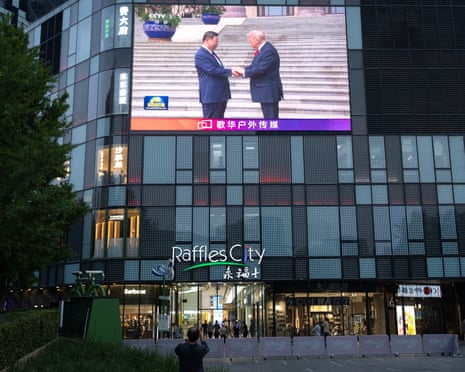
A broadcast is shown on a large screen in Beijing of Xi Jinping and Donald Trump meeting at their high-stakes summit, which finishes on Friday
TL;DR: Trump and Xi pledged to keep the Strait of Hormuz open for energy flow, even as Iran’s foreign minister warns the nation will not bow to external pressure.
The White House confirmed that President Donald Trump and President Xi Jinping discussed the strategic importance of the Strait of Hormuz during Trump’s recent China visit. Xi emphasized that the waterway “must remain open to support the free flow of energy,” underscoring Beijing’s interest in stable oil shipments.
Iran’s foreign minister, Abbas Araghchi, responded by reiterating Tehran’s stance against coercion. He told BRICS members—Brazil, Russia, India, China, and South Africa—to condemn what he called an illegal US‑Israel war on Iran, and declared that Iranians will “never bow to any pressure.” Araghchi added that no military solution exists for disputes with Tehran.
The Hormuz Strait, a narrow passage between Oman and Iran, carries roughly a fifth of the world’s petroleum. Any disruption can spike global oil prices and affect supply chains. China’s agreement with the United States signals a rare convergence of two major powers on a shared economic interest, despite broader geopolitical tensions.
Iran’s warning reflects its broader strategy of resisting sanctions and diplomatic pressure. By invoking BRICS, Tehran seeks to rally support from nations that often challenge Western dominance. The minister’s statement also signals that Iran will not entertain military escalation as a means to resolve the dispute.
What it means: The U.S.‑China alignment on Hormuz could help stabilize energy markets, but Iran’s defiant posture suggests continued diplomatic friction. Watch for any BRICS response and for further statements from Tehran that could affect shipping security in the region.
Continue reading
More in this thread
Fact Check: Virginia Governor Did Not Veto Collective‑Bargaining Bill for 500,000 Workers
Nadia Okafor
Israeli Ultranationalists Chant Racist Slogans at Jerusalem Day March
Nadia Okafor
Fact Check: Abigail Spanberger Did Not Veto Virginia Collective Bargaining Bill
Nadia Okafor
Conversation
Reader notes
Loading comments...