Trump Leads US CEOs to Beijing to Secure Tech and Auto Market Access
Trump brings top US CEOs to China to negotiate market access for electric vehicles, chips and renewable energy amid ongoing trade tensions.
TL;DR
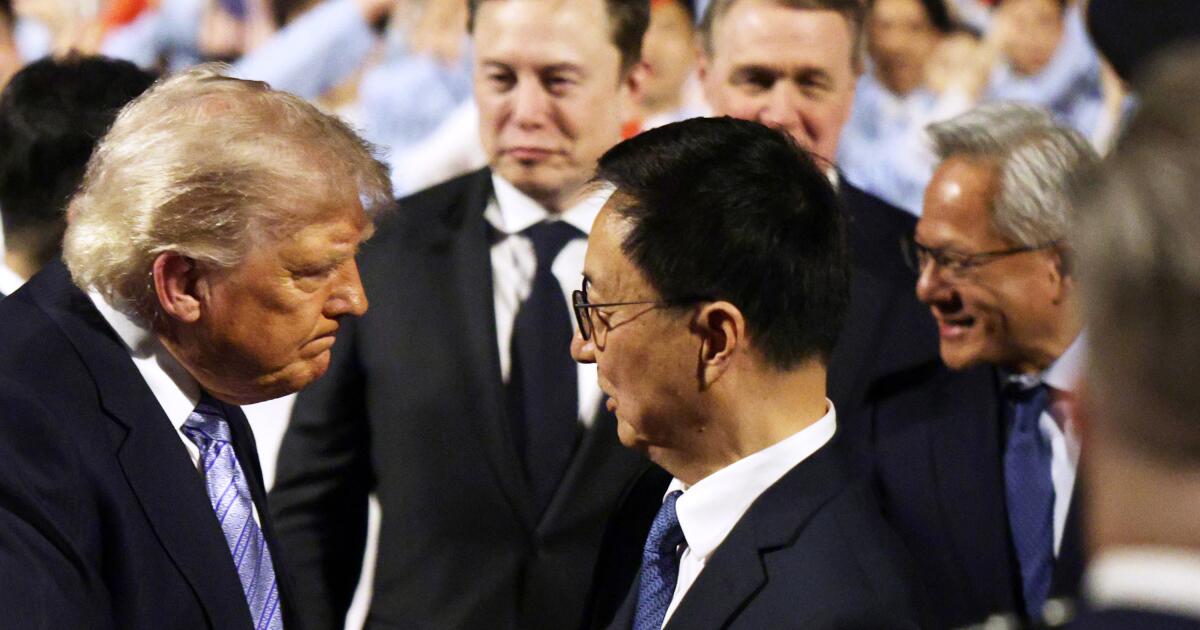
President Donald Trump arrived in Beijing with a delegation of more than a dozen U.S. CEOs, aiming to lock in market access for electric vehicles, chips and other high‑tech products.
Context Trump’s state visit follows a year‑long tariff truce and comes as both sides weigh the benefits of deeper economic ties before the U.S. midterm elections. The Chinese president welcomed the group, promising “broader prospects” for American firms.
Key Facts Elon Musk, CEO of Tesla and SpaceX, said he intends to achieve “many good things” in China, including approval for Tesla’s Full Self‑Driving system and a $2.9 billion purchase of solar‑panel equipment. Tesla’s Shanghai Gigafactory sold 292,876 vehicles from January to April 2026, a 26.7 % year‑over‑year rise, underscoring the plant’s importance as the company’s largest export hub.
Apple’s outgoing chief Tim Cook joined the delegation, highlighting the iPhone supply chain’s reliance on Chinese manufacturers. Nvidia’s Jensen Huang, who arrived on a stop‑over in Alaska, noted that a meeting with Chinese officials went “excellently.” Before recent U.S. export restrictions, Nvidia controlled roughly 95 % of China’s advanced‑chip market, a share now at risk.
Other participants included Goldman Sachs head David Solomon, BlackRock CEO Larry Fink and Boeing president Kelly Ortberg, all signaling a broad push for “mutually beneficial cooperation.”
What It Means The trip signals a coordinated U.S. effort to protect and expand critical supply chains for electric vehicles, AI chips and renewable‑energy hardware. Successful negotiations could restore Nvidia’s dominance in China’s chip market and secure Tesla’s growth trajectory, while Apple seeks to maintain its production base.
China’s willingness to ease rare‑earth export limits—materials essential for smartphones, batteries and defense systems—will be a litmus test for the truce’s durability. If Beijing offers clearer pathways for U.S. technology firms, the delegation could return with concrete agreements that reshape global tech competition.
Looking ahead, watch for any formal agreements on tariff extensions, rare‑earth export policies and regulatory approvals for autonomous‑driving software, all of which will determine the pace of U.S. corporate expansion in China.
Continue reading
More in this thread
Pennsylvania Deploys $15M Fund, Gecko Wins $71M Navy Deal, Mellon Gives $1.9M to Pittsburgh
Elena Voss
Allegiant Air Completes $1.5 Billion Sun Country Merger, Becomes Fifth-Largest U.S. Carrier
Elena Voss
Allegiant completes $1.5 B Sun Country merger, climbs to fifth‑largest U.S. airline
Elena Voss
Conversation
Reader notes
Loading comments...