Science Paper Shows Chemical Doping Brings Carbon Nanotube Conductivity Near Copper Levels
New research shows chemical doping boosts carbon nanotube electrical conductivity close to copper levels. This innovation addresses material science challenges.
TL;DR
A new study in *Science* reports that chemically doping carbon nanotube bundles significantly boosts their electrical conductivity to levels approaching copper. This development addresses a long-standing challenge in material science.
Carbon nanotubes once captured scientific imagination due to their exceptional strength, lightness, and distinct electrical properties. They offered the potential for groundbreaking advances in electronics and materials. However, their widespread adoption faced practical hurdles. Current manufacturing methods predominantly yield short nanotubes; achieving lengths over a few centimeters remains uncommon, restricting their immediate utility in many applications.
The inherent challenge also involved their electrical capacity. While metallic forms of individual nanotubes allow electrons to flow with very low resistance along their structure, bundles of these nanotubes struggle to carry a high volume of current. Most of their electrons are bound within the nanotube's chemical structure, leaving fewer available for robust electrical conduction across the entire material.
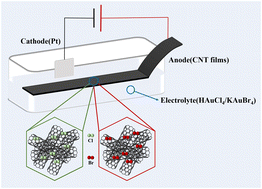
Researchers have now presented a significant step toward overcoming this limitation. The recent *Science* paper details how adding a specific chemical to carbon nanotube bundles markedly increases their electrical conductivity. This process, known as doping, involves integrating small quantities of another substance to alter a material's inherent properties, in this case, by adding more charge carriers. The doped nanotubes demonstrated conductivity levels nearly matching copper, a benchmark material for its excellent electrical performance.
However, the study also noted a critical limitation: the highly conductive doped nanotubes were not stable over extended periods. This suggests that while the approach successfully enhances conductivity, further development is essential to achieve lasting material performance suitable for practical use.
This discovery represents a notable step forward in enhancing the electrical performance of carbon nanotubes, moving them closer to practical application. Despite ongoing manufacturing challenges related to nanotube length, this improvement in conductivity expands the possibilities for future high-performance materials. Scientists will now focus on developing methods to ensure the long-term stability of these chemically enhanced systems. Watch for continued research aiming to integrate high conductivity with durable material design.
Continue reading
More in this thread
Apple’s entry‑level M4 Mac mini goes ‘currently unavailable’ as desktop ship times stretch to weeks
Alex Mercer
Intel Q1 Beats Estimates as Data Center AI Sales Jump 22% and CEO Sees CPU Resurgence
Alex Mercer
45% of Employees Use Unsanctioned AI at Work, Highlighting Governance Enforcement Gap
Alex Mercer
Conversation
Reader notes
Loading comments...