Nepal Orders Government Employees' Children to Attend State Schools, Warns of Overcrowding
Prime Minister Balendra Shah mandates public school enrollment for civil servants' children, raising concerns over class sizes and the need for phased reforms.
Transformation Of Government Education
TL;DR
Nepal’s prime minister has ordered that children of every government worker enroll in state schools, a move that could swell classrooms to 80‑100 pupils unless a staged rollout is implemented.
Context Balendra Shah announced a sweeping policy aimed at erasing the two‑tiered education system that separates elite private‑school students from the majority in underfunded public schools. The decree applies to all civil servants, regardless of rank, and seeks to boost enrollment in government‑run institutions.
Key Facts - The directive requires every government employee’s child to attend a government school. - Analysts calculate that a 20 % shift of private‑school students into the public system would push class sizes to 80‑100 learners, far beyond current capacities. - Existing public schools often operate in double shifts, lack adequate classrooms, toilets, clean water, and science labs, especially in districts such as Sindhupalchok and the outskirts of Kathmandu. - Language of instruction adds tension: private schools teach primarily in English, while most public schools use Nepali with English as a subject. - Teacher quality remains uneven due to historically politicized hiring; many lack subject mastery and modern pedagogical training.
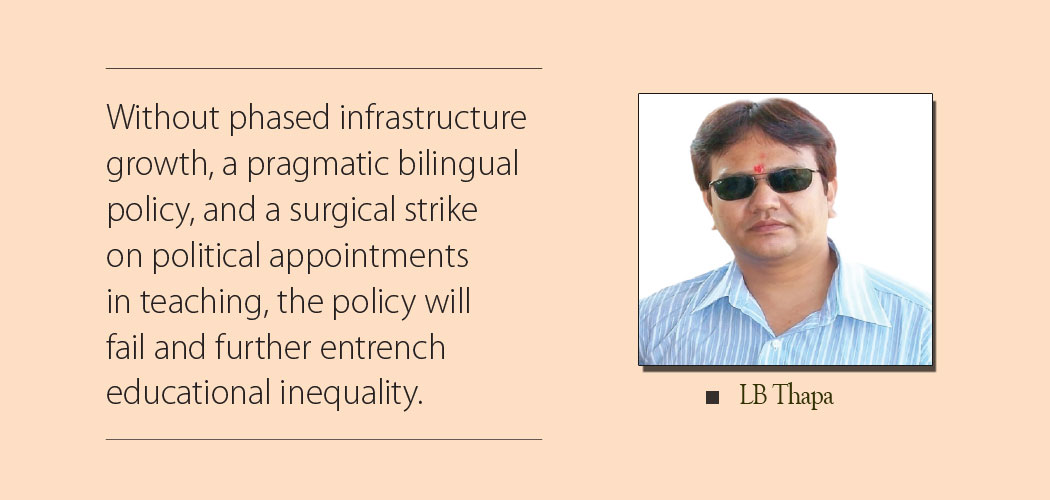
What It Means The policy’s intent—to strengthen public education and reduce social segregation—is clear, but implementation risks collapsing an already fragile system. Overcrowded classrooms would diminish learning outcomes and could drive families back to private tuition, undermining the reform’s purpose. A phased approach could mitigate these risks: start with grades 1 and 6, upgrade infrastructure using a dedicated education fund, and introduce bilingual instruction gradually. Simultaneously, a competency assessment for current teachers, coupled with competitive recruitment and performance incentives, would address the human‑resource gap. Empowering school management committees that include parents of civil‑service families could improve accountability and community buy‑in.
Looking Ahead Watch for the government’s rollout schedule, funding allocations, and any pilot programs that test the phased model in high‑density districts. The success of Shah’s vision will hinge on whether the state can expand capacity and quality fast enough to absorb the influx without compromising education standards.
Continue reading
More in this thread
Conversation
Reader notes
Loading comments...