NASA’s Roman Space Telescope Poised for Early September Launch on SpaceX Falcon Heavy
NASA's Nancy Grace Roman Space Telescope is set for an early September launch on a SpaceX Falcon Heavy rocket to explore dark energy and exoplanets.
TL;DR
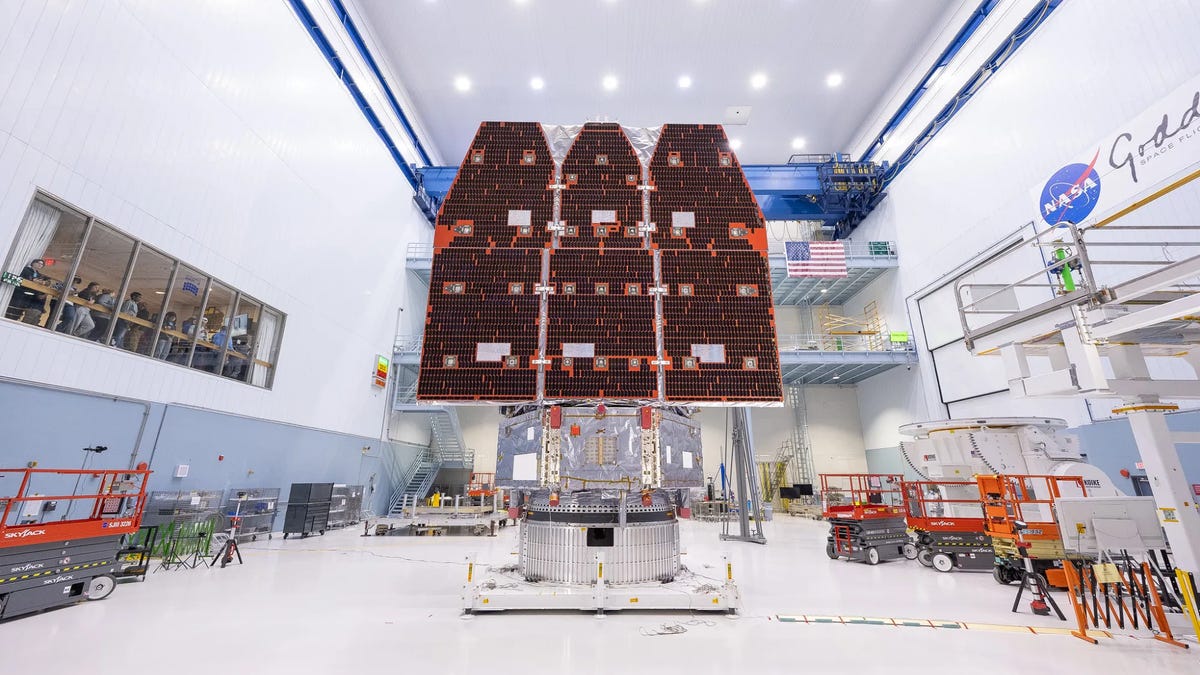
NASA's Nancy Grace Roman Space Telescope is preparing for an early September launch, departing from Maryland and lifting off from Florida aboard a SpaceX Falcon Heavy rocket. This mission aims to provide new insights into dark energy, exoplanets, and the vastness of the universe.
Context The Nancy Grace Roman Space Telescope represents a cornerstone of NASA’s future astronomical endeavors. This next-generation observatory will capture high-resolution images across expansive regions of the sky, a capability surpassing previous telescopes in its field of view. Its primary scientific objectives include mapping the distribution of dark matter, investigating the nature of dark energy, and discovering thousands of new exoplanets. The imminent launch marks the culmination of years of design, construction, and exhaustive pre-launch testing.
Key Facts The telescope is currently at NASA’s Goddard Space Flight Center in Greenbelt, Maryland, undergoing final preparations for transit. From this facility, it will begin its journey to Florida. The Kennedy Space Center, a historic launch complex, will serve as the departure point for its mission.
A SpaceX Falcon Heavy rocket is slated to conduct the launch from Florida’s Space Coast. This vehicle is among the world's most powerful operational rockets, capable of lifting substantial payloads into various orbits. Its selection underscores the Roman Telescope's size and mission requirements. The launch window is currently targeted for early September, emphasizing the precision planning involved in space missions.
What It Means The successful deployment of the Roman Space Telescope promises to redefine humanity's understanding of the cosmos. Its broad field of view will allow scientists to survey vast cosmic structures and distant galaxies with unprecedented efficiency. This capability is expected to yield critical data for understanding the universe's expansion history and the mechanisms behind dark energy, a mysterious force driving accelerated expansion.
Furthermore, the telescope will play a pivotal role in the search for exoplanets, providing detailed observations that could reveal new worlds beyond our solar system. Researchers anticipate the mission will uncover new classes of planets and contribute significantly to the assessment of planetary habitability. Observers should track its final integration and the opening of its scientific operations in the coming months.
Continue reading
More in this thread
Isaacman Urges Artemis Overhaul to Keep U.S. Ahead of China in Moon Race
Dr. Leo Tanaka
New Nature Paper Attributes Muon g-2 Discrepancy to Calculation Error, Upholds Standard Model
Dr. Leo Tanaka
New Calculation Shows Muon Anomaly Was a Math Error, Not New Physics
Dr. Leo Tanaka
Conversation
Reader notes
Loading comments...