Movable Spin Qubits Enable Any‑to‑Any Links in Scalable Quantum Dots
Researchers moved spin qubits between manufacturable quantum dots without loss, offering flexible connectivity for error-corrected quantum computers.
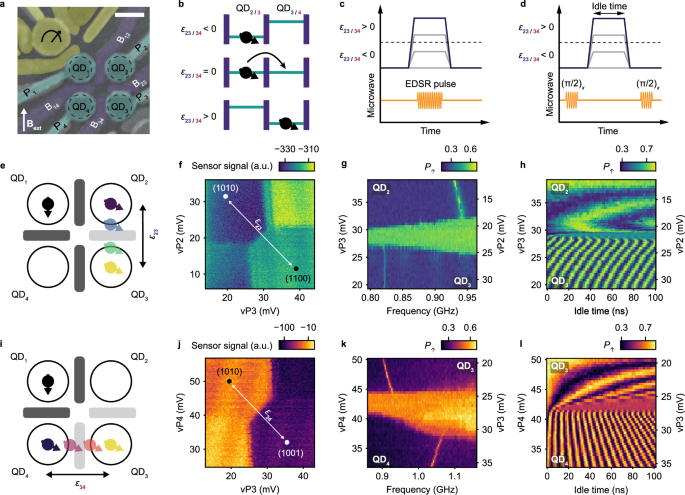
*TL;DR Spin qubits were shuttled between mass‑produced quantum dots while preserving their quantum state, offering the connectivity of atomic systems with the manufacturability of semiconductor chips.
Context Quantum computing requires millions of high‑fidelity qubits arranged so errors can be corrected. Two dominant strategies exist: semiconductor‑based qubits that scale with existing chip fabs, and atomic or photonic qubits that naturally allow any qubit to interact with any other but demand complex hardware. Semiconductor approaches traditionally lock qubits into fixed wiring, limiting the flexibility needed for efficient error correction.
Key Facts - Quantum dots—nanometer‑scale regions that trap single electrons—can be fabricated in bulk using standard semiconductor processes. Each dot can host a qubit encoded in the electron’s spin, the intrinsic angular momentum that points up or down. - In a recent experiment, researchers transferred a spin qubit from one quantum dot to another while maintaining its quantum coherence, meaning the delicate superposition of spin‑up and spin‑down survived the move. - This capability mirrors the any‑to‑any connectivity seen in trapped‑atom and photonic platforms, where qubits can be repositioned or linked on demand.
What It Means If spin qubits can be reliably moved across a chip, designers can route quantum information dynamically, bypassing the static wiring constraints of current semiconductor designs. Such routing could simplify the layout of error‑correcting codes, reducing the overhead of additional qubits needed for fault tolerance. Moreover, because quantum dots are compatible with existing manufacturing lines, the approach promises a path to large‑scale processors without the costly, bespoke hardware required for atomic systems.
The next step is to demonstrate high‑fidelity transfers across longer distances and within larger arrays, while integrating the necessary control electronics. Success will bring us closer to quantum processors that combine the scalability of silicon with the flexibility of atomic qubits, a crucial milestone for practical, error‑corrected quantum computing.
Continue reading
More in this thread
Conversation
Reader notes
Loading comments...