London Deploys 4,000 Officers and Live Facial Recognition for Dual Protests
London police used 4,000 officers and live facial recognition to manage far‑right and pro‑Palestine rallies, making 43 arrests in a costly operation.
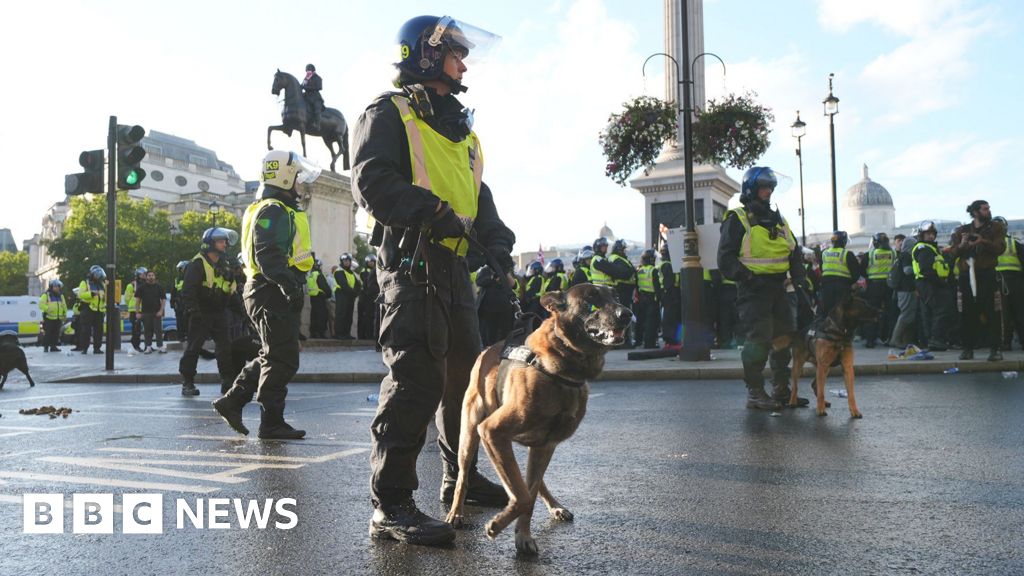
A police officer with a riot helmet stands on a street next to Trafalgar Square with the statues and museum in the background, with crowds of officers in reflective uniform in the background, during a Unite the Kingdom protest in September.
TL;DR: London police deployed 4,000 officers and live facial‑recognition technology to police simultaneous far‑right and pro‑Palestine protests, resulting in 43 arrests.
Context Two massive rallies converged on central London on Saturday. One, organized by far‑right activist Tommy Robinson, was billed as the “Unite the Kingdom” march; the other marked Nakba Day, a Palestinian commemoration. Authorities had warned of heightened tensions and prepared extensive resources.
Key Facts - The Metropolitan Police assigned 4,000 officers, the largest public‑order deployment in years, including reinforcements from outside the city. - Armoured vehicles, mounted police, dogs, drones and helicopters supported crowd control. - Live facial‑recognition (LFR) systems were used for the first time to identify individuals in real time. - Police reported 43 arrests across both demonstrations, with four officers assaulted and six officers targeted by hate‑crime offences. - The operation cost an estimated £4.5 million (about $6 million). - Officials imposed route and timing restrictions to keep the rival groups apart and warned organizers that speakers could be held legally responsible for hate‑speech violations.
What It Means The scale of the deployment signals a shift toward more aggressive policing of large‑scale demonstrations in the UK, especially when rival ideologies intersect. The use of LFR marks a new tool in the Met’s arsenal, raising questions about privacy and the threshold for its activation. While police claim the protests remained “largely without significant incident,” the arrests and assaults on officers suggest underlying volatility.
Future monitoring will focus on how LFR is applied in subsequent public order events and whether legal challenges arise over its use. Additionally, the effectiveness of the zero‑tolerance stance and the new organizer liability rules will be tested in upcoming rallies.
Continue reading
More in this thread
Dela Rosa Evades Senate Arrest Amid Gunfire, Marcos Faces 72-Hour Deadline
Nadia Okafor
Child Maintenance Service Errors Prompt Thousands of Appeals, One‑Quarter Overturned
Nadia Okafor
Senator Dela Rosa Evades ICC Warrant, Exits Senate Via Fire Exit After Gunfire
Nadia Okafor
Conversation
Reader notes
Loading comments...