Kyiv Unveils 30‑kg Carbon Sculpture ‘Crushed Ecology’ to Visualize Car Emissions on Earth Day
Kyiv marks Earth Day with 'Crushed Ecology,' a 30 kg carbon sculpture demonstrating emissions from 100 km of driving. It makes invisible pollution tangible.
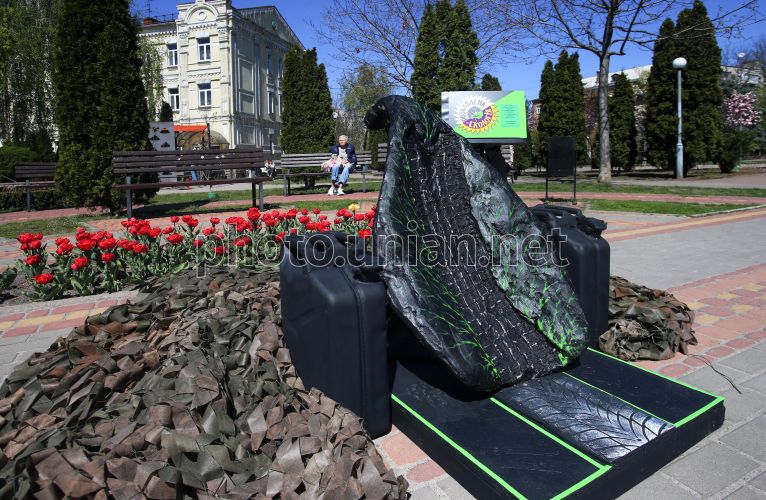
Kyiv's 'Crushed Ecology' sculpture makes invisible car emissions tangible, showcasing 30 kg of pure carbon from just 100 km of driving.
Kyiv marked Earth Day by unveiling "Crushed Ecology," a carbon sculpture designed to visualize atmospheric emissions. This installation transforms the unseen impact of vehicle exhaust into a physical form, bringing attention to a critical environmental challenge. Emissions typically remain invisible, yet their particles and gases significantly affect both the environment and human health. The sculpture's purpose is to make the environmental cost of transportation evident and understandable to the general public.
The sculpture, weighing 30 kg, represents pure carbon, a primary component of carbon emissions. This mass of carbon originates from burning approximately two cans of diesel fuel, a quantity typically consumed when driving a car for roughly 100 km. Students from the Volodymyr the Great Cadet Corps State Military Lyceum, collaborating with sculptor Dmytro Mulyarchuk, gave this physical form and volume to vehicle emissions.
Cadet Vladyslav Haponko explained the scientific basis for the sculpture's weight. Diesel fuel has an approximate density of 840 grams per liter, and carbon constitutes about 86% of its weight. Based on these figures, 40 liters—equivalent to two cans of diesel—contain nearly 30 kg of carbon. The artists named their creation "Crushed Ecology" and strategically placed the installation near one of Kyiv's active air quality monitoring stations, linking the artwork directly to real-time environmental data.
This physical representation underscores the pervasive issue of air pollution, making a usually abstract problem concrete. Invisible particulate matter and greenhouse gases released into the atmosphere contribute to climate change and negatively impact respiratory and cardiovascular health. The sculpture highlights that even seemingly small amounts of vehicle activity generate substantial amounts of carbon.
Globally, air quality remains a significant concern. Data compiled by EcoPolitic shows that only 14% of the world’s urban centers meet the World Health Organization’s air quality standards. This statistic highlights a broad environmental and public health challenge across urban environments worldwide. The Kyiv sculpture provides a stark reminder of each vehicle's contribution to this cumulative problem, prompting a re-evaluation of individual and collective impact.
Watch for evolving strategies in public environmental education and for further policy interventions addressing urban air quality and vehicle emissions.
Continue reading
More in this thread
Solar Power Surpasses Coal Globally as Countries Like Chile and Hungary Hit Record Shares
Dr. Leo Tanaka
Solar Surpasses Wind to Lead Renewables as Clean Power Overtakes Coal in 2025
Dr. Leo Tanaka
U.S. Climate Worry Stays Near Record High as 44% Say Media Underestimates Threat
Dr. Leo Tanaka
Conversation
Reader notes
Loading comments...