James Webb Finds Massive Non‑Rotating Galaxy Only 2 Billion Years After the Big Bang
James Webb Telescope discovers a massive early‑universe galaxy with no spin, challenging current models of galaxy formation.
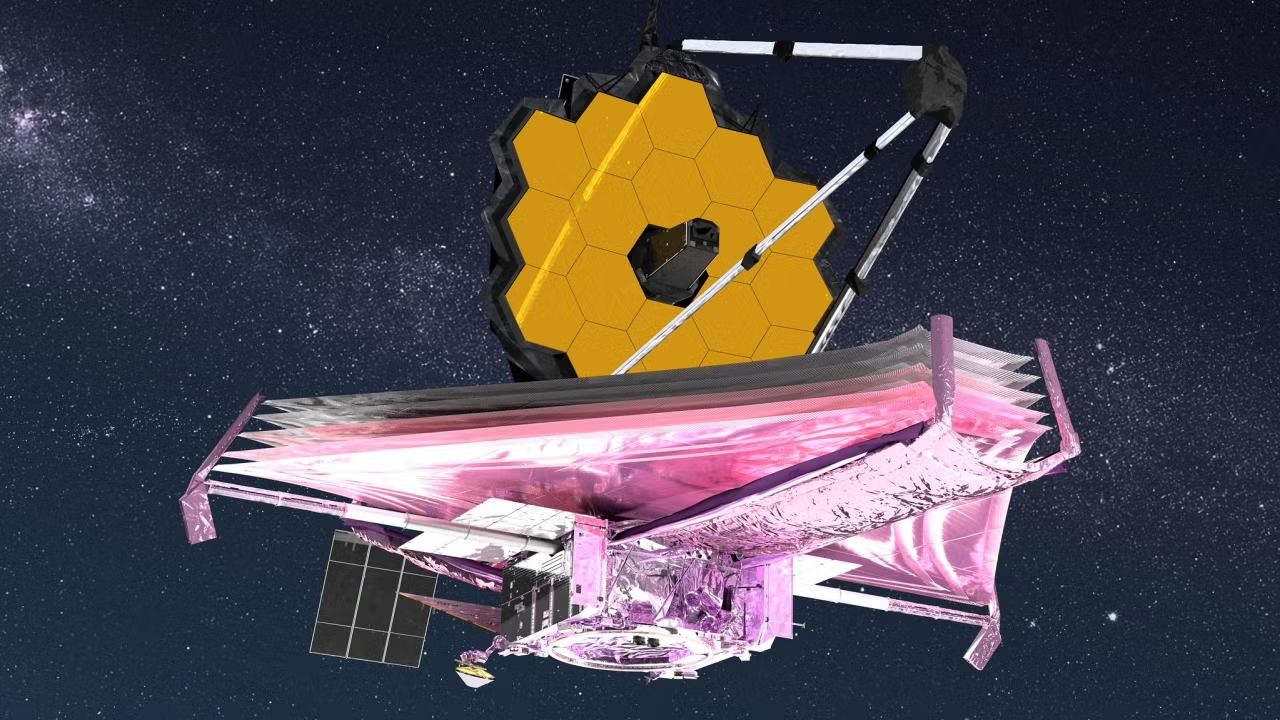
James Webb Finds Massive Non‑Rotating Galaxy Only 2 Billion Years After the Big Bang
TL;DR
James Webb Space Telescope discovered a massive galaxy formed less than 2 billion years after the Big Bang that shows no rotation, a trait normally seen only in much older systems.
The discovery came from a team led by Ben Forrest of UC Davis, publishing results in *Nature Astronomy* on May 4, 2026. Using Webb’s near‑infrared spectrograph, the researchers measured the internal motions of three distant galaxies, including the standout object XMM‑VID1‑2075. While one galaxy rotated clearly and another displayed irregular kinematics, XMM‑VID1‑2075 exhibited random stellar motions with no coherent spin.
XMM‑VID1‑2075 is among the most massive galaxies known from that epoch, containing several times more stars than the Milky Way and already quiescent—no new star formation. Earlier observations with the W.M. Keck Observatory confirmed its mass and lack of star‑forming activity, making it a prime target for Webb’s higher‑resolution follow‑up.
Current galaxy‑formation theory predicts that young galaxies inherit angular momentum from collapsing gas, causing them to spin. Over billions of years, mergers can either amplify or cancel this spin, but a “slow rotator” should emerge only after many such events. Forrest called the absence of rotation “surprising and very interesting,” because it implies a rapid dynamical transformation.
One hypothesis is a single, nearly head‑on collision between two oppositely rotating progenitors, which would cancel out net angular momentum. Webb images show an excess of light on one side of XMM‑VID1‑2075, hinting at a recent interaction that could have disrupted any spin.
The team plans to expand the search for similar early‑universe slow rotators. By comparing the frequency of such objects with predictions from cosmological simulations, researchers can test whether current models underestimate the speed of dynamical evolution. If non‑rotating massive galaxies prove common, theories of early galaxy assembly will need revision.
Future Webb observations of additional high‑redshift systems will clarify whether XMM‑VID1‑2075 is an outlier or the first glimpse of a broader, previously hidden population.
Continue reading
More in this thread
Germany Deploys First Commercial Carbon‑Storing Concrete Floor, Cutting Embodied Carbon 13%
Dr. Leo Tanaka
Maine’s Community Solar Growth Halts After New Law Blocks Net Billing
Dr. Leo Tanaka
Europe’s Aviation Emissions Rise as Tax Gap Leaves €8.5 bn Untaxed
Dr. Leo Tanaka
Conversation
Reader notes
Loading comments...