Generative AI Drug Discovery Market Projected to Reach $0.86B by 2030 at 27% CAGR
The global generative AI drug discovery market is poised for rapid growth, projected to reach $0.86 billion by 2030 at a 27% CAGR. Learn about key investments driving this transformation.
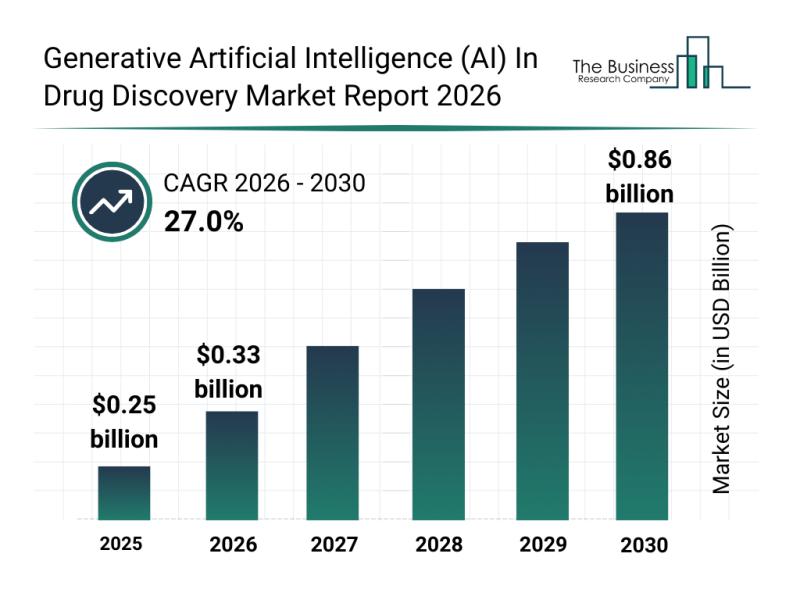
The global generative artificial intelligence (AI) drug discovery market is set for significant expansion, projected to reach $0.86 billion by 2030 with a 27.0% compound annual growth rate. This rapid growth reflects increasing strategic investments, including Recursion Pharmaceuticals' $87.5 million in acquisitions, accelerating drug development.
Generative artificial intelligence (AI) enables computers to create novel data, from text to molecular structures, based on learned patterns. In drug discovery, this technology allows researchers to design entirely new molecules and predict their efficacy or side effects much faster than traditional laboratory experiments. This capability significantly reduces the time and cost involved in bringing new medications to market, addressing unmet medical needs across various diseases.
The global generative AI in drug discovery market projects to reach $0.86 billion by 2030. This market anticipates a 27.0% compound annual growth rate (CAGR), indicating a period of rapid, sustained expansion. A compound annual growth rate measures the average annual growth over multiple years, smoothed out to account for volatility.
Industry players are making strategic investments to capitalize on this growth. In May 2023, Recursion Pharmaceuticals acquired Cyclica for $40 million and Valence for $47.5 million. These acquisitions, totaling $87.5 million, significantly enhance Recursion's capabilities in artificial intelligence and machine learning, furthering its drug development efforts.
These financial commitments highlight a significant shift in pharmaceutical research towards advanced computational methods. Generative AI accelerates the identification of potential drug candidates and optimizes their design with greater precision. This integration aims to move therapies from concept to clinical trials more efficiently and improve overall success rates in drug development.
The continued investment in AI suggests a future where new treatments emerge faster, transforming the pharmaceutical landscape. Watch for further technological advancements and strategic partnerships between AI developers and pharmaceutical companies. These collaborations will likely deepen AI's role across all stages of drug development.
Continue reading
More in this thread
Only 10% of Pastors Regularly Use AI While 61% of Churchgoers Fear Its Influence on Faith
Alex Mercer
Amazon adds $5B to Anthropic deal, unlocking up to 5 GW of AI chips
Alex Mercer
Benghazi Scouts Host AI Safety Lecture Amidst Growing Digital Dangers
Alex Mercer
Conversation
Reader notes
Loading comments...