GCC AI Market Set to Reach $23.03 Billion by 2034
Analysts project the GCC AI market to expand from $6.22 billion in 2025 to $23.03 billion by 2034, driven by a 14.87% CAGR and strong government backing.
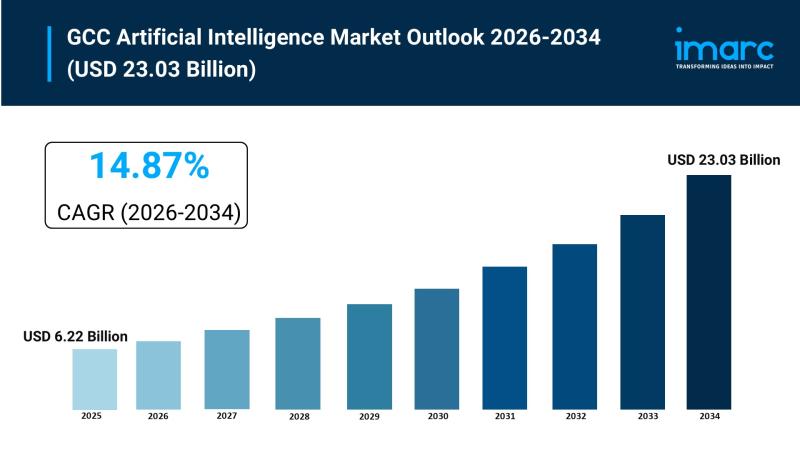
TL;DR: The GCC AI market is forecast to rise from $6.22 billion in 2025 to $23.03 billion by 2034, climbing at a 14.87% compound annual growth rate.
Governments across the Gulf Cooperation Council are prioritizing artificial intelligence as a core component of their economic diversification plans. National strategies allocate billions to AI research, infrastructure, and talent acquisition.
Saudi Arabia’s Vision 2030 includes a dedicated AI initiative that funds universities, supports startups, and partners with global tech firms. Public‑sector AI budgets in the two countries are expected to exceed $1 billion annually by 2027. The UAE’s National AI Strategy 2031 similarly targets sectors such as health, energy, and transportation.
Qatar, Bahrain, Kuwait, and Oman have also launched AI‑focused programs, often linked to smart‑city projects and digital government services, creating a region‑wide push for adoption.
Analysts estimate the market was worth $6.22 billion in 2025. This figure reflects spending on software, hardware, and services across the six GCC states.
They project it will reach $23.03 billion by 2034. The implied compound annual growth rate (CAGR) for the period 2026‑2034 is 14.87%.
The expansion signals rising demand for machine‑learning platforms that enable predictive analytics in finance and logistics. Enterprise spending on AI‑enabled software licenses is projected to grow at double‑digit rates through 2030. Natural‑language processing tools tuned to Arabic are seeing increased use in customer service and content moderation.
Computer‑vision systems are gaining traction in surveillance, quality control on manufacturing lines, and healthcare imaging. These applications require robust data pipelines and edge‑computing capabilities.
Companies that invest early in AI infrastructure stand to capture market share as public and private spending increases. Simultaneously, governments will need to expand AI education and vocational programs to supply the skilled engineers and data scientists required for sustained growth.
Watch for upcoming AI‑focused funding rounds, updates to national AI roadmaps, and the rollout of sector‑specific pilot projects that could accelerate adoption beyond 2025.
Continue reading
More in this thread
Conversation
Reader notes
Loading comments...