Europe Cyber Insurance Market Projected to Reach $18.6 B by 2034
Europe's cyber insurance market is set to grow at 17.96% CAGR, reaching $18.6 B by 2034 amid rising ransomware threats and stricter regulations.
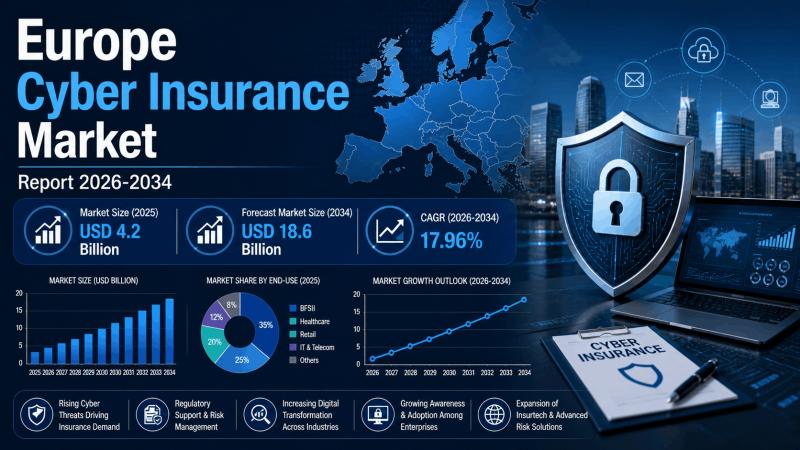
TL;DR
Europe’s cyber insurance market will expand from $4.2 B in 2025 to $18.6 B by 2034, fueled by stricter regulations and a surge in ransomware attacks.
Context European firms are confronting a wave of ransomware, data‑breach, and business‑interruption incidents. Governments have tightened data‑privacy rules, most notably the GDPR, which imposes heavy fines for inadequate protection. Insurers are responding with higher premiums, tighter underwriting, and AI‑driven risk scoring.
Key Facts - Market size stood at $4.2 B in 2025. - Forecasted to reach $18.6 B by 2034, a compound annual growth rate (CAGR) of 17.96% from 2026‑2034. - Growth drivers: regulatory mandates, escalating cyber threats, and deeper digital reliance across sectors such as finance, healthcare, and e‑commerce. - Insurers are embedding AI and machine‑learning models to assess real‑time threat intelligence, allowing more granular pricing and coverage for smaller enterprises. - Ransomware now dominates claim losses, prompting insurers to require multi‑factor authentication, endpoint detection and response (EDR), and verified backup practices before issuing policies.
What It Means Security teams must treat cyber insurance as a component of risk management, not a safety net. The tightening of underwriting criteria means organizations will need demonstrable controls to qualify for coverage and avoid sub‑limits that cap payouts. The rise of AI in underwriting also creates a feedback loop: better security posture improves risk scores, which lowers premiums, encouraging further investment in defenses.
Mitigations – What Defenders Should Do 1. Patch Management – Apply critical updates promptly, especially for known CVEs such as CVE‑2023‑XXXXX that target remote desktop services. 2. Multi‑Factor Authentication (MFA) – Enforce MFA on all privileged and remote access points to satisfy insurer requirements and block credential‑stuffing attacks. 3. Endpoint Detection and Response (EDR) – Deploy EDR solutions capable of detecting MITRE ATT&CK techniques like T1486 (Data Encrypted for Impact) used by ransomware groups. 4. Backup Hygiene – Maintain immutable, offline backups and test restoration quarterly to meet insurer backup‑hygiene clauses. 5. Threat Intelligence Integration – Feed real‑time intel into AI‑based risk scoring platforms to demonstrate proactive posture during underwriting. 6. Incident Response Plan – Document and rehearse a response plan that includes forensic analysis, notification procedures, and ransom negotiation protocols.
Looking Ahead Watch for emerging EU directives that could further tighten cyber‑risk reporting and for insurers’ next‑generation underwriting models that may tie premiums directly to continuous security monitoring metrics.
Continue reading
More in this thread
Conversation
Reader notes
Loading comments...