CFTC Sues Wisconsin to Reclaim Authority Over Crypto‑Based Prediction Markets
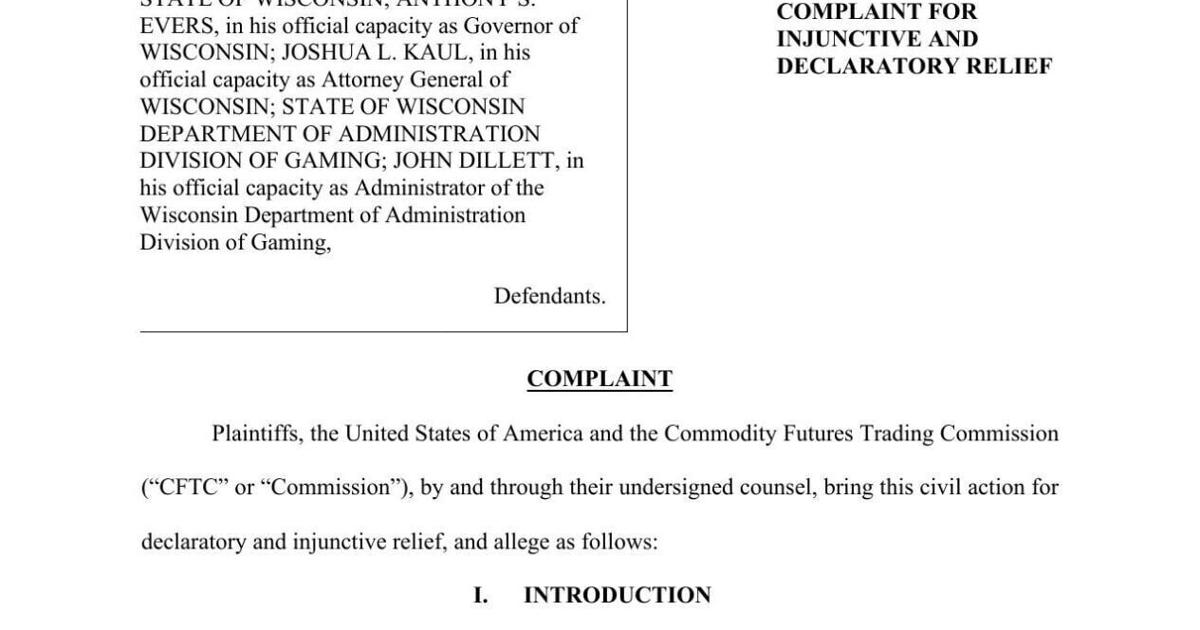
The CFTC filed a lawsuit on April 28, 2026, challenging Wisconsin's state suits against major crypto prediction market platforms and asserting federal authority.
TL;DR
The CFTC sued Wisconsin on April 28, 2026, to reassert exclusive federal jurisdiction over prediction markets after the state filed civil actions against Kalshi, Polymarket, Crypto.com, Robinhood and Coinbase.
Context The Commodity Futures Trading Commission (CFTC) regulates derivatives, including tokenized contracts that mimic traditional futures. Prediction markets—platforms where users bet on outcomes such as election results—have migrated to blockchain, blurring lines between gambling and regulated derivatives. Wisconsin’s recent lawsuits allege that the five firms violated state consumer‑protection statutes.
Key Facts - On April 28, 2026, the CFTC filed a federal suit demanding that Wisconsin withdraw its civil actions and recognize the agency’s exclusive authority. - The state’s complaints target Kalshi (ticker KAL), Polymarket (no public ticker), Crypto.com (ticker CRO), Robinhood (ticker HOOD), and Coinbase (ticker COIN). - Coinbase shares fell 3.2% to $58.40 after the news, trimming its market cap to roughly $22 billion. - Robinhood’s stock slipped 2.7% to $7.15, valuing the company at about $6 billion. - Crypto.com’s native token CRO dropped 4.1% to $0.058, pushing its circulating market cap near $1.2 billion. - Kalshi, listed on the NYSE, saw its price dip 1.9% to $12.30, leaving a market cap of $1.1 billion. - The CFTC’s filing cites the need for a uniform regulatory framework as blockchain‑based derivatives proliferate, referencing the agency’s authority under the Commodity Exchange Act, which governs futures and swaps.
What It Means The lawsuit signals the CFTC’s intent to block state‑level fragmentation of the emerging crypto‑derivatives market. If the court sides with the CFTC, Wisconsin’s suits would be dismissed, and the five companies would face federal enforcement rather than state penalties. A federal ruling could set a precedent for other states that have pursued similar actions, potentially consolidating regulatory oversight under the CFTC.
For investors, the immediate market reaction shows heightened sensitivity to jurisdictional risk. Coinbase’s $22 billion market cap now reflects a discount that could widen if further legal challenges arise. Traders should monitor the case’s progress through the U.S. District Court for the Eastern District of Wisconsin and watch for any CFTC guidance on tokenized prediction contracts, which could reshape compliance costs for the sector.
Looking ahead, the next key indicator will be the court’s preliminary injunction decision, expected in the coming weeks, which will determine whether Wisconsin can proceed with its state suits or must defer to federal authority.
Continue reading
More in this thread
Arcellx CFO Sells 72,000 Shares in Gilead Merger Tender Offer at $115 per Share
David Amara
Rare Earths Americas Prices IPO at $17‑$19, GMR Solutions Files, Barrick Prepares North American Spin‑Off
David Amara
US Army Sergeant Pleads Not Guilty to First Insider Trading Case Involving Prediction Market
David Amara
Conversation
Reader notes
Loading comments...