Braintrust Leader Questions Whether Generative AI Falls to Data Scientists
Phil Hetzel of Braintrust asks if generative AI belongs to data scientists, prompting a look at team structures and AI development roles.
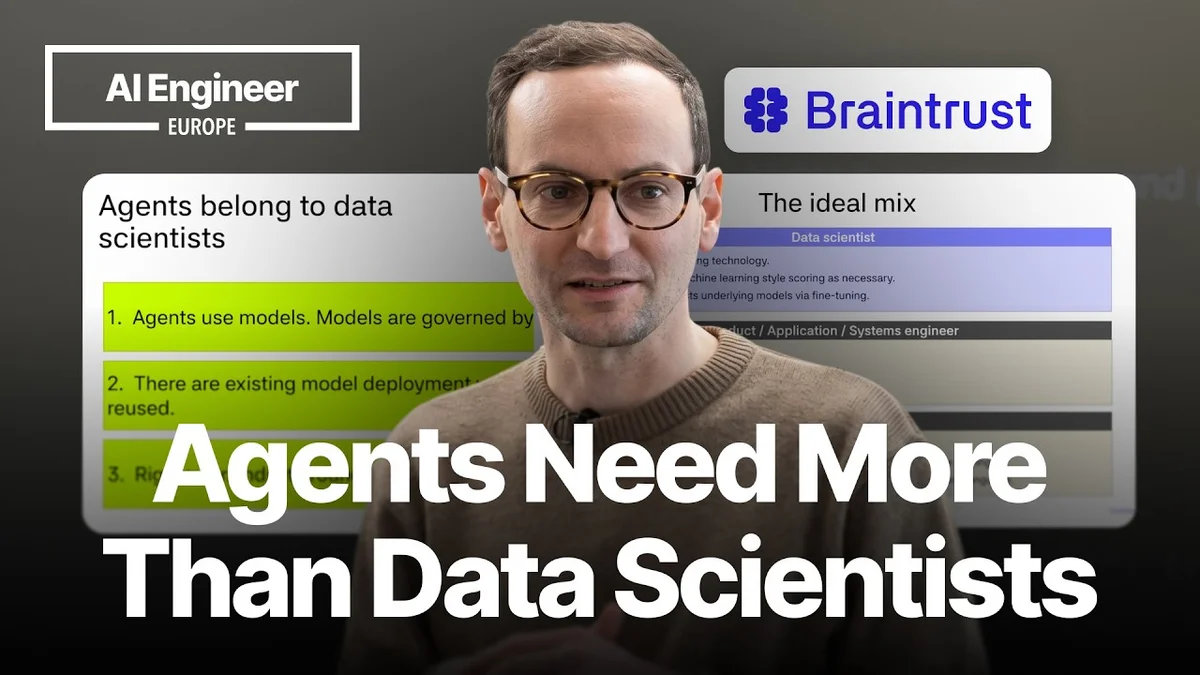
Does GenAI Belong to Data Scientists?
TL;DR
Phil Hetzel, Braintrust’s head of solution engineering, challenges the notion that generative AI is the sole domain of data scientists.
Context At the AI Engineer Europe conference, Hetzel raised a provocative question: does generative AI “belong” to data scientists? The query cut through typical hype, focusing on who should own the development of AI agents that can write code, create images, or draft text.
Key Facts Hetzel brings more than a decade of consulting and implementation experience to his role at Braintrust, a platform that matches freelancers with enterprise projects. Before joining Braintrust, he led Slalom’s global Databricks business unit, overseeing cloud‑based data engineering services. In his presentation, he highlighted how organizational design—whether a company groups AI talent under data science, engineering, or product—shapes the creation and deployment of generative AI tools.
He noted that data scientists excel at model training and statistical validation, while software engineers focus on integration, scalability, and user experience. When generative AI agents are built as end‑to‑end products, the line between these disciplines blurs. Hetzel’s own background in both consulting and data platform leadership informs his view that ownership should be fluid, matching the skill set required at each stage of development.
What It Means If companies adopt Hetzel’s perspective, they may restructure teams to embed AI expertise across functions rather than silo it within data science. This could accelerate product cycles, reduce hand‑off friction, and broaden accountability for AI outcomes. Conversely, retaining generative AI within a data‑science‑only group might limit cross‑functional insight, slowing adoption in real‑world applications.
The debate also touches on talent pipelines. Universities and bootcamps may need to blend data‑science curricula with software‑engineering practices to prepare graduates for hybrid roles. Employers might look for professionals who can both fine‑tune large language models and embed them into production systems.
Looking Ahead Watch how major tech firms and consultancies adjust their AI team structures in the coming months, and whether new job titles—such as “generative AI engineer”—gain traction as the industry settles the question Hetzel raised.
Continue reading
More in this thread
Jack Clark Predicts Human‑AI Nobel Prize Within Year and AI‑Only Firms Earning Millions
Alex Mercer
Musk Says AGI Will Arrive in 2026 as Benchmarks Surge and One‑In‑Six Use Generative AI
Alex Mercer
Nigeria Launches $4.2 B Hyperscale Data Centre to Halt $850 M Cloud Leak
Alex Mercer
Conversation
Reader notes
Loading comments...